Classical

Aristotle's Hierarchy of Needs (It's Not Maslow's)

Aristotle’s Hierarchy of Needs (It’s Not Maslow’s)

Everyone knows Maslow’s pyramid. It shows up in psychology textbooks, corporate training slides, and motivational Instagram posts with sunset backgrounds. Food and shelter at the bottom. Self actualization at the top. Climb the pyramid, find yourself. Simple. Clean. Wrong. Well, not entirely wrong. But incomplete in a way that matters. Because roughly 2,300 years before […]

Aristotle’s Hierarchy of Needs (It’s Not Maslow’s) Read More »
Before You Get Angry- The 5 Second Marcus Aurelius Reality Check

Before You Get Angry: The 5 Second Marcus Aurelius Reality Check

You are about to say something you will regret. Your jaw tightens. Your pulse spikes. A coworker just took credit for your idea. A stranger cut you off in traffic. Your partner forgot something important for the third time. The anger is already moving through your nervous system like an electrical current, looking for a

Before You Get Angry: The 5 Second Marcus Aurelius Reality Check Read More »

The One Habit That's Making You Poor (and It's Not Your Latte) (Seneca)

The One Habit That’s Making You Poor (and It’s Not Your Latte) (Seneca)

We love a good financial villain. For years, personal finance experts pointed at your morning coffee like it was drinking your retirement fund through a straw. Skip the latte, they said, and you’ll be rich. But here’s what nobody mentions: the person buying the four-dollar coffee might actually understand money better than the person white-knuckling

The One Habit That’s Making You Poor (and It’s Not Your Latte) (Seneca) Read More »

NATO is the New Delian League- And We All Know How That Ended (Thucydides)

NATO is the New Delian League: And We All Know How That Ended (Thucydides)

Thucydides watched Athens destroy itself through the very alliance meant to protect it. Twenty-five centuries later, we might be watching a rerun. The Delian League began with the noblest of intentions. Greek city-states, exhausted from repelling Persian invasions, needed collective security. They needed someone strong enough to coordinate defense, wealthy enough to maintain a navy,

NATO is the New Delian League: And We All Know How That Ended (Thucydides) Read More »

The Original "Thought Leader": How Cicero Monetized Intellect

The Original “Thought Leader”: How Cicero Monetized Intellect

Before LinkedIn influencers discovered the power of personal branding, before TED Talks became the currency of intellectual prestige, there was Marcus Tullius Cicero. Standing in the Roman Forum around 63 BCE, he wasn’t just another lawyer arguing cases. He was building something we’d recognize today: a media empire based entirely on the monetization of ideas.

The Original “Thought Leader”: How Cicero Monetized Intellect Read More »

Why Prediction is Not Strategy: Sun Tzu's Caution Against Future-Gazing

Why Prediction is Not Strategy: Sun Tzu’s Caution Against Future-Gazing

We love predictions. Every January, experts line up to tell us what the stock market will do, which technologies will dominate, who will win elections. By February, most of these predictions are already wrong. By December, we’ve forgotten them entirely. Yet come next January, we’ll listen to the same experts make new predictions with the

Why Prediction is Not Strategy: Sun Tzu’s Caution Against Future-Gazing Read More »

The Roman Emperor Who Knew Why We Crave Constant Entertainment (Marcus Aurelius)

The Roman Emperor Who Knew Why We Crave Constant Entertainment (Marcus Aurelius)

You’re scrolling through your phone again. Another video, another post, another dopamine hit. You tell yourself you’ll stop in five minutes, but five minutes becomes fifty. When you finally put the device down, you feel somehow emptier than before. A Roman emperor figured out why this happens nearly two thousand years ago. He did it

The Roman Emperor Who Knew Why We Crave Constant Entertainment (Marcus Aurelius) Read More »

Seneca Would Say Your Greatest Power Isn’t Your IQ—It’s Your Ability to Handle Insults

The Roman philosopher Seneca once watched a wealthy merchant have a complete meltdown because someone called him uncultured at a dinner party. The merchant—brilliant enough to build a trading empire spanning three continents—spent the next six months obsessing over the comment, writing angry letters, and hiring philosophers to publicly defend his sophistication. Seneca’s observation was

Seneca Would Say Your Greatest Power Isn’t Your IQ—It’s Your Ability to Handle Insults Read More »

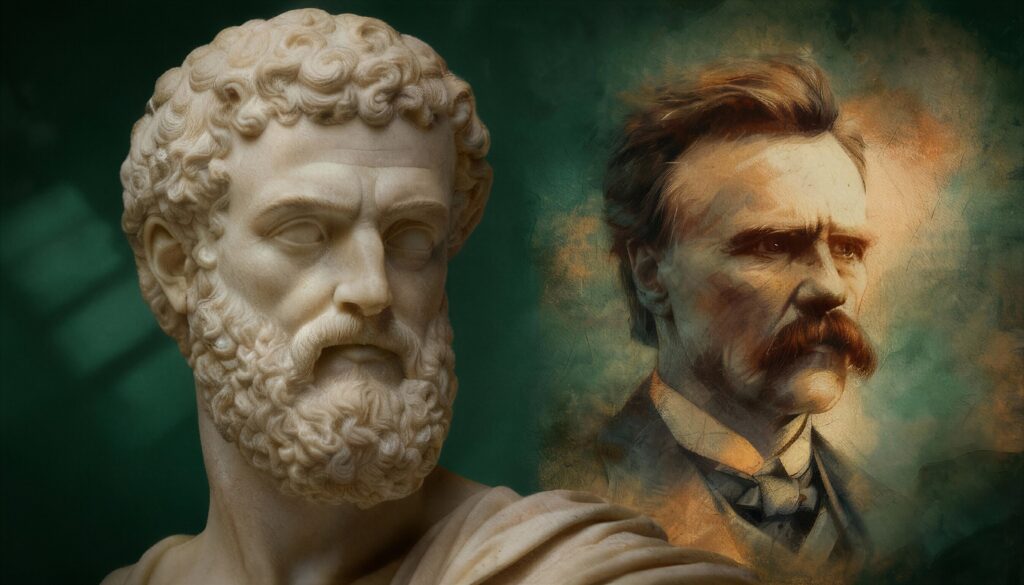
Nietzsche vs. Aristotle: Whose Vision of Excellence Wins?

Nietzsche vs. Aristotle: Whose Vision of Excellence Wins Today?

Two of history’s most influential philosophers separated by nearly two millennia offer radically different answers to one of humanity’s most enduring questions: What does it mean to live excellently? Aristotle, the systematic Greek thinker who tutored Alexander the Great, championed a balanced, socially integrated path to human flourishing. Friedrich Nietzsche, the iconoclastic German philologist writing

Nietzsche vs. Aristotle: Whose Vision of Excellence Wins Today? Read More »