Table of Contents
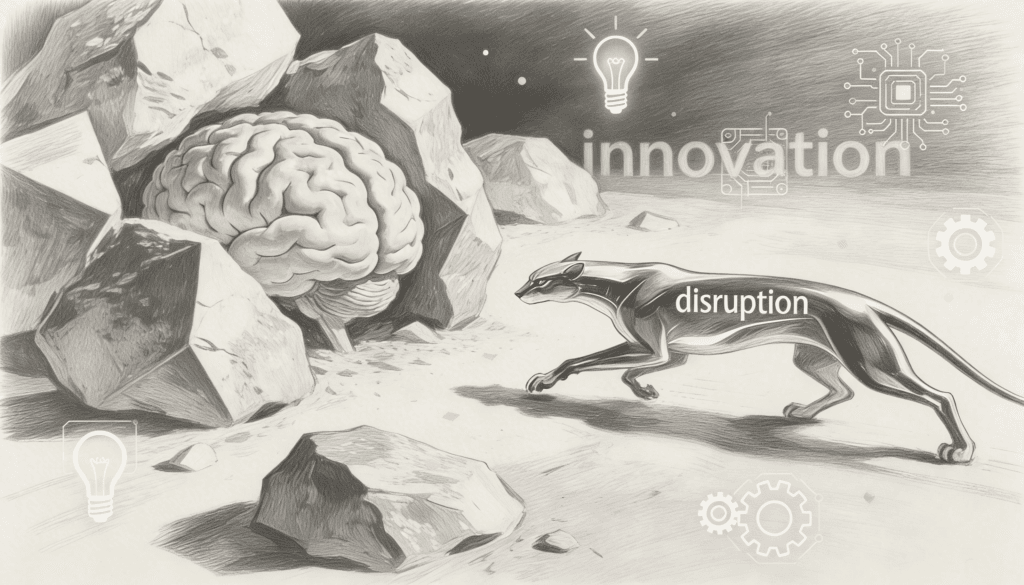
The executive team sits around a polished table, reviewing a proposal for digital transformation. Heart rates spike. Palms sweat. Cortisol floods bloodstreams. To an outside observer, you’d think they were being chased by a lion rather than discussing a software upgrade.
They’re not irrational. They’re human.
Our brains come equipped with machinery designed for a world that no longer exists. The same neural circuits that kept our ancestors alive on the African savanna now make quarterly earnings calls feel like mortal threats. Understanding this mismatch between our biological hardware and our modern business environment reveals why intelligent people make baffling decisions when confronted with change.
The Threat Detection System That Won’t Quit
Your amygdala doesn’t care about your MBA. This almond shaped cluster of neurons evolved to answer one question: Will this kill me? It scans the environment roughly every tenth of a second, categorizing inputs as safe or dangerous before your conscious mind gets involved.
This system works beautifully when faced with actual predators. It’s less helpful during strategic planning sessions.
When a new competitor enters your market or a novel technology threatens your business model, your brain processes this information through the same ancient pathways. The amygdala flags novelty as potential danger. It doesn’t distinguish between a rustling bush that might contain a leopard and a startup that might contain your obsolescence.
The response is identical: preparation for fight, flight, or freeze.
This explains the executive who responds to disruption by doubling down on legacy business models (fight), the board member who suddenly finds reasons to retire early (flight), or the entire leadership team that spends eighteen months forming committees to study the problem (freeze).
None of these responses look like cowardice from the inside. They feel like prudence. Your brain is protecting you from what it perceives as existential threat, using the only playbook it has.
The Cost of Being Wrong
Here’s where our evolutionary inheritance really trips us up. In the ancestral environment, the penalty for false positives was low. Mistake a stick for a snake? You waste some energy jumping back. No big deal. But the penalty for false negatives was death. Fail to recognize an actual snake? Game over.
Natural selection ruthlessly favored the paranoid. The calm, rational ancestors who carefully evaluated whether that shape in the grass was truly dangerous? They’re not our ancestors. They got eaten.
We descend from the anxious ones, the ones who overreacted, the ones who saw threats everywhere. This legacy means our brains are calibrated to avoid losses far more intensely than to pursue gains. Behavioral economists call this loss aversion.
Your brain would rather you miss ten opportunities than suffer one loss.
This made perfect sense when losses meant death and opportunities meant extra berries. It makes less sense when the “loss” is cannabilizing your own product line and the “opportunity” is owning the next decade of your industry.
Status and the Invisible Hierarchy
Every primate species, including ours, organizes itself into dominance hierarchies. Your position in this hierarchy historically determined everything: access to food, mates, safety, and resources. Losing status wasn’t just embarrassing. It was often fatal.
The business world is drenched in status signals. Corner offices, titles, the order in which people speak in meetings, who gets heard and who gets ignored. These aren’t superficial concerns. Your brain tracks them obsessively because, from an evolutionary perspective, they matter enormously.
Disruption threatens status.
The executive who built her career on expertise in a technology that’s becoming obsolete faces more than a professional challenge. Her brain interprets this as a plummet down the dominance hierarchy. The physiological stress response is real and it’s powerful.
This creates a curious dynamic. The very people with the most organizational power to resist change often have the strongest biological incentive to do so. They have the most status to lose. Meanwhile, junior employees or outsiders who propose radical innovations have less to lose and potentially everything to gain. They’re trying to climb the hierarchy, not defend their position in it.
The result is a fundamental misalignment between who sees opportunities most clearly and who has the power to act on them.
Coalitions and the Politics of Survival
Humans are what anthropologists call obligate cooperators. Unlike bears or tigers, we can’t survive alone. Our ancestors lived or died based on their ability to form and maintain coalitions. Getting expelled from your group was essentially a death sentence.
This wired us for exquisite sensitivity to group dynamics. We instinctively monitor who’s allied with whom, who’s in favor and who’s falling out, where the power centers are shifting. Office politics isn’t a corruption of business. It’s an inevitable expression of our deepest social instincts.
When disruption arrives, it scrambles existing coalitions. The alliances that made sense in the old paradigm may become liabilities in the new one. This creates intense anxiety because our brains read coalition instability as dangerous.
Watch what happens when a company brings in a new CEO to drive transformation. The old guard doesn’t resist just because they disagree with the strategy. They resist because the entire social structure that gave them safety and power is under threat. Their brains are screaming warnings about coalition breakdown and status loss.
The tragic irony is that this resistance often creates the very outcome everyone fears. Companies that can’t adapt do fail, and everyone loses their position. But in the moment, the anxiety about change overwhelms the rational calculation about the risks of stagnation.
The Certainty Trap
Human brains crave predictability. This isn’t a preference, it’s a requirement for basic functioning. When we can predict what happens next, we conserve cognitive resources and reduce stress. Uncertainty triggers the same threat circuits as physical danger.
This presents a profound challenge because disruption is, by definition, the arrival of the unpredictable.
Leaders often demand detailed projections and extensive analysis before approving innovative initiatives. This seems rational, but it’s often impossible to provide the kind of certainty they’re requesting. How do you forecast the ROI of a business model that doesn’t exist yet? How do you de-risk something genuinely novel?
The brain’s demand for certainty before action made sense when dealing with known threats. Should I cross this river? Well, I’ve crossed it before, I’ve seen others cross it, I understand the risks. But innovation requires moving into territory with no map.
Organizations that insist on traditional risk assessment for truly innovative projects are really saying “we will only do new things that look like old things.” This approach feels safe but it’s actually quite dangerous. Your competitors aren’t all making the same mistake.
The Time Horizon Problem
We value immediate rewards more than distant ones, and we fear immediate threats more than distant ones.
A berry in hand beats two berries next week. A predator in the bush demands attention right now, even if climate change might be the bigger long term threat.
This discounting creates serious problems for strategic thinking. Disruption usually arrives slowly, then suddenly. The threat seems distant right up until it’s immediate. By the time your brain registers it as requiring urgent action, it’s often too late to respond effectively.
Meanwhile, the costs of transformation are immediate and concrete. Budget allocations, organizational restructuring, retraining staff, these things hurt right now. The benefits are theoretical and distant. Your brain is built to avoid the immediate pain even if it leads to greater future pain.
This is why companies often wait until they’re in crisis before making necessary changes. The crisis finally makes the threat immediate enough to overcome the brain’s resistance to short term costs.
Memory and the Illusion of Stability
Here’s something counterintuitive: we systematically misremember the past. Our brains don’t store memories like a video recording. We reconstruct them each time we recall them, and in that reconstruction, we smooth out the chaos and uncertainty we actually experienced.
The result is that the past always seems more stable than it was. We forget how uncertain we felt, how much we worried, how unclear the path forward looked. This creates a false baseline against which we judge the present.
When leaders say “we’ve never done it this way before” or “this isn’t how we built this company,” they’re often comparing a chaotic present to a falsely stable past. The early days of the company were probably just as uncertain and improvised, but those memories have been edited into a coherent narrative of steady progress.
This memory bias makes change feel more threatening than it needs to. We’re comparing the genuine uncertainty of transformation against an illusory memory of past stability.
The Paradox of Expertise
Expertise is simultaneously essential and dangerous. Deep knowledge in a domain allows for rapid, intuitive decision making. The expert sees patterns that novices miss. But expertise also creates blind spots.
Your brain builds models of how things work based on experience. These models become so ingrained that you stop questioning them. You literally can’t see certain possibilities because they don’t fit your existing mental frameworks.
This is why true disruption often comes from outsiders. They don’t know enough to know what’s impossible. Their ignorance is actually an advantage because they’re not constrained by the industry’s collective assumptions about what can and cannot work.
Inside established organizations, the most experienced people are often the least able to recognize genuinely novel opportunities. Their expertise tells them it won’t work, and they have extensive evidence supporting that conclusion. The problem is that their evidence comes from a world that’s changing.
Social Proof and the Comfort of Crowds
We are neurologically wired to look at what others are doing and follow along. This is called social proof, and it was a very useful heuristic for most of human history. If everyone is running in one direction, you should probably run that way too. They might know something you don’t.
In business, this manifests as industry best practices, benchmark studies, and competitive analysis. Companies watch each other obsessively and find comfort in doing what their peers are doing.
The problem is that social proof is a terrible guide during periods of actual disruption. By definition, if everyone is doing it, it’s not innovative. The crowd is usually right during stable periods and catastrophically wrong at inflection points.
Yet going against the crowd triggers intense anxiety. Your brain interprets disagreement with your peer group as dangerous. You might be wrong, and being wrong alone is how you get kicked out of the coalition.
This creates herding behavior in industries. Everyone makes similar moves because it feels safer to be wrong together than to be wrong alone. It’s actually riskier to be right alone than wrong with everyone else, at least from a personal career standpoint.
What Actually Works
Understanding the evolutionary roots of resistance to change doesn’t make the resistance go away. But it does suggest different approaches.
First, make the threat vivid and immediate. Your brain needs to feel that staying the same is more dangerous than changing. This is why burning platform strategies sometimes work. They convert a distant, abstract threat into something that triggers the right neural circuits.
Second, create small wins quickly. The brain updates its threat assessment based on actual experience. Successfully navigating small changes reduces the perceived risk of larger ones. This is why agile methodologies and rapid prototyping aren’t just efficient, they’re neurologically smart.
Third, preserve status and coalition stability wherever possible. If people feel that their position and relationships are secure, they can tolerate more change in other domains. Transformation that threatens everyone’s status simultaneously will trigger maximum resistance.
Fourth, involve the experts but don’t let them drive. Their knowledge is valuable but their intuition about what’s possible is compromised. You need their information without being constrained by their mental models.
Fifth, accept that uncertainty is unavoidable and stop demanding impossible levels of certainty before acting. Better to make reversible decisions quickly than perfect decisions slowly.
The Real Challenge
The hardest part isn’t identifying what needs to change. Most leaders know. The hardest part is overriding the biological machinery that evolved to keep you safe through caution, conformity, and protection of existing status.
Your brain is doing exactly what it’s supposed to do. It’s trying to keep you alive using strategies that worked for millions of years. The fact that these strategies are now counterproductive doesn’t make them any less powerful.
The caveman in the c-suite isn’t going anywhere. He’s part of the package. The question is whether you can recognize his voice when he speaks and decide whether to listen.
Sometimes he’s right. Not every change is necessary. Not every disruption requires a response. Some threats are real and some are noise.
But sometimes he’s protecting you from exactly the kind of calculated risk that defines successful strategy. Learning to tell the difference might be the most valuable skill a leader can develop.
The tools we use have changed dramatically since the savanna. The hardware running the show has not. Understanding that gap is the beginning of wisdom.