Table of Contents
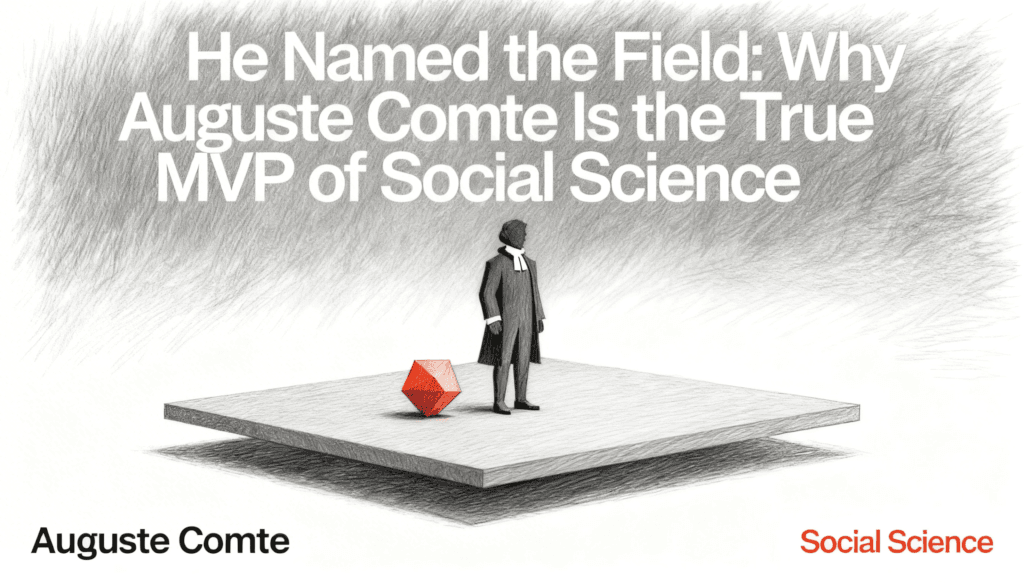
There is a particular kind of genius that does not get celebrated enough. It is not the genius of discovery. It is the genius of naming. Before Auguste Comte came along in the early nineteenth century, people had been thinking about society for thousands of years. Aristotle did it. Montesquieu did it. Ibn Khaldun did it with a sophistication that still makes modern academics nervous. But none of them gave the enterprise a name, a method, and a manifesto all rolled into one. Comte did. And for that, he deserves more credit than he typically receives.
The word “sociology” exists because of Auguste Comte. He coined it in the 1830s, stitching together a Latin root and a Greek suffix in a way that would make any linguist wince. But ugly or not, the word stuck. It gave shape to something that had been floating around in the intellectual atmosphere like smoke without a chimney. Suddenly, the study of society was not just philosophy with better footnotes. It was a discipline. It had a name tag. And in the world of ideas, having a name tag matters more than most people realize.
The Man Who Wanted Science to Fix Everything
To understand Comte, you have to understand the moment he was born into. France in the late eighteenth and early nineteenth century was not a calm place. The Revolution had come and gone, leaving behind a society that could not quite figure out what it wanted to be. The old certainties of monarchy and church had been shattered. Napoleon had risen and fallen. People were looking for something stable, something that could explain why human societies behave the way they do and, more importantly, how to make them behave better.
Comte looked at this chaos and had a thought that was either breathtakingly ambitious or spectacularly arrogant, depending on your mood. He decided that society could be studied with the same rigor and precision as physics or chemistry. Not metaphorically. Literally. He believed that if you applied the scientific method to human behavior, you could uncover laws of social development just as Newton had uncovered laws of motion.
This was not a modest proposal. This was a man standing in the wreckage of post revolutionary France, saying that he could build a science of everything human. And to his credit, he did not just talk about it. He spent decades constructing an elaborate intellectual system to back up the claim.
The Law of Three Stages
Comte’s most famous contribution is his Law of Three Stages, which argues that human thought evolves through three distinct phases. In the theological stage, people explain the world through gods, spirits, and supernatural forces. In the metaphysical stage, they replace gods with abstract concepts like “nature” or “essence.” And in the positive stage, they abandon both and rely solely on observation, evidence, and scientific reasoning.
The beauty of this framework is its simplicity. The danger of this framework is also its simplicity. Comte essentially argued that all of human intellectual history follows a single trajectory, moving inevitably from superstition to science. It is a seductive idea. It is also, if you think about it for more than a few minutes, a deeply Eurocentric one. It assumes that the Western scientific tradition is the endpoint of all human thought, which is the kind of assumption that does not age particularly well.
But here is where things get interesting. Even though Comte’s specific model has been thoroughly critiqued, the underlying impulse has proven remarkably durable. The idea that societies change in patterned, observable ways, that history is not just one thing after another but has some kind of internal logic, remains one of the foundational assumptions of social science. Every time a sociologist identifies a trend or a political scientist builds a model of institutional change, they are, whether they know it or not, working in the shadow of Comte.
Positivism: The Philosophy That Ate the World
Comte did not just name sociology. He also gave the world positivism, a philosophy that insists knowledge can only come from sensory experience and empirical investigation. If you cannot observe it, measure it, or test it, it does not count. Feelings, intuitions, and divine revelations need not apply.
Now, positivism in its pure form has taken quite a beating over the past century. Philosophers of science have poked so many holes in it that it sometimes looks like intellectual Swiss cheese. Thomas Kuhn argued that science does not progress in the neat, linear way positivists imagined. Karl Popper insisted that falsifiability, not verification, is the real mark of science. Postmodernists questioned whether objective observation is even possible when the observer is always embedded in a particular culture and history.
All fair points. But consider this: the basic positivist instinct, the belief that claims about the world should be supported by evidence, that we should prefer data to dogma, that rigorous method matters, is so deeply embedded in modern thought that we barely notice it anymore. When a news article cites a study, when a government bases policy on statistics, when a doctor recommends a treatment based on clinical trials rather than tradition, positivism is running quietly in the background like an operating system nobody thinks about. Comte did not invent the scientific method. But he was one of the first to argue, loudly and systematically, that it should be applied to human affairs. That argument changed everything.
The Hierarchy of Sciences
One of Comte’s more underappreciated ideas is his hierarchy of sciences. He arranged all the sciences in a specific order: mathematics at the base, then astronomy, physics, chemistry, biology, and finally sociology at the top. This was not arbitrary. Each science in the hierarchy depends on the ones below it but adds its own layer of complexity.
The logic is actually quite elegant. You need mathematics to do physics. You need physics to do chemistry. You need chemistry to understand biology. And you need all of them, plus something extra, to understand society. Sociology sits at the top not because it is the most prestigious but because it is the most complex. Human societies involve everything that the other sciences study, plus the added complication of consciousness, culture, intention, and meaning.
This is a point that still resonates. Anyone who has tried to build a predictive model of human behavior knows that people are not particles. They do not obey neat equations. They lie on surveys. They change their minds. They do things for reasons that make no sense even to themselves. The fact that social science is harder than physics is not a weakness. It is a reflection of the staggering complexity of its subject matter. Comte understood this, even if he was overly optimistic about how quickly that complexity could be mastered.
The Part Where He Goes Off the Rails
No honest account of Comte can avoid mentioning that his later career took some unusual turns. After spending decades arguing for cold, rational, evidence based inquiry, he fell deeply in love with a woman named Clotilde de Vaux. She died of tuberculosis in 1846, and her death transformed Comte in ways that were, to put it diplomatically, unexpected.
He proceeded to create an entire Religion of Humanity, complete with rituals, saints, a calendar, and a priesthood. The supreme being in this religion was not God but Humanity itself. The whole thing looked suspiciously like Catholicism with the supernatural bits removed and sociology professors installed where the bishops used to sit.
This is the part of Comte’s biography that makes his admirers uncomfortable and his critics gleeful. The man who built his entire intellectual reputation on the superiority of scientific reason over religious thinking ended up founding what was essentially a secular church. The irony is almost too perfect. It is as if the inventor of the fire extinguisher burned down his own house.
But even this strange episode contains a useful insight. Comte recognized something that pure rationalists often miss: people need more than facts. They need meaning, community, ritual, and a sense of belonging to something larger than themselves. His solution was bizarre, but the problem he identified was real. Modern debates about the limits of technocracy, about why people do not simply follow the science, about the persistence of religion and tribalism in an age of information, are all wrestling with the same tension Comte stumbled into nearly two centuries ago.
Why He Still Matters
It is easy to dismiss Comte. His specific theories have been revised, challenged, and in some cases abandoned. His prose style, translated from the French, can be punishing. His personal life was messy. His Religion of Humanity was, by any reasonable standard, a bit much.
But dismissing Comte because his specific ideas have been superseded is like dismissing the Wright brothers because their plane would not pass a modern safety inspection. The point is not that he got everything right. The point is that he got something started.
Before Comte, thinking about society was the domain of philosophers, theologians, and the occasional pamphleteer. After Comte, it was a science. A messy, imperfect, perpetually arguing with itself science, but a science nonetheless. He drew the boundary lines. He set the terms of debate. He insisted that human societies are not random, not beyond understanding, and not solely the province of priests and poets.
Every survey that gets conducted, every social experiment that gets run, every regression analysis that gets published in a peer reviewed journal, owes something to the intellectual space Comte carved out. He did not fill that space perfectly. But he created it. And creation, even imperfect creation, deserves recognition.
The Connection Nobody Talks About
There is an interesting parallel between Comte and another figure from a completely different field: Carl Linnaeus, the Swedish botanist who created the modern system of biological classification. Linnaeus did not discover any new species. What he did was create a system for organizing and naming the ones that already existed. Before Linnaeus, biology was a mess of local names and overlapping categories. After Linnaeus, it was a discipline with a shared language.
Comte did something remarkably similar for the social world. The phenomena he wanted to study, institutions, norms, social change, collective behavior, had been observed and discussed for centuries. What Comte provided was a framework for organizing the conversation. He gave the field its name, its method, and its ambition. Like Linnaeus, his greatest contribution was not a discovery but a structure. And structures, however invisible they become over time, are what allow everything else to be built.
The Verdict
Auguste Comte was not right about everything. He was not even right about most things, if we are being strict about it. His evolutionary model of society was too neat. His positivism was too rigid. His Religion of Humanity was too weird. He had the unfortunate habit of brilliant people everywhere: he could not tell the difference between a good idea and his own idea.
But he did something that matters more than being right about the details. He asked the right question. Can we study human society scientifically? And he answered it with a resounding yes, then spent his life trying to show how. That the answer turned out to be more complicated than he imagined does not diminish the courage of the question.
Social science today is a vast, sprawling enterprise. Sociologists, economists, political scientists, anthropologists, and psychologists all occupy the territory that Comte helped map. Most of them have never read a word he wrote. Most of them would find his work dated if they did. But they are all, in some fundamental sense, his intellectual descendants. They are all working in a field that exists, in part, because one stubborn French thinker decided that human beings were worth studying with the same seriousness we bring to stars and atoms.
He named the field. He fought for its legitimacy. He made mistakes that were as grand as his ambitions. And the world of ideas is richer for all of it. If that does not make him the true MVP of social science, the term has no meaning.