Table of Contents
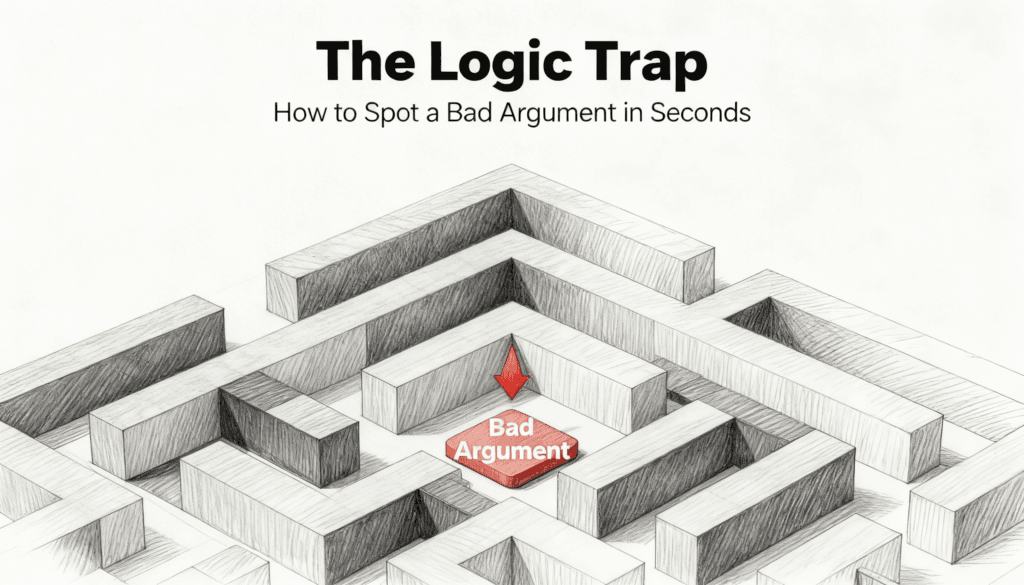
You have been fooled by a bad argument today. Maybe twice. You probably did not notice, which is exactly how bad arguments work. They dress up in reasonable clothes, speak in a confident voice, and walk right past the part of your brain that is supposed to be standing guard.
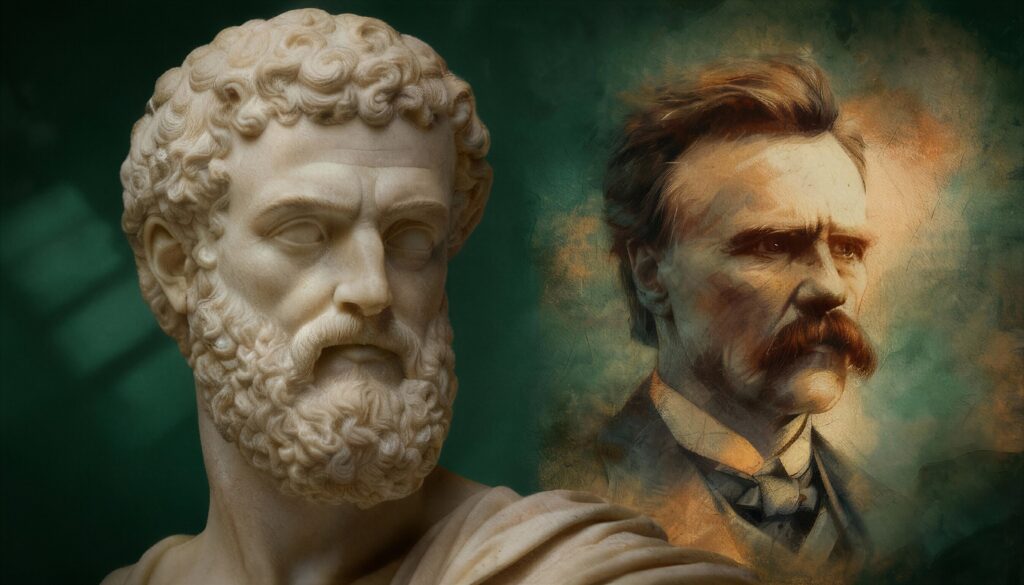
Aristotle noticed this problem about 2,400 years ago. He got so annoyed by it that he essentially invented the study of logic just to give people a fighting chance. His work on fallacies, reasoning, and persuasion was not some dusty academic exercise. It was a survival manual for anyone who had to sit through an Athenian assembly and listen to politicians twist language into knots.
The remarkable thing is that almost nothing has changed. The same tricks that worked in ancient Athens work on Twitter, in board meetings, in political debates, and at your family dinner table. The packaging is different. The machinery underneath is identical.
So let us do what Aristotle would have wanted. Let us learn to spot the gears turning inside a bad argument before it finishes its sentence.
Why Your Brain Is Not on Your Side
Before we get to the arguments themselves, we need to talk about the audience. That is you. Your brain is not a logic machine. It is a pattern recognition engine that evolved to make fast decisions about whether that rustling in the grass was the wind or a predator. Speed was the priority. Accuracy was a luxury.
This means you are wired to accept arguments that feel right long before you check whether they are right. Aristotle understood this deeply. In his Rhetoric, he identified three modes of persuasion: logos (logic), ethos (credibility), and pathos (emotion). Most bad arguments work by cranking up the ethos and pathos while quietly turning the logos dial down to zero.
A confident speaker making an emotional appeal can bypass your critical thinking the way a fire alarm bypasses your decision to stay in bed. You react first. You think later. And by the time you think, you have already nodded along, shared the post, or agreed to something you should not have.
This is not a character flaw. It is a design feature of the human mind. But like any design feature, once you know it exists, you can work around it.
The Fallacy Toolbox: What Aristotle Actually Found
Aristotle catalogued thirteen fallacies in his Sophistical Refutations. Thirteen ways that an argument can look valid on the surface while being completely hollow underneath. We are not going to walk through all thirteen, because some of them are specific to the Greek language and the way formal debates were structured in his era. But the core ones are so universal that you will recognize them from conversations you had this week.
The first and most common is the irrelevant conclusion. Aristotle called it ignoratio elenchi. It happens when someone gives you a perfectly good argument that proves something entirely different from what was being discussed.
Imagine someone asks whether a new company policy will actually improve productivity. A colleague responds with a passionate speech about how much the CEO cares about the employees. That might be true. It might even be moving. But it does not answer the question. The argument reached a conclusion. It just was not the conclusion anyone asked for.
This one is everywhere. In courtrooms, lawyers use it constantly. “My client may have been at the scene, but let me tell you about his difficult childhood.” The childhood may be real. The difficulty may be genuine. But the question was about the scene, not the childhood.
The second is the appeal to the person, or what Aristotle placed under arguments directed at the speaker rather than the claim. Instead of addressing what someone said, you attack who they are.
“You cannot talk about fiscal responsibility when you went bankrupt five years ago.” This feels devastating in the moment. It gets applause. It makes the other person defensive. But notice what it does not do. It does not engage with any specific point about fiscal responsibility. A person who went bankrupt might actually have learned more about fiscal responsibility than someone who never had to think about money at all. The argument skips the claim and goes straight for the throat. That is not reasoning. That is theater.
The third is begging the question, and almost nobody uses this phrase correctly anymore. Begging the question does not mean “raising the question.” It means assuming the very thing you are trying to prove.
“This policy is the best option because no other option is as good.” Read that again. It says absolutely nothing. It is a circle drawn with words. The conclusion is hidden inside the premise like a magician palming a card. You feel like you heard an argument, but you heard the same claim repeated in a different outfit.
Aristotle found this one particularly dangerous because it is so hard to spot in real time. The sentence structure feels complete. The tone feels conclusive. Your brain checks for the shape of an argument, finds something that looks roughly right, and moves on. Meanwhile, nothing was actually established.
The Speed Test: Three Seconds or Less
Here is where we get practical. You do not need a philosophy degree to catch these. You need one question, asked at the right moment.
“What exactly is this proving?”
That is the whole test. When someone makes an argument and you feel yourself being persuaded, pause and ask what the argument actually proves. Not what it implies. Not what it feels like it proves. What it logically, structurally establishes.
If you cannot state the proven conclusion in one clear sentence, something is wrong. Either the argument is too vague to pin down, which is a problem, or the conclusion it supports is different from the conclusion being claimed, which is a bigger problem.
Aristotle would have loved this shortcut. His entire project was about making the structure of arguments visible. He wanted to pull the skeleton out of the body of rhetoric and hold it up to the light. That is all this question does. It strips away the tone, the emotion, the charisma, and asks what is left.
Try it the next time you watch a political debate. You will be amazed at how often the answer is “nothing.”
The Counterintuitive Problem With Good Speakers
Here is something that should bother you: the better someone is at speaking, the harder it is to spot their bad arguments.
This is not a minor inconvenience. It is a fundamental problem with how we process information. Aristotle himself warned about this. He recognized that rhetoric, the art of persuasion, was morally neutral. It could be used to advance truth or to bury it. A skilled speaker could make a weak argument feel unassailable, while a clumsy speaker could make an airtight case sound unconvincing.
Think about that for a moment. The quality of an argument and the quality of its delivery are completely independent variables. Yet we treat them as if they are the same thing. A smooth talker with a terrible point will beat a stuttering genius in almost every public forum. We know this. We watch it happen. And we fall for it anyway.
This is why Aristotle spent so much time on logic as a formal system. He wanted a method that did not depend on how the argument made you feel. Written out as a syllogism, stripped of all performance, an argument either holds or it does not. There is no charisma in a syllogism. There is no dramatic pause between the premise and the conclusion.
The lesson here is uncomfortable but useful: be more skeptical of arguments you find beautiful. Elegance is not evidence.
The Social Media Amplifier
Aristotle dealt with bad arguments in person, in real time, in small groups. We deal with them at scale, at speed, across platforms designed to reward engagement over accuracy.
Social media did not invent logical fallacies. But it built them a cathedral.
Consider how the structure of a tweet or a short video rewards exactly the kinds of arguments Aristotle warned about. You have seconds to make a point. Nuance is punished. Emotional reactions drive sharing. The arguments that spread fastest are the ones that feel right immediately, which means the ones that bypass the part of your brain that checks whether they are right.
The appeal to emotion, which Aristotle analyzed as a tool of persuasion, has become the entire architecture of how information moves online. An argument that makes you angry will travel ten times further than one that makes you think. This is not a guess. Researchers at MIT found that false stories on social media spread significantly faster and further than true ones, and that the primary driver was the emotional reaction they provoked.
Aristotle could not have predicted the internet. But he predicted the vulnerability it exploits.
The Hardest Fallacy to Catch: Your Own
We have been talking about other people’s bad arguments as if we are above them. We are not.
The most persistent logical fallacy in your life is not coming from a politician or a pundit. It is coming from you. Aristotle knew this too. In his Nicomachean Ethics, he wrote extensively about self deception and the way desire distorts reasoning. We do not just fall for bad arguments from others. We construct them for ourselves, custom built to justify whatever we already wanted to do.
“I deserve this purchase because I have been working hard.” The premise (working hard) may be true. But the conclusion (deserving a specific purchase) does not follow from it. Working hard does not create a logical entailment to any particular reward. You built that bridge yourself because you wanted to cross it.
This is where the real value of Aristotle’s framework lives. Not as a weapon to use against other people, though it works wonderfully for that, but as a mirror. The fallacies you spot in your own thinking are worth ten times the ones you spot in someone else’s.
Every time you catch yourself reasoning backward from a conclusion you want to reach, you are doing what Aristotle actually hoped people would do. Not become debate champions. Become honest thinkers.
The Connection to Modern Decision Science
There is a fascinating link between Aristotle’s fallacy work and what behavioral economists like Daniel Kahneman documented two millennia later. Kahneman’s “System 1 and System 2” framework, the fast intuitive mind versus the slow deliberate mind, maps almost perfectly onto Aristotle’s distinction between rhetorical persuasion and logical demonstration.
System 1 is where fallacies live. It is the part of your brain that accepts an argument because the speaker seems trustworthy, because the conclusion feels right, because everyone else is nodding. System 2 is the Aristotelian ideal. Slow, structured, willing to sit with the discomfort of not knowing until the logic checks out.
The tragedy, and Kahneman was clear about this, is that System 2 is lazy. It does not activate unless forced. Which means the default mode of human reasoning is exactly the mode that fallacies are designed to exploit.
Aristotle did not have the language of cognitive science. But he was describing the same machine.
So What Do You Actually Do With This?
You cannot analyze every argument you encounter. Life is too short and the arguments are too many. But you can build a habit that catches the worst offenders before they settle into your thinking.
First, notice when you feel strongly persuaded. Strong persuasion is not a sign that an argument is good. It is a sign that you should check whether the argument is good. The feeling of being convinced and the fact of being shown something true are not the same experience, even though they wear the same expression.
Second, ask the question. “What does this actually prove?” Force yourself to state it plainly. If the answer is vague or circular or different from what was claimed, you have found a bad argument. Congratulations. That took about three seconds.
Third, apply the test to yourself first. The next time you are about to justify a decision, pause and run your own reasoning through the same filter. You might be surprised at what falls apart.
Aristotle did not write about logic because he thought it was interesting, though he clearly did. He wrote about it because he believed that clear thinking was a prerequisite for a good life. That people who could not reason well could not choose well. That societies full of people susceptible to manipulation would make terrible collective decisions.
He was, as it turns out, exactly right about that.
The bad arguments are not going away. They are getting faster, louder, and better dressed. But the tools to spot them have been sitting on a shelf for 2,400 years, waiting for someone to pick them up.
It takes about three seconds. That is a bargain.