Table of Contents
Everyone knows Maslow’s pyramid. It shows up in psychology textbooks, corporate training slides, and motivational Instagram posts with sunset backgrounds. Food and shelter at the bottom. Self actualization at the top. Climb the pyramid, find yourself. Simple. Clean. Wrong.
Well, not entirely wrong. But incomplete in a way that matters. Because roughly 2,300 years before Abraham Maslow stacked human needs into a triangle, Aristotle was already working on the same problem. He just came to very different conclusions. And if you read him carefully, his version is more useful, more honest, and far less flattering to our modern obsession with individual achievement.
The Pyramid That Never Was
Before we get to Aristotle, let’s be fair to Maslow. He never actually drew a pyramid. That image was added later by others who wanted a visual shorthand for his 1943 paper “A Theory of Human Motivation.” Maslow proposed a sequence: physiological needs, safety, love and belonging, esteem, and self actualization. The idea was that you had to satisfy the lower needs before the higher ones could emerge.
There is something appealing about this. It makes personal growth look like a video game. Clear levels. Defined progression. Beat the boss at each stage and move on. The problem is that life does not work like a video game, and Maslow himself spent his later years questioning the rigidity of his own model. People in concentration camps wrote poetry. Starving artists chose meaning over meals. The sequence kept breaking.
Aristotle would not have been surprised by any of this.
What Aristotle Actually Said
Aristotle did not write a self help book. He wrote the Nicomachean Ethics, which is essentially a 2,300 year old instruction manual for how to live well. His central concept was eudaimonia, a word that gets translated as “happiness” but actually means something closer to “flourishing” or “living in full bloom.” The difference matters enormously.
Happiness, as we use the word today, is a feeling. You eat a good meal, you feel happy. You get a promotion, you feel happy. Eudaimonia is not a feeling. It is a condition of your entire life, evaluated not moment by moment but as a whole. You cannot experience eudaimonia in an instant any more than you can experience a symphony in a single note.
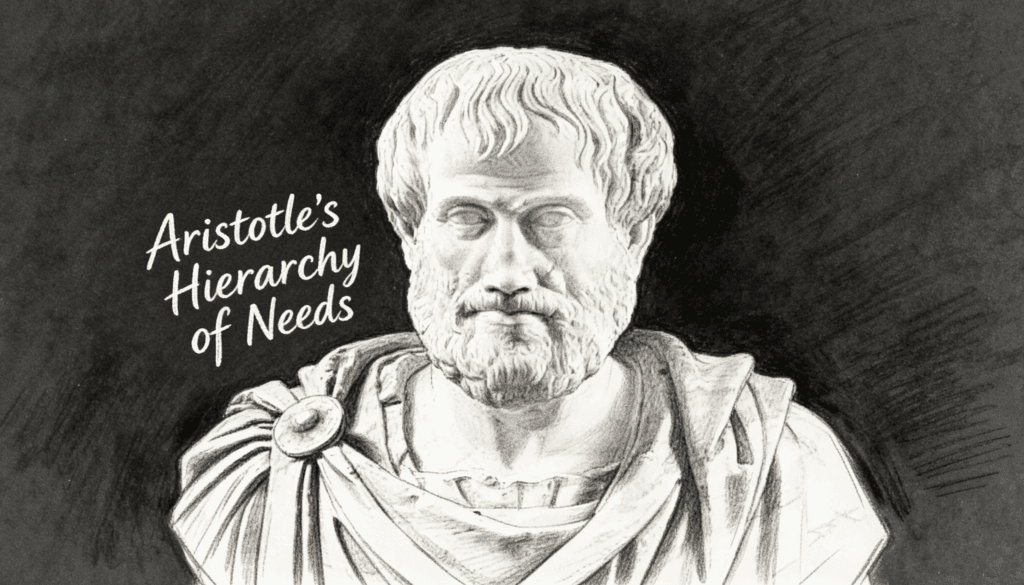
Aristotle argued that human beings need several things to flourish, and he arranged them not as a pyramid but more like a set of concentric circles or interlocking conditions. Here is the rough structure, translated into plain language.
The body’s requirements come first, but they are the least interesting. Aristotle agreed with Maslow on this much. You need food, shelter, and basic physical security. A person cannot philosophize on an empty stomach. But Aristotle treated this as obvious and moved quickly past it, the way you might acknowledge that a car needs fuel without spending the whole conversation talking about gasoline.
Material sufficiency matters, but not in the way you think. Aristotle believed you needed enough wealth to live without constant anxiety about survival. But he was very specific: enough, not more. He considered the endless pursuit of money to be a kind of disease, a confusion of means with ends. Money is useful the way a hammer is useful. Nobody’s life goal should be to accumulate hammers.
Friendship and community are not optional extras. This is where Aristotle starts to diverge sharply from the modern pyramid. For Maslow, love and belonging sit in the middle of the stack, a stage you pass through on the way to something higher. For Aristotle, deep friendship was not a stage. It was one of the highest goods a person could achieve. He devoted more space in the Nicomachean Ethics to friendship than to almost any other topic. Two full books out of ten. He was not being sentimental. He meant it.
Virtue is the operating system. The centerpiece of Aristotle’s framework was not any external condition but the development of character. He identified virtues like courage, temperance, justice, and practical wisdom as habits that had to be cultivated over time. You did not achieve virtue by reading about it. You achieved it by practicing it, the way a musician becomes good not by studying music theory but by playing scales until their fingers know what to do without being told.
Contemplation and meaning sit at the center, not the top. Aristotle placed the contemplative life, the examined life of thought and understanding, at the core of human flourishing. But unlike Maslow’s self actualization, which sounds like something you do alone on a mountain, Aristotle’s contemplation was tied to community, to politics, to the shared life of a city. You did not think well in isolation. You thought well in conversation.
Why the Shape Matters
The difference between a pyramid and a set of interlocking conditions is not just visual. It changes everything about how you approach life.
A pyramid implies sequence. First handle survival, then safety, then relationships, then esteem, then actualization. It implies that each stage is left behind as you ascend. It implies that the person at the top has transcended the needs at the bottom. This is a seductive idea and it is mostly fiction.
Aristotle’s model implies simultaneity. You need physical security AND meaningful relationships AND virtuous character AND intellectual engagement, all at the same time, all reinforcing each other. Remove any one element and the whole structure weakens. A wealthy person without friends is not flourishing. A person with deep friendships but no sense of purpose is not flourishing. A brilliant thinker who treats people badly is not flourishing.
This is less comforting than the pyramid. The pyramid gives you a clear to do list. Aristotle gives you a balancing act that never ends. But the balancing act is closer to how life actually feels.
The Friendship Problem
Modern culture has largely adopted Maslow’s framework without knowing it. We treat relationships as something that serves individual growth. “Surround yourself with people who help you level up.” Social media, which is perhaps the greatest monument ever built to Maslow’s esteem stage, reinforces this constantly. Relationships become instruments. People become networking opportunities.
Aristotle would have found this repulsive. He distinguished between three types of friendship: friendships of utility (you are useful to me), friendships of pleasure (you are fun to be around), and friendships of virtue (we make each other better people through mutual commitment to living well). Only the third type was real friendship in his view. And real friendship was not a tool for personal advancement. It was an end in itself, one of the primary components of a good life.
Here is the part that will sound strange to modern ears: Aristotle believed that a truly virtuous person needed friends not because friendship feels good, but because goodness itself is incomplete without someone to share it with. Virtue practiced alone is like applause with one hand. Technically possible. Practically absurd.
This is where Aristotle’s framework connects unexpectedly to modern psychology. Researchers studying loneliness have found that social isolation is as dangerous to physical health as smoking fifteen cigarettes a day. The data is robust and growing. It turns out that a philosopher who died in 322 BC understood something about human biology that we are only now catching up to with brain scans and longitudinal studies.
The Virtue Gap
Perhaps the most radical difference between Aristotle and Maslow is the role of character.
Maslow’s pyramid is essentially morally neutral. It describes needs, not obligations. There is no requirement in the pyramid to be a good person. You can theoretically achieve self actualization while being terrible to everyone around you, as long as your lower needs are met and you feel a subjective sense of fulfillment. Plenty of people have tried. Some of them write bestselling memoirs about the experience.
Aristotle flatly rejected this possibility. In his framework, you cannot flourish without virtue, and virtue is not a feeling or a belief. It is a set of practiced habits. Courage is not something you have. It is something you do, repeatedly, in situations where it would be easier not to. Justice is not a principle you agree with. It is a pattern of behavior you maintain even when no one is watching.
This is deeply inconvenient. It means you cannot buy your way to a good life. You cannot hack it, optimize it, or delegate it to an app. You have to actually become a certain kind of person, and that process is slow, uncomfortable, and has no guaranteed outcome. Aristotle was honest about this in a way that modern frameworks tend to avoid.
Where Maslow Went Right (and Where Aristotle Went Wrong)
It would be unfair to paint this as a simple contest where Aristotle wins and Maslow loses. Maslow made genuine contributions. His emphasis on the reality of psychological needs, coming as it did after decades of behaviorism that treated humans as stimulus response machines, was important. He helped psychology take subjective experience seriously. His later work on peak experiences and transcendence moved closer to what Aristotle was describing.
Aristotle, for his part, had blind spots large enough to drive a chariot through. He believed that some people were natural slaves. He excluded women from the possibility of full flourishing. He assumed that a certain level of inherited social status was necessary for virtue, which conveniently happened to match his own position in Athenian society. His framework was built for free Greek men of comfortable means, and extending it to all of humanity requires doing some renovation that he himself would probably have resisted.
This matters because it reminds us that every framework is a product of its time. Maslow’s pyramid carries the fingerprints of mid twentieth century American optimism, with its faith in progress and individual achievement. Aristotle’s model carries the fingerprints of ancient Athens, with its small scale community life and its assumptions about who counts as fully human. Neither framework is pure. Both contain insights that the other misses.
What This Means Now
So what do we actually do with this? Here are some observations, offered not as instructions but as things worth thinking about.
First, if you have ever felt like something was missing despite checking all the conventional boxes, Aristotle might explain why better than Maslow. The pyramid suggests that once you have security, relationships, esteem, and a sense of purpose, you should feel complete. Aristotle suggests that these elements have to be integrated, that they have to work together, and that the quality of each matters far more than simply having them present. A hundred shallow connections do not equal one deep friendship. A prestigious career does not equal a meaningful one.
Second, the emphasis on virtue as practice rather than belief is worth taking seriously. We live in a culture that treats values as something you profess rather than something you do. People put their values in their social media bios and then behave in ways that contradict them daily. Aristotle would argue that your values are not what you say they are. Your values are what you do when it costs you something. The rest is advertising.
Third, the role of community in Aristotle’s framework deserves renewed attention. The dominant cultural narrative in much of the Western world is one of individual achievement. Pull yourself up. Find yourself. Become yourself. Aristotle’s counterpoint is that the self is not something you find in isolation. It is something that emerges through sustained engagement with other people who are also trying to live well. The good life is inherently social. Not in the sense of having many followers, but in the sense of having people in your life who will tell you the truth even when you do not want to hear it.
The Framework Behind the Frameworks
What is most interesting about comparing these two models is what the comparison reveals about our assumptions. Maslow’s pyramid became popular because it fit the story we wanted to tell about ourselves. That story was about progress, individual achievement, and the idea that fulfillment is something you arrive at, a destination.
Aristotle’s model never became a cultural phenomenon because it tells a less flattering story. Flourishing is not a destination. It is a daily practice. It requires other people. It demands that you develop your character, not just your career. And it can be undone at any time by bad luck, because Aristotle was honest enough to admit that fortune plays a role in human life and that no amount of virtue makes you immune to tragedy.
This is not the kind of message that fits on a motivational poster. But it might be the kind of message that actually helps.
The ancient Greeks had a saying: the fox knows many things, but the hedgehog knows one big thing. Maslow was a fox, mapping the many things humans need. Aristotle was the hedgehog, insisting on one big thing: that all of those needs have to serve something larger than themselves, and that the something larger is not a peak experience or a moment of transcendence but the slow, daily, unglamorous work of becoming a person you would actually respect if you met yourself at a dinner party.
That might be the most useful hierarchy of needs anyone has ever proposed. It just happens to be 2,300 years old.