Table of Contents
There is a strange little secret hiding inside every fair system ever built. You can hand everyone the same starting line, the same rulebook, the same coach, and the same shoes. You can scrub the playing field clean of every bias you can identify. And yet, when the dust settles, a small group will end up holding most of what there is to hold. Not because the system failed. Because it worked.
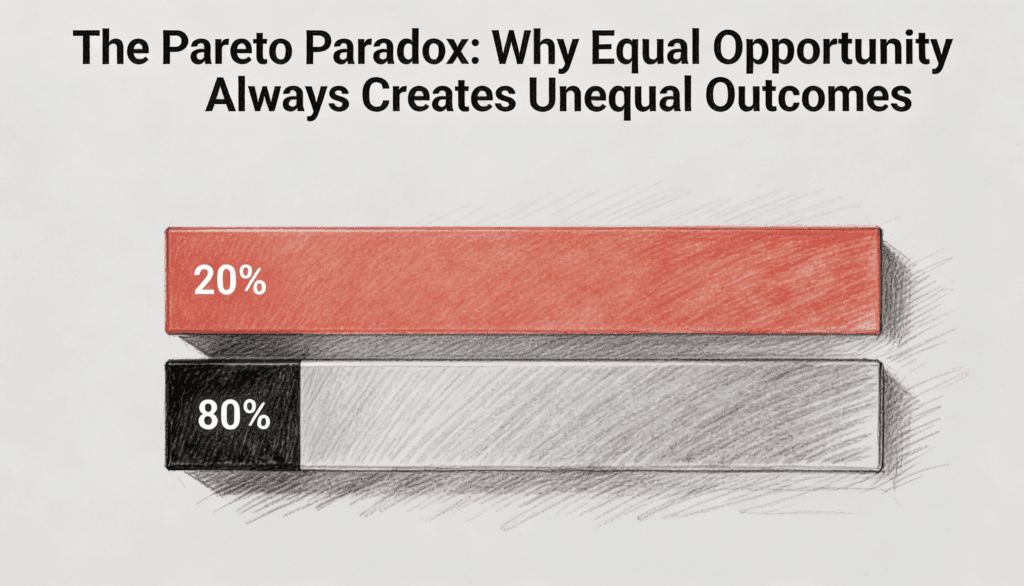
This is the discovery that haunted Vilfredo Pareto more than a century ago, and it has been quietly haunting economists, sociologists, and policy makers ever since. Pareto was an Italian engineer turned economist who, in the late 1800s, noticed something odd while studying land ownership in Italy. Roughly 20 percent of the population owned about 80 percent of the land. Curious, he started looking elsewhere. Pea pods in his garden. Income distributions across Europe. Wealth in ancient societies. The same lopsided pattern kept showing up, like a watermark pressed into the fabric of reality.
He had stumbled onto what we now call the Pareto Principle, or the 80/20 rule. But the deeper insight, the one most people miss, is not really about the numbers. It is about the unsettling fact that this imbalance shows up even when the inputs are equal. Especially when the inputs are equal.
The Garden That Refused to Cooperate
Picture a perfectly fair garden. Identical seeds. Identical soil. Identical water. Identical sunlight. You would expect identical plants. What you actually get is a handful of thriving giants, a middle pack of decent performers, and a long tail of stragglers that never quite found their footing.
Why? Because tiny differences, the kind too small to measure, compound. One seed germinates twelve hours earlier than its neighbor. That seed gets twelve more hours of sunlight, which means slightly more chlorophyll, which means slightly more energy, which means slightly faster root growth, which means slightly better access to water and nutrients. By week three, the head start is no longer tiny. By harvest, that seed is a beanstalk and its identical twin is a sad little sprig wondering where the time went.
This is what Pareto saw in human societies, except with people instead of peas. Equal opportunity does not produce equal outcomes because opportunity is only the first frame of a very long movie. What happens after the starting gun fires is governed by feedback loops that magnify small advantages into enormous ones.
The Quiet Tyranny of Compounding
Compounding is the engine that makes the Pareto Paradox so unavoidable. We tend to think of it in the context of money, where a small interest rate over decades turns modest savings into something embarrassing. But compounding is not just financial. It is the operating logic of almost everything that matters.
Skills compound. The person who reads slightly more than average becomes slightly more articulate, which makes reading slightly more enjoyable, which leads to more reading. Five years in, the gap between the casual reader and the obsessive one is not five years wide. It is a chasm.
Relationships compound. The person with a slightly larger network gets invited to slightly more dinners, where they meet slightly more people, who invite them to slightly more dinners. Ten years later, one person knows everyone and the other person knows their neighbor’s dog.
Reputation compounds. A musician who plays slightly better gets booked at a slightly nicer venue, which puts them in front of a slightly better crowd, which leads to slightly better gigs. The famous get more famous. The obscure stay obscure. Not because the world is rigged, but because the world rewards what it can already see.
Even attention compounds. The popular YouTube video gets recommended more often, which makes it more popular, which makes it get recommended more often. The algorithm is not biased. It is just doing what algorithms do, which is amplifying whatever is already winning.
You can give everyone the same starting conditions and the same rules. You cannot stop the math.
The Cruel Joke of Meritocracy
Here is where things get uncomfortable. The fairer a system becomes, the more inequality it tends to produce. This sounds like the kind of thing a contrarian says at a dinner party to get attention, but it has been observed in study after study.
Consider this. In societies with strong barriers to entry, where bloodline or caste or gender determines your fate, the inequality is artificial and arbitrary. Talented people are blocked. Mediocre people are protected. The result is a kind of forced flatness in certain layers of society, because the system actively prevents merit from sorting people.
Now remove those barriers. Let everyone compete fairly. What happens? The truly talented start to pull away. The truly hardworking start to outpace the lazy. The naturally gifted start to dominate their domains. The system, having been freed from its old distortions, starts sorting people with brutal efficiency. And the gaps it produces are larger, not smaller, than the gaps in the old rigged system.
This is the cruel joke at the heart of meritocracy. The more accurately a system measures and rewards ability, the more unequal its outcomes become. We dismantled the old aristocracy and built a new one, except this time the aristocrats can claim, with some justification, that they earned it.
Pareto, who was not exactly a sentimental man, found this observation darkly amusing. He believed that elites would always exist, no matter what political system you tried. The faces would change. The composition would shift. But the shape of the distribution would remain stubbornly the same. He called this the circulation of elites, the idea that revolutions do not abolish hierarchy. They just swap one set of names for another.
The 80/20 Rule Is Everywhere, and It Is Annoying
Once you start noticing Pareto distributions, you cannot stop. Twenty percent of your wardrobe gets worn 80 percent of the time. Twenty percent of the products in a store generate 80 percent of the revenue. Twenty percent of the bugs in your software cause 80 percent of the crashes. Twenty percent of your friends provide 80 percent of your social life, which is a depressing thing to realize on a Tuesday night.
In language, a small number of words account for the vast majority of everyday speech. In science, a tiny fraction of papers get most of the citations. In sports, a handful of athletes dominate their leagues. In dating apps, the math is so lopsided it has been called a humanitarian crisis by people who probably need to put their phones down.
The pattern is not exactly 80/20, of course. Sometimes it is 90/10. Sometimes it is 70/30. The point is that distributions in the real world are almost never bell shaped and democratic. They are skewed, lumpy, and top heavy. The bell curve is a comforting story we tell ourselves about height and IQ. Reality, in most domains, looks more like a ski slope.
Why This Matters for How You Live
If you accept that unequal outcomes are baked into the structure of any free system, a few things start to look different.
First, beating yourself up for not being in the top 20 percent of everything is a category error. The structure guarantees that most people will not be at the top of most distributions. You cannot all be exceptional. That is what the word means. The healthier move is to figure out which distributions you actually care about being near the top of, and accept your position in the rest. You do not need to be in the top 20 percent of amateur chess players to have a good life. You probably do need to be reasonably competent at the one or two things you have chosen to build your career around.
Second, the leverage points in your own life follow the same pattern. A small number of habits, relationships, and decisions are responsible for most of your outcomes. The rest is noise. Most of what you do in a given week does not matter much. Identifying the 20 percent that does, and protecting it from the 80 percent that does not, is probably the single most useful application of Pareto’s insight.
Third, complaining about inequality of outcomes as if it were a glitch is a misunderstanding of the system. Inequality is the output. The system is not broken when a few people accumulate disproportionate success. It is broken when the few are the wrong few, when the sorting is corrupted by something other than the qualities the system claims to reward. That is a real problem, and worth fighting. But the existence of a top and a bottom is not, in itself, evidence of failure.
The Counterintuitive Comfort
There is a strange comfort hidden in all of this. If outcomes are always going to be unequal, then your job is not to win some impossible race against everyone else. Your job is to find the specific game you can play well, and play it. The distribution will sort itself out without your help.
You also stop expecting the world to be fair in the simple way children are told it should be. Fair systems produce unfair looking results. Equal opportunity guarantees unequal outcomes. The two ideas, which seem opposed, are actually two sides of the same coin. You cannot have one without the other, unless you are willing to rig the game in the other direction, which has its own problems and tends to involve large men in uniforms.
Pareto himself was not particularly cheerful about any of this. He thought human beings were largely irrational, that ideologies were rationalizations dressed up as principles, and that most political reform was theater. You do not have to share his pessimism to take the lesson. The lesson is simply that the distribution is older than us. It shows up in pea plants and city sizes and book sales and the lengths of rivers. It is not the fault of capitalism or socialism or any particular human arrangement. It is what happens when small differences compound over time in any system complex enough to have winners and losers.
The Quiet Liberation
Once you stop expecting the world to be even, you can start asking better questions. Not how to make everyone equal, which is a war against arithmetic, but how to make sure the people at the bottom are not crushed, and the people at the top are not insulated from accountability. Not how to flatten the distribution, which cannot be done, but how to make movement between its levels possible. Not how to win every race, which is delusional, but how to find the races worth running.
The Pareto Paradox is not really a paradox at all once you sit with it. It is just a description of how things sort themselves when you let them. The world is lumpy. It always has been. The fair systems we build do not erase the lumpiness. They just make sure that, this time, the lumps form for reasons we can almost defend.
And maybe that is the best we can do. A world where the top is earned, the bottom is humane, and the middle is wide enough for most people to find a place to stand. That is not equality. But it might be something better. It might be the kind of unfairness we can live with.