Table of Contents
A French economist named Frédéric Bastiat died in 1850, long before anyone had heard of a federal student loan, a Pell Grant, or a TikTok video explaining why your $80,000 in debt is actually society’s fault. And yet, somehow, he wrote the most devastating critique of student loan forgiveness ever published.
He just did not know he was doing it at the time.
His essay was called “That Which Is Seen, and That Which Is Not Seen.” The core idea is almost embarrassingly simple. When the government does something, you tend to notice the obvious result. The bridge gets built. The check arrives. The debt vanishes. What you do not notice is everything that did not happen because the resources were used for the first thing instead.
Bastiat called the obvious part “the seen.” He called the invisible cost “the unseen.” His entire argument, distilled, is that bad economics looks only at the seen, while good economics forces itself to look at both.
So let us do something Bastiat would have appreciated. Let us look at the unseen price of “free” student loan forgiveness, the part nobody puts on a campaign poster.
The Broken Window That Started It All
Before we get to loans, you need to know about a window.
In his most famous parable, Bastiat describes a shopkeeper whose careless son smashes a pane of glass. The neighbors gather around and, after the initial sympathy, start saying something strange. They say it is not so bad, really. After all, the glazier will get paid to replace it. The glazier will then spend that money at the butcher. The butcher will spend it at the tailor. Everyone wins. Perhaps broken windows are good for the economy.
Bastiat shakes his head. Yes, the glazier gets paid. That is the seen. But what is the unseen?
The shopkeeper was going to spend that money on a new pair of shoes. Now he cannot. The shoemaker loses the sale. The shopkeeper ends up with a window he already had, instead of a window plus shoes. Society is not richer. It is poorer by exactly one pair of shoes, and nobody notices because the shoes were never made.
The broken window fallacy is one of those ideas that, once you see it, you cannot unsee it. It shows up everywhere. Including, as it turns out, in the great debate over wiping out student debt.
What You Are Supposed to See
The seen part of student loan forgiveness is genuinely lovely. I will not pretend otherwise.
A teacher in Ohio who has been making payments for five years suddenly does not have to anymore. A young couple can buy a house. A graduate can start a business. A 45 year old who thought she would die owing money can plan a retirement.
These are real people. The relief is real. The tears are real. If you put a camera on any of them on forgiveness day, you would see joy that is impossible to fake.
This is the part politicians put on banners. This is the part news anchors talk about. This is the seen.
And if this were the whole story, the math would be simple. Forgiveness would just be kindness with a price tag, and we could argue about whether the kindness is worth the tag.
But Bastiat is whispering in our ear. He is asking the inconvenient question.
What about the pair of shoes that never got made?
The People Who Are Not in the Photograph
Forgiveness does not come from a magic forgiveness fairy. It comes from somewhere. Specifically, it comes from the federal government, which means it comes from taxpayers, which means it comes from people.
Some of those people went to college and paid off their loans by working two jobs and skipping vacations for a decade.
Some of those people went to community college instead of a four year school precisely because they did not want to take on debt.
Some of those people never went to college at all. They became plumbers, welders, electricians, mechanics, truck drivers. They are doing fine, often better than the graduates, but they are still on the hook for the bill.
Some of those people are nineteen years old and have not even decided what to do with their lives yet, and they will pay through future taxes for decisions other people made before they were born.
None of these people show up at the forgiveness press conference. They are not in the photograph. They are the shoemaker in Bastiat’s parable, the one who lost a sale he never knew he was going to make. They paid for the window. They just do not get to celebrate it.
This is not an argument that they are morally superior. Some of them probably are. Some of them probably are not. The point is something much smaller and much sharper.
They exist. And in the conversation about forgiveness, they almost never do.
The Tuition That Will Keep Climbing
Here is where it gets interesting, and a bit dark.
If you forgive student loans once, you have helped some people. If you signal that you are willing to forgive them again, you have done something much stranger. You have told universities that the price tag does not really matter, because someone else will eventually pick up the tab.
Think about what happens to any market when the buyer believes the price is not really the price.
If your insurance covers everything, hospitals charge more.
If the government will pay for any car you buy, dealerships do not exactly start a price war.
If a future president might forgive any tuition you sign up for, what exactly is the incentive for a university to keep tuition reasonable?
Forgiveness, far from solving this problem, pours gasoline on it. The next generation of students will face higher tuition, take out bigger loans, and then ask for forgiveness too. And the generation after that will do the same.
This is the unseen on a long delay. You do not feel it next week. You feel it in 2040, when an undergraduate degree costs as much as a small house and everyone is shocked. Shocked, that things ended up this way.
The Quiet Insult to the People Who Paid
There is a kind of person who almost never complains in public. This person took on debt, hated the debt, worked extra hours, ate cheap food, drove a beat up car, postponed having kids, postponed buying a home, postponed everything, and paid the debt off. Maybe it took ten years. Maybe twenty.
When forgiveness arrives, this person does not protest in the streets. They do not write angry op eds. They just sit there, quietly, and feel something they cannot quite name.
It is not exactly anger. It is closer to the feeling you get when you find out the rules changed after you played by them.
Bastiat understood this too, though he would not have used the word fairness in quite the modern sense. He understood that policy is not just numbers. It is also a signal about what behaviors are rewarded and what behaviors are punished. When you forgive the debt of those who did not pay, you are not just helping them. You are also, by implication, sending a message to those who did pay.
The message is: you were a sucker.
You may disagree that this is the message. The person who paid does not disagree. They got it loud and clear.
What Bastiat Would Probably Say
If Bastiat walked into a modern American policy debateI imagine he would ask one question.
“Show me the shoemaker.”
He would not deny that the people getting forgiveness are happy. He would not pretend their lives are not improved. He would simply, stubbornly, almost annoyingly, insist on asking who is paying. Where the money came from. What that money would have been used for if it had not been used for this. Whose silent loss made the visible gain possible.
He would not necessarily oppose all forgiveness. Bastiat was not a heartless man. He just wanted both sides of the ledger to be visible at the same time.
And this is, in the end, the modest thing he is asking us to do. Not to oppose forgiveness. Not to support it. Just to see the whole picture before we cheer.
The Better Question
So here is the question worth asking yourself.
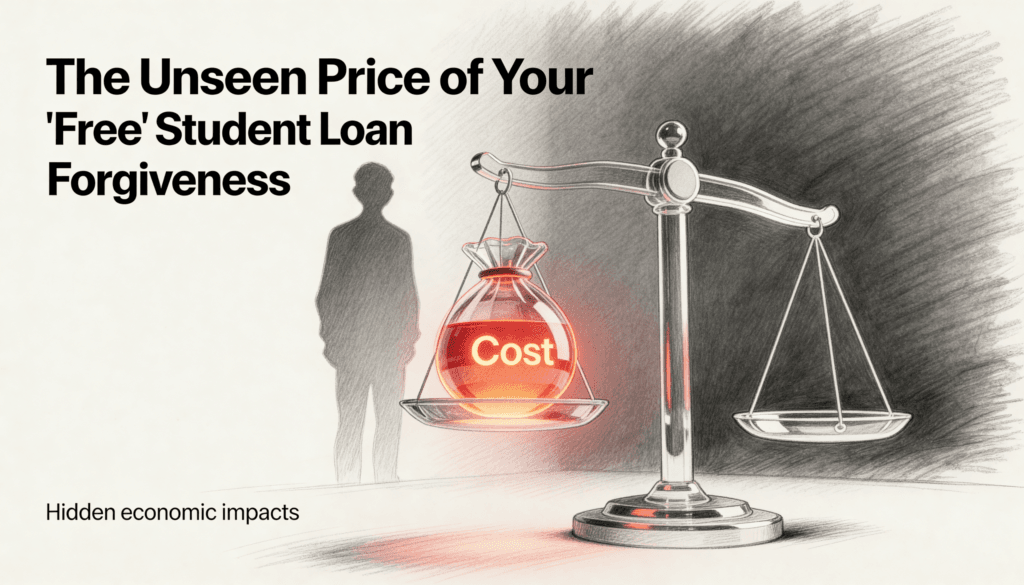
If student loan forgiveness were genuinely free, in the way that the noon sun is free, there would be no debate. We would just do it. The fact that we are arguing about it is a clue. There is a cost somewhere. The argument is really about where that cost lands, and on whom.
The seen cost is zero, because debts just disappear with a stroke of a pen.
The unseen cost is borne by the plumber who never went to college, by the graduate who paid her loans, by the future student who will pay higher tuition, by the taxpayer who has no idea their money is involved, and by the long term health of an economy that increasingly believes prices do not matter as long as somebody else is paying them.
You may decide, after weighing all of this, that forgiveness is still worth it. That is a defensible position. Bastiat himself would have respected an honest cost benefit argument.
What he would not have respected, and what nobody really should, is the version of the argument that pretends the cost is not there.
The window is broken. Somebody is paying for it.
The only question is who.