Table of Contents
Most people think of a savings account as responsible. Prudent. The grown up thing to do. You put money away for a rainy day, watch the balance grow, and feel a small glow of virtue every time you check the number.
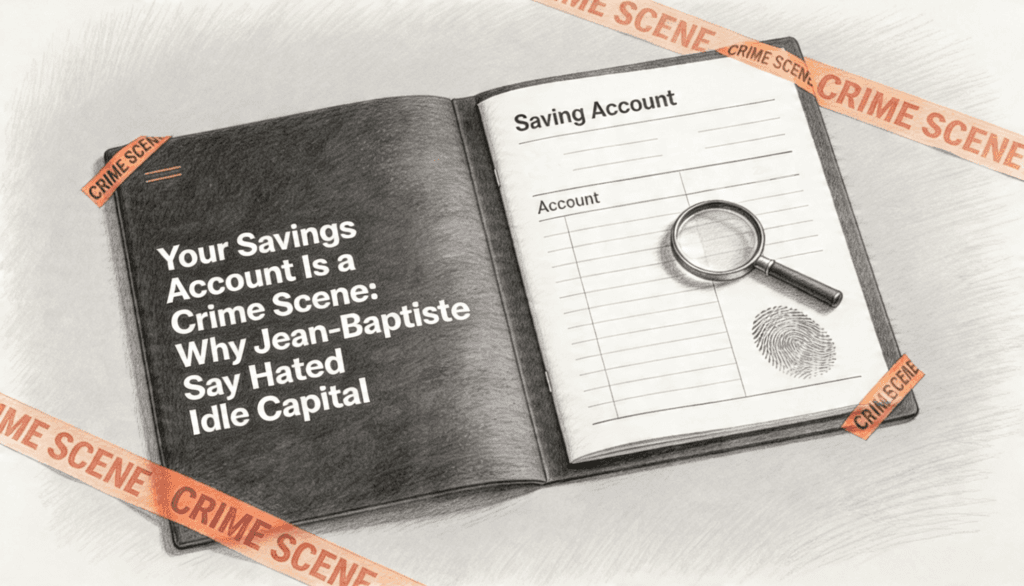
Jean-Baptiste Say would have looked at your savings account the way a detective looks at a chalk outline on the floor. Something died here. Something productive was taken out of the world.
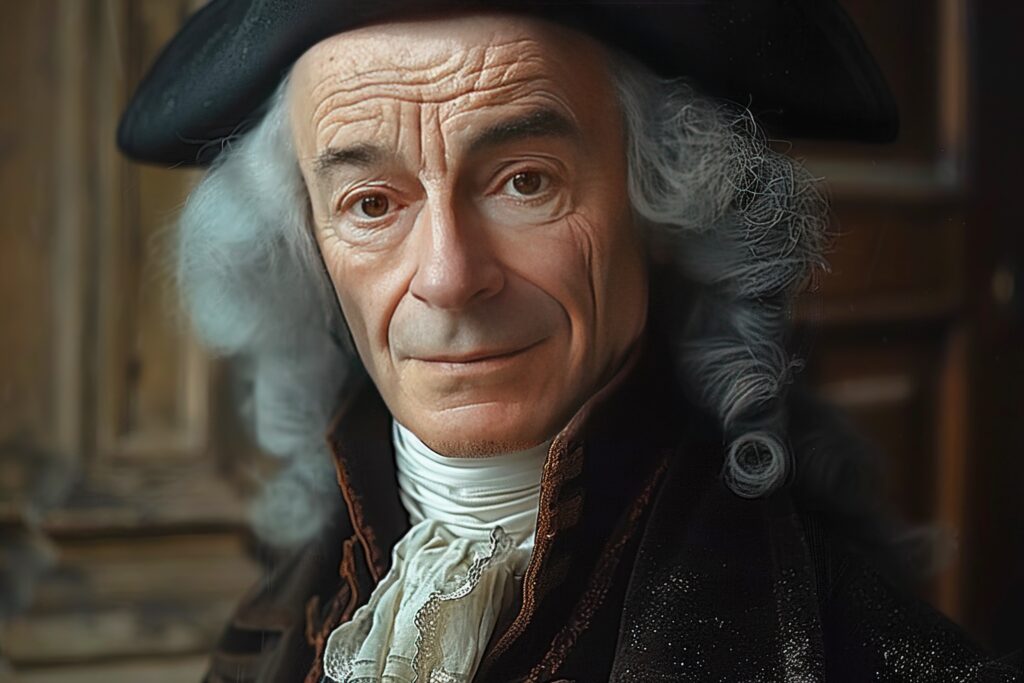
Say was a French economist born in 1767, and he spent most of his intellectual life trying to convince people of a single, uncomfortable idea: money that sits still is money that betrays its purpose. Capital is not meant to rest. It is meant to move, to transform, to become goods, services, wages, and new enterprises. When it stops moving, the economy does not just slow down. It suffocates.
This was not a minor footnote in his thinking. It was the engine of everything he believed.
The Man Who Argued With Everyone
Say is mostly remembered today for one thing: Say’s Law, often summarized as “supply creates its own demand.” That summary is a bit like saying Darwin’s big idea was “stuff changes.” Technically not wrong. Functionally useless.
What Say actually argued was more interesting and more radical. He believed that the act of producing something automatically generates the income required to purchase something else. A farmer who grows wheat has, by the act of production, created the means to buy shoes from the cobbler. The cobbler, now with income from shoe sales, can buy bread. The wheat did not just feed people. It set an entire chain of exchange into motion.
Production, in Say’s mind, was not just an economic activity. It was the heartbeat of civilization. And anything that interrupted production, anything that pulled capital out of this living chain and locked it in a vault, was doing real damage.
This put him at odds with nearly everyone. The mercantilists wanted to hoard gold. The aristocrats wanted to hoard land. The bankers wanted to hoard reserves. Say looked at all of them and saw the same disease: the confusion of wealth with money.
Wealth Is Not What You Think It Is
Here is where Say gets genuinely interesting, and where his ideas start to bite.
Most people, then and now, think wealth means having a lot of money. Say thought this was not just wrong but dangerously wrong. Money, he argued, is a medium of exchange. It is a tool, like a hammer. And a hammer sitting in a drawer is not building anything.
Wealth, for Say, was the flow of goods and services through a society. A nation was rich not because it had mountains of gold coins but because it had factories producing cloth, farmers producing grain, merchants moving products from where they were abundant to where they were scarce. Wealth was a verb, not a noun. It was the act of creating and exchanging, not the act of accumulating and sitting.
This distinction matters enormously, and it is one that most people still get wrong. When you stuff money into a savings account earning a negligible interest rate, you might feel wealthy. Say would argue you have actually made yourself and everyone around you slightly poorer. That capital could have funded a new workshop. It could have hired an apprentice. It could have purchased raw materials that someone else produced, completing a circuit of exchange that would leave everyone better off.
Instead, it sits there. Doing nothing. A tiny economic corpse.
The Paradox of Thrift Before Keynes Named It
Here is something that might surprise you. More than a century before John Maynard Keynes became famous for arguing that excessive saving could harm an economy, Say was already making a version of the same case.
The two men would have disagreed about almost everything else. Keynes wanted government to step in and spend when individuals would not. Say would have found that idea horrifying. But on this one point, there is a strange and mostly unacknowledged overlap: both men understood that money withdrawn from circulation is money that stops working.
Say just arrived at the conclusion from the opposite direction. He did not want government to replace private spending. He wanted private individuals to stop hoarding and start investing. He wanted capital to stay in the game, to keep circulating through productive enterprise, creating employment and goods along the way.
The irony is rich. Say is usually claimed by free market thinkers who celebrate saving and thrift as cardinal virtues. But Say himself would have told you that saving without investing is not a virtue at all. It is a kind of economic negligence.
Why Your Bank Loves Your Laziness
Now, a sophisticated reader might object here. “But my savings account is not idle,” you might say. “The bank lends it out. My money is being used.”
Fair point. And Say would have acknowledged it, up to a point. Banks do lend out deposits, and that lending can fund productive activity. But here is the catch: you are earning almost nothing on that deposit, which means the bank is capturing nearly all the productive value of your capital. You have outsourced the most important economic decision, where to allocate resources, to an institution whose primary interest is its own profit margin.
In Say’s framework, the passive saver is not just economically lazy. They are complicit in whatever misallocation their bank decides to engage in. That is a harsh judgment, but Say was not a man given to gentle assessments.
The Entrepreneur as Hero
If idle capital was the villain in Say’s story, the entrepreneur was the hero.
Say was, in fact, one of the first economists to take entrepreneurs seriously as a distinct and vital economic force. Before him, most economic thinkers lumped everyone into categories like “labor” and “capital owners.” Say saw something different. He saw a special class of people who did something that neither workers nor passive investors could do: they combined resources in new ways to create value that did not previously exist.
The entrepreneur, in Say’s view, was the person who looked at idle capital, idle labor, and idle raw materials and saw not a collection of dormant assets but a potential product. The entrepreneur was the one who brought these elements together, took on the risk, and set the chain of production and exchange into motion.
This is why Say hated idle capital so intensely. Every franc sitting in a vault was a franc that some entrepreneur could not access. Every unit of dormant savings represented a factory not built, a worker not hired, a product not created. The savings account was not just a passive failure. It was an active obstruction.
Think of it in biological terms. Say saw the economy as a living organism, and capital was the blood. An organism with blood pooling in its extremities rather than circulating through its organs is not healthy. It is in crisis. The savings account, in this metaphor, is a blood clot.
The Crime Scene, Revisited
So let us return to the crime scene metaphor and take it seriously for a moment.
What exactly dies when capital goes idle? Say would have given you a list.
First, potential employment dies. Money that could have paid wages sits in a vault instead. The worker who might have been hired remains unemployed or underemployed.
Second, potential goods die. Products that could have been manufactured, shipped, and consumed never come into existence. The consumer who might have benefited from a cheaper or better product never gets the chance.
Third, potential innovation dies. The entrepreneur who might have combined resources in a novel way cannot access the capital needed to experiment. The new method, the new product, the new industry that might have emerged, stays trapped in the realm of the hypothetical.
Fourth, and this is the one Say cared about most, future production dies. Because production creates the income to purchase other production (this is the real content of Say’s Law), every unit of production that does not happen creates a ripple effect. The farmer who does not grow wheat cannot buy shoes. The cobbler who does not sell shoes cannot buy bread. The chain breaks, and everyone in the chain is worse off.
One idle franc does not just represent one franc of lost value. It represents an entire cascade of exchanges that never occurred.
Where Say Gets Uncomfortable
It would be dishonest to present Say’s ideas without noting where they get difficult.
Say’s framework assumes that all capital, if deployed, will find productive use. This is not always true. Capital can be invested badly. It can fund ventures that fail, products nobody wants, or speculative bubbles that enrich a few and devastate many. The 2008 financial crisis was not caused by too much idle capital. It was caused by too much active capital flowing into spectacularly unproductive places.
Say also underestimated the legitimate reasons people save. Not everyone who keeps money in a savings account is being lazy or negligent. Some people are saving because they face genuine uncertainty. They might lose their job. They might get sick. They might need to care for a family member. In a world without robust safety nets, saving is not just rational. It is survival.
There is a tension here that Say never fully resolved. He wanted capital to stay in motion, but he lived in a world where the consequences of failed investment could be devastating for the individual investor. Telling a working family to invest rather than save is easy advice to give when you are not the one who will go hungry if the investment fails.
What Say Would Think of Modern Finance
If Say could see the modern financial landscape, his reaction would probably be complicated.
On one hand, he would be delighted by the sheer range of options available to ordinary people. Index funds, bonds, small business lending platforms, crowdfunding. The barriers between savers and productive investment have never been lower. The passive saver of the 21st century has far less excuse for idleness than the passive saver of the 19th.
On the other hand, he would be appalled by the scale of speculation. Trillions of dollars flowing into financial instruments that produce nothing, that exist only to be traded back and forth in increasingly elaborate games of timing and leverage. Say distinguished clearly between investment in production and speculation on price movements. He would have looked at modern derivatives markets the way a physician looks at a fever: a sign that something in the body has gone seriously wrong.
He would also, one suspects, have had sharp words for the modern cult of liquidity. The idea that the highest virtue of an asset is how quickly you can sell it would have baffled him. Liquidity is the preference for not being committed. Say wanted commitment. He wanted capital locked into factories, workshops, and enterprises. He wanted it transformed into wages, goods, and productive capacity. The obsession with liquidity is, in Say’s terms, just a polite way of saying you want your capital to remain idle while pretending it is not.
The Uncomfortable Takeaway
Say’s argument is not comfortable for anyone. It is not comfortable for the cautious saver who keeps six months of expenses in a checking account. It is not comfortable for the speculator who trades assets without creating anything. And it is not comfortable for the economist who likes neat models where saving automatically equals investment.
But discomfort is often a sign that an idea has teeth.
The core of Say’s insight remains as sharp as ever: an economy runs on production and exchange, not on accumulation. Money is a tool, and tools are meant to be used. Capital that sits still is capital that has been removed from the living economy, and the economy is poorer for its absence.
Your savings account is safe. It is responsible. It is prudent. And according to one of the most influential economists in history, it is also the scene of a quiet, ongoing crime. The victim is every product that was never made, every job that was never created, every exchange that never took place.
The chalk outline is invisible. But Say would tell you it is there.