Table of Contents
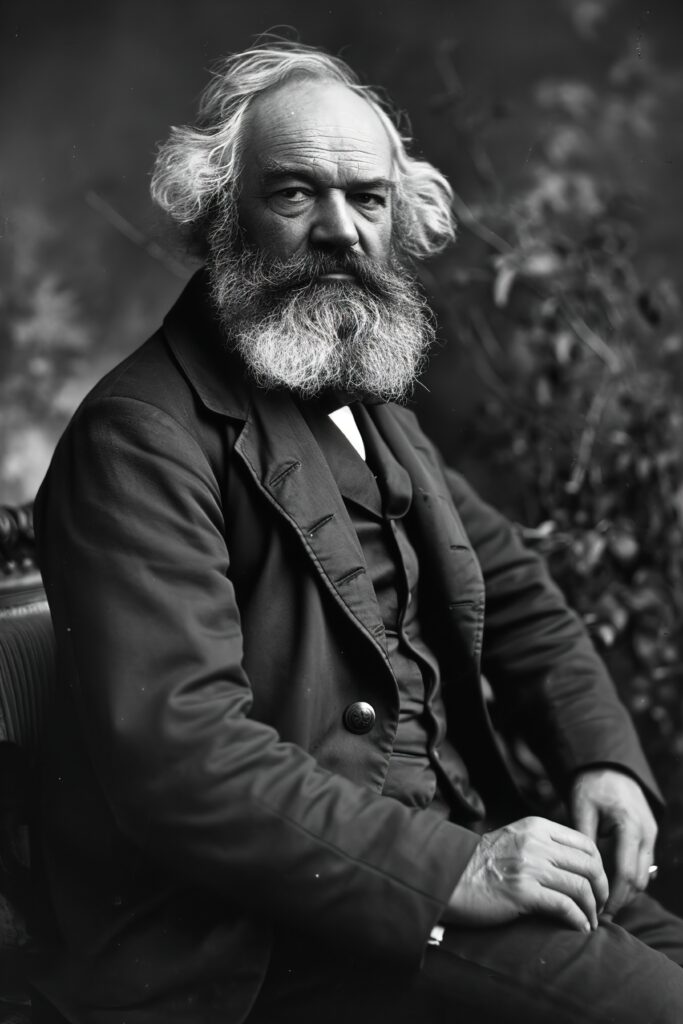
Karl Marx never saw a smartphone. He never scrolled through an endless feed of dance challenges, life hacks, and oddly satisfying videos. He died in 1883, long before electricity reached most homes. And yet, if you dropped him into 2026 with a charged iPhone and a TikTok account, he would probably nod slowly and say something like: “Yes. This is exactly what I was talking about.”
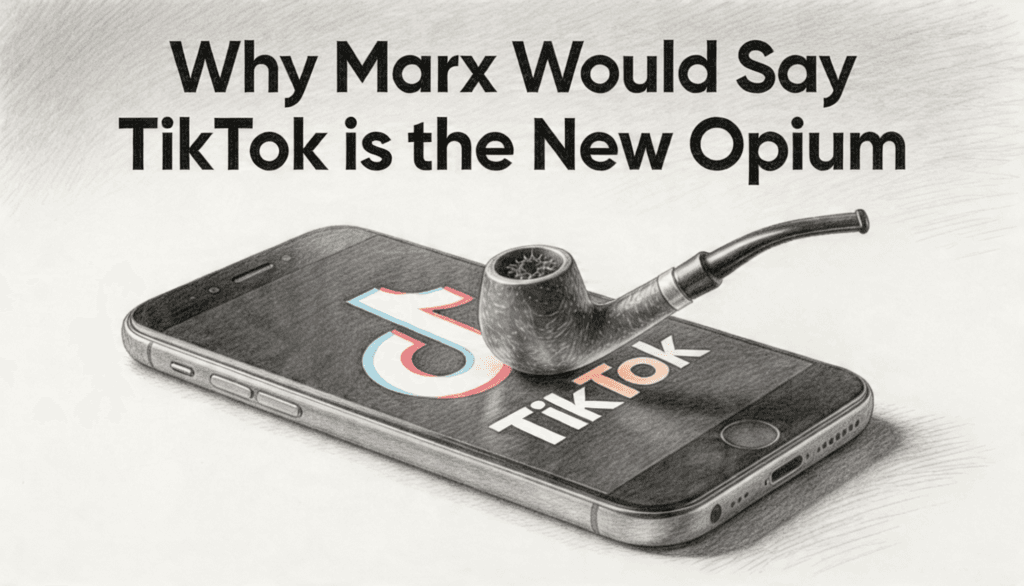
Marx famously called religion the opium of the people. Not because he hated religious people. Not because he thought faith was stupid. He meant something more precise and, honestly, more unsettling. He meant that when life is painful, when the economic system crushes you, when your labor is exploited and your future feels like a locked door, people reach for something that soothes. Something that makes the suffering bearable without actually changing anything. Religion, in his view, was the painkiller that kept the working class from demanding surgery.
Now replace the church with a screen. Replace the sermon with a 47 second video of someone ranking fast food sauces. The mechanism is identical. The delivery system just got a massive upgrade.
The Factory Floor Has Moved Into Your Palm
Marx spent years studying how capitalism extracts value from workers. His core insight was straightforward. Workers produce more value than they are paid for. The difference, which he called surplus value, goes to the owner. The worker gets wages. The owner gets profit. Simple math, ugly consequences.
TikTok runs on a version of this equation that Marx would find almost poetic in its brutality. Every video you watch, every like you tap, every comment you leave, every extra second you linger on a clip of a golden retriever wearing sunglasses generates data. That data is packaged, analyzed, and sold to advertisers. You are producing value. You are not being paid for it. You are not even aware you are doing it.
In Marx’s era, the worker at least knew they were working. They could see the factory. They could feel the exhaustion. They could count the hours. TikTok has accomplished something the nineteenth century factory owner could only dream of: it has made labor feel like leisure. You think you are relaxing. You think you are being entertained. In reality, you are working a shift at the most profitable factory ever built, and your compensation is dopamine.
This is not a metaphor. Advertising revenue from user engagement is real money. ByteDance, the company that owns TikTok, was valued at roughly 550 billion dollars. That wealth was not created by the company alone. It was created by billions of thumbs scrolling in the dark. Marx would call this alienation on an unprecedented scale. The worker does not recognize their labor as labor, which means they cannot even begin to resist it.
The Algorithm as Ideology
Marx believed that the ruling class does not just control the economy. It controls ideas. The people who own the means of production also own the means of mental production. In his time, this meant newspapers, universities, churches. The ideas that circulated in society were shaped by those who benefited from the existing order. Not through conspiracy, necessarily. Just through the quiet, structural reality that whoever pays the bills gets to set the agenda.
TikTok’s algorithm is ideology made invisible. It does not tell you what to think. It does something far more effective. It decides what you see. And what you see shapes what you think about, what you care about, what you believe is normal, what you believe is possible.
The algorithm learns you faster than you learn yourself. It knows you get angry about housing prices. It knows you find comfort in cooking videos. It knows you are more likely to engage at 11 PM when your defenses are down. It does not have opinions. It has objectives. And its primary objective is to keep you on the platform, producing data, generating value, consuming ads. The content it serves you is not chosen because it is true, or good, or important. It is chosen because it works.
Marx would recognize this instantly. He would see it as the most sophisticated ideological apparatus ever created. Not because it promotes one political view over another, but because it promotes passivity itself. It keeps you watching instead of doing. It gives you the feeling of being informed, connected, and culturally relevant while you sit alone on your couch accomplishing nothing. The illusion of participation replaces actual participation.
The Opium Is Personalized Now
Here is what makes TikTok genuinely different from every previous opium, and arguably more dangerous. It is personalized.
When Marx talked about religion as opium, he was describing a one size fits all sedative. Everyone in the congregation heard the same sermon. Everyone sang the same hymns. The comfort was collective and generic.
TikTok gives you your own private blend. Your feed is not the same as anyone else’s feed. The algorithm has built a unique psychological profile of you, and it serves content calibrated precisely to your vulnerabilities, your interests, your emotional needs. It is not mass opium. It is a custom prescription.
This makes it extraordinarily difficult to critique. When someone tells you TikTok is wasting your time, your immediate response is: “But my feed is different. I learn things. I watch educational content. I follow historians and scientists.” And you might be right. But the mechanism is the same. Whether you are watching PhD physicists explain black holes or watching someone organize their pantry, the platform is still extracting your attention, converting it to data, and selling it. The content varies. The exploitation does not.
Marx would appreciate the irony. The working class has been given a tool that feels like liberation and education but functions as a more efficient form of control. You are not even sedated against your will. You are enthusiastically sedating yourself and defending the syringe.
Bread and Circuses, But the Circus Never Closes
There is a connection here that stretches back much further than Marx. The Roman poet Juvenal coined the phrase “bread and circuses” to describe how the Roman state kept the populace docile. Give people food and entertainment, and they will not revolt. They will not even complain.
TikTok is the circus that never closes. It is available at every moment. It requires no effort to access. It costs nothing in money, only in time, which most people do not account for. And unlike the Roman circus, which was a shared public experience, TikTok is consumed in isolation. You scroll alone. You laugh alone. You get outraged alone. Even when you share a video with a friend, you are each watching it separately, on your own screens, in your own algorithmically curated realities.
Marx believed that collective experience was essential for political consciousness. Workers had to see each other, talk to each other, recognize their shared condition before they could organize. TikTok fragments experience so thoroughly that this recognition becomes nearly impossible. Everyone is having a different experience of the same platform. Everyone thinks their relationship with it is unique. Nobody sees the pattern.
The Uncomfortable Truth About Complicity
Here is the part that nobody enjoys hearing. We are not just victims of this system. We are participants.
Marx understood that ideology is not simply imposed from above. It is reproduced from below. Workers internalize the values of the system that exploits them. They believe in meritocracy while being crushed by it. They defend the rights of billionaires while struggling to pay rent.
TikTok users do something similar. They defend the platform with the passion of stockholders. They identify with it. They build their identities around it. When someone criticizes TikTok, the response is personal, because the algorithm has made it personal. Your feed feels like you. An attack on the platform feels like an attack on your taste, your interests, your self.
This is alienation at its most complete. You do not just fail to recognize your exploitation. You love the thing that exploits you. You would fight to keep it. Marx wrote about workers who sided with factory owners against their own interests. He would recognize the TikTok user who spends four hours a day on the app and then argues passionately that it is not a problem.
So What Would Marx Actually Do?
Marx was not in the business of offering easy solutions. He was in the business of revealing structures. He wanted people to see the machinery behind the curtain, not so they could tweak the settings, but so they could ask whether the machine should exist at all.
He would not tell you to delete TikTok. That kind of individualist self help advice would strike him as missing the point entirely. The problem is not your willpower. The problem is a system designed to capture human attention at industrial scale and convert it into private profit. You cannot fix a structural problem with a personal decision.
What he would demand is something harder. He would want you to look at TikTok and see it clearly. Not as entertainment. Not as education. Not as connection. But as a system of extraction that has figured out how to make the extracted feel grateful.
He would want you to notice that every hour you spend scrolling is an hour you are not organizing, not reading, not building, not resting in any way that actually restores you. He would want you to ask who benefits from your passivity. And he would want you to sit with the discomfort of knowing the answer.
Religion promised paradise after death. TikTok promises it right now, fifteen seconds at a time. Marx would say both are offering the same deal. Feel better now. Change nothing. The opium has evolved. The function has not.
The phone in your pocket is the most sophisticated pacification device ever invented. And unlike every previous version, this one does not even need to be imposed. You carry it willingly. You charge it every night. You reach for it first thing in the morning.
Marx would not be surprised. He would just be sad.