Table of Contents
There is a quiet war in economics that most people never hear about. It is not fought with data or equations, though both sides pretend it is. It is fought over a single question: who do you trust more, governments or people?
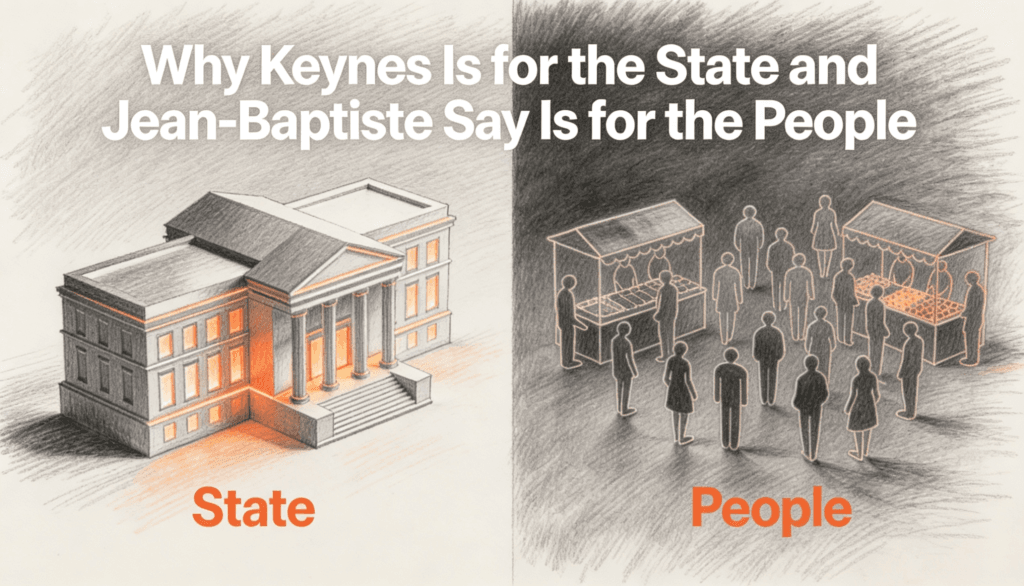
On one side stands John Maynard Keynes, the elegant British aristocrat who believed that economies break down and that only the state can fix them. On the other side stands Jean-Baptiste Say, a French businessman and thinker who believed that people, left to produce and trade freely, generate their own prosperity. One wanted to manage the machine. The other trusted the machine to run itself.
This is not just an academic debate. It shapes your taxes, your job, your savings, and how much of your paycheck the government decides it knows how to spend better than you do.
The Man Who Trusted Production
Jean-Baptiste Say was born in 1767 in Lyon, France. He lived through revolution, terror, Napoleon, and the messy birth of industrial capitalism. He was not an armchair philosopher. He ran a cotton mill. He met payroll. He understood what it meant to create something from nothing and sell it to someone who wanted it.
His most famous idea is often reduced to a bumper sticker: “supply creates its own demand.” This phrase, which economists call Say’s Law, has been mangled and misquoted for two centuries. What Say actually meant was more subtle and more powerful than the shorthand suggests.
Say argued that when someone produces a good or service, that act of production generates the income needed to buy other goods and services. A farmer who grows wheat has created something of value. He can now exchange that value for shoes, tools, or a doctor’s visit. Production is not just about making things. It is about creating the means to participate in the economy. Every producer is simultaneously a consumer. The economy is not a machine that needs to be started from the outside. It is a living network of people solving each other’s problems.
This sounds almost too simple. And that is precisely what makes it dangerous to those who prefer complexity.
The Man Who Trusted Management
John Maynard Keynes arrived on the scene more than a century later, in a very different world. Born in 1883 to an academic family in Cambridge, Keynes never ran a factory. He ran committees. He advised treasuries. He attended peace conferences. His world was one of policy levers and government budgets, not production lines and customer orders.
Keynes looked at the Great Depression and saw something that terrified him: an economy stuck. People wanted to work but could not find jobs. Factories could produce but had no buyers. The gears of commerce had frozen. Say’s Law, in Keynes’s view, was a fairy tale. Supply does not automatically create demand. Sometimes people hoard money. Sometimes fear paralyzes markets. Sometimes the whole system just stops.
His solution was breathtaking in its implications. If private citizens will not spend, the government must. Borrow money, print money, build roads, dig holes and fill them back in if you have to. The point is to get cash moving through the economy again. Demand is the engine. Without it, supply is just inventory gathering dust.
This was music to the ears of every politician who ever lived. Keynes essentially told governments that spending money was not just acceptable but heroic. That deficit spending was medicine, not poison. That the state was not a burden on the economy but its savior.
You can imagine how popular that message was in the halls of power.
Two Visions of Human Nature
Strip away the equations and what you find underneath are two fundamentally different views of people.
Say believed that human beings are naturally productive. Given freedom, they will create, trade, innovate, and solve problems. The economy is not a fragile thing that collapses without expert supervision. It is the sum of millions of individual decisions, each one driven by personal knowledge that no central planner could possibly possess. A baker knows his neighborhood. A carpenter knows her clients. A farmer knows his soil. This distributed intelligence is the real engine of prosperity.
Keynes believed that human beings are fundamentally irrational. They panic. They hoard. They follow the herd off cliffs. Left to their own devices, people will destroy themselves and everyone around them. The economy is a wild animal that must be tamed by the cool, rational hand of trained experts. People cannot be trusted with their own money, their own decisions, or their own future.
There is something deeply telling about which vision appeals to which audience. Say’s vision appeals to entrepreneurs, small business owners, and anyone who has ever built something with their own hands. Keynes’s vision appeals to academics, bureaucrats, and politicians. This is not a coincidence. People tend to believe in systems that place them at the center.
The Convenience of Keynesianism
Here is the part that rarely gets discussed in economics textbooks. Keynesian economics is extraordinarily convenient for the state. It provides an intellectual framework that justifies almost unlimited government spending. Every recession becomes a reason to expand the budget. Every crisis becomes an argument for more control. And the beautiful part, from the government’s perspective, is that the spending never has to stop.
Keynes himself said that in good times, governments should pay down the debts they accumulated during bad times. This is the part that every government in history has conveniently forgotten. The spending goes up during recessions. Then it stays up during recoveries. Then it goes up more during the next recession. The ratchet only turns one way.
This is not a flaw in Keynesian theory. It is a feature of Keynesian politics. The theory provides cover. The politics provides incentive. And the taxpayer provides the money.
Say, by contrast, offers nothing useful to the ambitious politician. His framework says that the best thing the government can do is get out of the way. Lower taxes. Reduce regulation. Let people produce. This is a deeply unsatisfying message for anyone who wants to be seen doing something. There are no ribbon cuttings in deregulation. There are no photo opportunities in leaving people alone.
The Knowledge Problem
There is a connection here to one of the most powerful ideas in all of social science, one that did not come from either Say or Keynes but from the Austrian economist Friedrich Hayek. Hayek argued that the knowledge needed to run an economy is not concentrated in any single mind or institution. It is scattered across millions of individuals, each of whom knows things that nobody else knows. The price system, when left alone, aggregates this knowledge automatically. No committee meeting required.
This insight devastates the Keynesian project. If no group of experts can possibly know enough to manage an economy, then the entire premise of government intervention collapses. You cannot steer what you cannot see. And the economy, in all its beautiful complexity, is fundamentally invisible to the planner’s eye.
Say understood this intuitively, even if he did not articulate it in Hayek’s terms. His emphasis on production and exchange was an emphasis on the wisdom of ordinary people making ordinary decisions. The farmer does not need a government economist to tell him what to plant. The merchant does not need a central bank to tell her what to sell. These people are not stupid. They are simply closer to the problem than any bureaucrat will ever be.
The Paradox of Thrift and Other Elegant Traps
Keynes was brilliant, and brilliant people build beautiful traps. One of his most famous ideas is the paradox of thrift. If everyone tries to save money at the same time, total spending falls, businesses fail, people lose jobs, and everyone ends up poorer. Individual virtue becomes collective disaster.
It is a clever argument. It is also a perfect example of how Keynesian thinking subtly reframes saving as a problem and spending as a solution. Notice who benefits from this framing. If saving is dangerous, then consumption must be encouraged. And who is the great encourager of consumption? The government, with its stimulus checks, its low interest rates, and its gentle suggestion that you should really be spending more.
Say would have found this absurd. Saving, in his framework, is not money disappearing under a mattress. Saving is investment. Money in a bank gets lent to a business. Money in a stock funds a company. Saving is just production delayed. It is the seedcorn of future prosperity, not a threat to present stability.
The paradox of thrift only works if you assume that saving means hoarding, that banks do not lend, and that capital markets do not function. In other words, it only works if you assume the economy is already broken. Which, conveniently, is exactly the assumption Keynes needs to justify his solution.
Why This Matters Now
We are living in the golden age of Keynesianism, whether we realize it or not. Government debt in most developed nations has reached levels that would have been unthinkable a generation ago. Central banks manipulate interest rates, buy bonds, and effectively control the price of money itself.
And yet. Productivity growth has slowed. Real wages have stagnated in many countries. Housing has become unaffordable for young people. The cost of healthcare and education rises faster than inflation. The promises of Keynesian management are everywhere.
Say would not have been surprised by any of this. When you redirect resources from productive people to government programs, you do not create wealth. You redistribute it. And you do so less efficiently than the market would, because the government does not have the knowledge, the incentive, or the feedback mechanisms that private actors do. A business that wastes money goes bankrupt. A government program that wastes money gets a bigger budget.
The People vs. The Planners
There is something almost religious about the divide between Say and Keynes. It comes down to faith. Do you have faith in people or in institutions? Do you believe that prosperity comes from the bottom up or from the top down? Do you think the economy is a garden that grows on its own or a machine that needs an operator?
Say’s economics is the economics of humility. It says that no one is smart enough to run an economy, and that the attempt to do so will cause more harm than good. It places its trust in the collective intelligence of free people making free choices. It is not flashy. It does not promise quick fixes. It does not make politicians feel important.
Keynes’s economics is the economics of confidence. It says that smart people with the right tools can manage the business cycle, smooth out recessions, and deliver prosperity through planning. It is intellectually seductive. It offers solutions. It makes experts feel essential. And it gives the state a blank check signed by future taxpayers.
The irony is that Keynes himself was a speculator, an investor, a man who understood markets and profited from them. He was, in his private life, exactly the kind of self-interested actor that his theory said could not be trusted. Say, the factory owner who argued for free markets, actually lived the philosophy he preached. Keynes preached government control and practiced personal freedom. There is a lesson in that contradiction, if you care to look for it.
Choosing Sides
You do not have to be an economist to have a stake in this debate. Every time a government raises taxes to fund a new program, it is choosing Keynes over Say. Every time a regulation makes it harder to start a business, it is choosing the planner over the producer. Every time a central bank manipulates interest rates, it is telling you that experts know better than markets.
And every time someone starts a business, hires an employee, or invents a better product, they are proving Say right. Production creates opportunity. Exchange creates wealth. Freedom creates prosperity. Not perfectly, not without friction, but organically, from the ground up, driven by the knowledge and ambition of ordinary people.
Say’s economics is not fashionable. It does not win elections. It does not fill lecture halls. But it does describe something true about how the world actually works when you let it. The economy is not a patient in need of a doctor. It is a forest in need of sunlight. The best thing the state can do, more often than not, is stop standing in the way.
Keynes gave governments a reason to grow. Say gave people a reason to believe in themselves. The question is not which economist was smarter. The question is which world you want to live in.