Table of Contents
We like to believe that science marches forward. That every discovery builds on the last. That the arrow of knowledge points in one direction, and that direction is up. Thomas Kuhn thought this was a beautiful story. He also thought it was mostly wrong.
In 1962, Kuhn published The Structure of Scientific Revolutions, a book that did to the philosophy of science what a brick does to a stained glass window. Before Kuhn, the popular understanding of science was comforting. Scientists observed the world, formed hypotheses, tested them, and humanity inched closer to truth. Progress was cumulative. It was rational. It was inevitable.
Kuhn said no. What actually happens, he argued, is far messier. Scientists work within a paradigm, a shared framework of assumptions, methods, and accepted truths. They solve puzzles inside that framework, and they get very good at it. Then anomalies pile up. The framework creaks. Eventually, someone proposes a radically different way of seeing things, and the old paradigm collapses. A revolution occurs. A new paradigm takes over.
Here is where it gets uncomfortable. Kuhn did not claim the new paradigm is necessarily closer to the truth. He claimed it is different. It solves different problems. It asks different questions. It sees the world through a different lens entirely. And if that is the case, then science does not progress toward truth the way a climber ascends a mountain. It shifts laterally, like a man wandering through rooms in a house with no second floor.
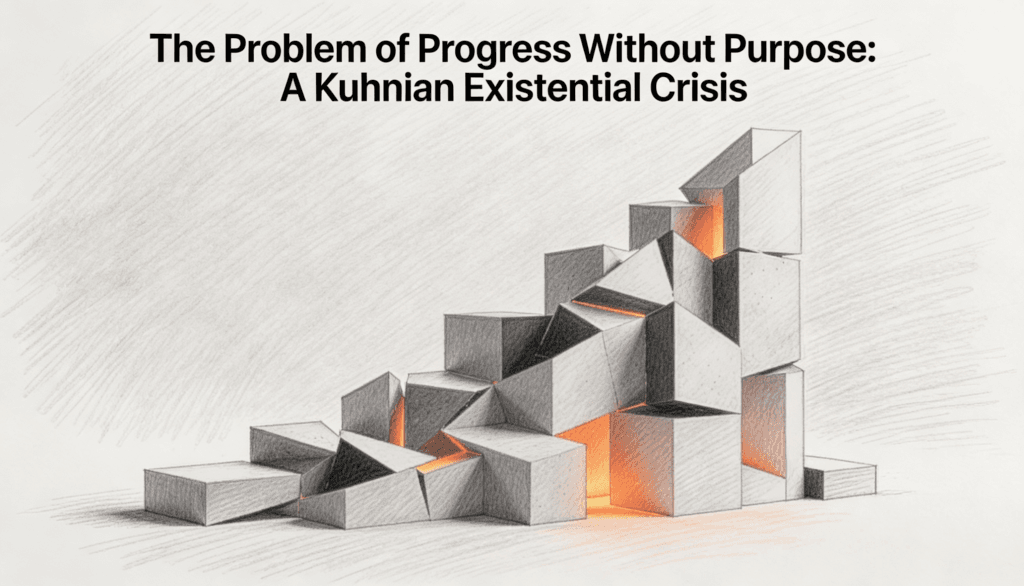
This is the existential crisis buried in Kuhn’s work. Not a crisis about science itself, but about what we mean when we say the word progress.
The Comfort of the Ladder
To understand why Kuhn’s argument matters beyond dusty philosophy seminars, consider how deeply the idea of linear progress is wired into modern life. We do not just believe in scientific progress. We believe in progress as a civilizational principle. Better technology. Better medicine. Better governance. Better people. The whole project of modernity rests on the assumption that tomorrow will improve on today, and that this improvement is meaningful.
This is what philosophers call a teleological view. History has a direction. Effort has a destination. The metaphor is a ladder. Each rung lifts you higher. Each step is justified by the one above it.
Kuhn pulled the ladder away.
If paradigm shifts are not steps upward but sideways movements into entirely new conceptual landscapes, then the notion of cumulative progress becomes suspect. Newtonian physics did not become wrong when Einstein arrived. It became a special case within a larger framework. But that framing itself is generous. In practice, Einsteinian physics did not simply absorb Newton. It replaced the underlying picture of reality. Space was no longer a stage. Time was no longer constant. Gravity was no longer a force. These are not minor amendments. They are a different universe.
And yet, both paradigms work. Newtonian mechanics still sends rockets into orbit. Einsteinian relativity still corrects GPS satellites. The question Kuhn forces us to confront is this: if two incompatible pictures of reality both produce useful results, what exactly are we progressing toward?
Incommensurability, or the Art of Talking Past Each Other
Kuhn introduced a term that sounds academic but describes something deeply human: incommensurability. Two paradigms are incommensurable when they cannot be directly compared because they do not share the same standards of evaluation. They do not even mean the same things by the same words.
When a Newtonian physicist says “mass,” he means something absolute. When an Einsteinian physicist says “mass,” he means something that changes with velocity. They are using the same syllable to describe different realities. This is not a translation problem. It is a communication impossibility.
Now zoom out from physics. This pattern is everywhere.
Think about economics. A classical economist and a behavioral economist can look at the same market and see entirely different phenomena. One sees rational agents maximizing utility. The other sees cognitive biases producing systematic irrationality. They are not disagreeing about the answer. They are disagreeing about the question. They are operating in different paradigms, and no amount of data will resolve the dispute, because they cannot agree on what the data means.
Or think about something closer to daily life. The way we talk about mental health has undergone a paradigm shift in the last thirty years. What was once laziness is now depression. What was once shyness is now social anxiety. What was once a difficult child is now ADHD. These are not just new labels for old things. They are new ways of seeing, and they reshape what counts as a problem, what counts as a solution, and what counts as a person functioning well.
Kuhn would recognize this pattern immediately. The old paradigm has not been refuted. It has been abandoned. And the people still living inside it find the new one incomprehensible, just as the new inhabitants find the old one barbaric.
The Puzzle Solver’s Trap
One of Kuhn’s most underappreciated insights is his description of what scientists actually do most of the time. They do not make discoveries. They solve puzzles. The paradigm defines the puzzle, provides the tools, and even hints at the shape of the solution. The scientist’s job is to make the pieces fit. This is what Kuhn called “normal science,” and he did not mean it as a compliment.
Normal science is productive. It fills in details, extends applications, refines measurements. But it is also conservative by design. It does not question the framework. It cannot question the framework, because the framework is what makes the puzzles solvable in the first place. A scientist who questions the paradigm is not doing science. He is doing philosophy. And his colleagues will treat him accordingly.
This creates a paradox that extends well beyond laboratories. Most human institutions operate in normal science mode. Companies optimize within a business model. Governments refine policy within an ideological framework. Schools teach within a curriculum. Individuals build careers within a professional identity. The puzzles are defined. The tools are provided. The rewards go to those who solve the puzzles fastest.
But what if the puzzles are wrong?
This is the trap. The better you get at solving puzzles within a paradigm, the harder it becomes to see that the paradigm itself might be the problem. Resistance to paradigm change does not come from stupidity. It comes from competence. The people most invested in the current framework are the ones who have mastered it. They have the most to lose.
There is something almost tragic about this. The very skills that make someone excellent within a system are the skills that blind them to the system’s limitations. Kuhn noticed that paradigm shifts are often driven not by the established experts but by newcomers, outsiders, people too young or too peripheral to have fully internalized the reigning assumptions. They see what the experts cannot, precisely because they have not yet learned what they are supposed to ignore.
Progress Toward What?
Here is where the existential weight of Kuhn’s argument becomes unavoidable. If scientific revolutions are not steps toward truth but shifts between incompatible worldviews, then the concept of progress needs redefinition. And this is not just a problem for philosophers.
Consider technology. We have more processing power than ever. We can sequence genomes, edit DNA, generate photorealistic images with neural networks, and put a supercomputer in every pocket. By any conventional measure, this is progress. But progress toward what?
The question is not rhetorical. It is genuinely open. More technology does not automatically mean better lives. The smartphone is a miracle of engineering that has also produced an epidemic of anxiety and attention fragmentation. Social media connects billions of people and simultaneously makes many of them miserable. Artificial intelligence promises to revolutionize everything and threatens to destabilize the labor markets that give people economic purpose.
These are not failures of technology. They are failures of teleology. We have astonishing means and no agreed upon ends. We are solving puzzles with extraordinary sophistication inside a paradigm that has never clearly stated what the puzzle is for.
Kuhn would not be surprised. This is exactly what happens when a paradigm matures. The tools get sharper. The techniques get more refined. The results get more precise. And the fundamental questions get buried deeper and deeper beneath the accumulation of technical success. Nobody asks whether the project makes sense, because everyone is too busy making it work.
The Revolution That Does Not Come
If Kuhn’s model is correct, the natural resolution would be a paradigm shift. Anomalies would accumulate. The old framework would crack. A new vision would emerge. But there is a possibility Kuhn did not fully explore: what happens when a paradigm is in crisis but no viable alternative appears?
This might be the situation we find ourselves in now, not just in science, but in culture at large. The paradigm of perpetual progress is showing cracks everywhere. Climate change suggests that industrial growth has limits. Political polarization suggests that liberal democracy has unresolved contradictions. The mental health crisis suggests that material prosperity does not reliably produce human flourishing. The anomalies are piling up.
And yet, no coherent alternative has emerged. We are stuck in what you might call a pre revolutionary period, aware that the old answers are inadequate but unable to articulate new ones. This is the most disorienting phase of a Kuhnian crisis. The old map is wrong, but there is no new map. You are just standing in unfamiliar territory, squinting.
Living Without the Ladder
So what do you do when progress loses its destination? One answer, the one Kuhn himself seemed to lean toward, is to accept that science, and perhaps all human intellectual endeavor, does not converge on a final truth. It evolves. It adapts. It changes shape. But it does not climb.
This is not nihilism. It is a different kind of honesty. The value of a paradigm is not that it is true in some ultimate sense. It is that it is useful. It solves problems that matter to the people living inside it. When it stops solving those problems, it will be replaced by something that does. And that replacement will not be a step up. It will be a step into a different room, with different furniture, different windows, and a different view.
There is something liberating about this, if you can stomach it. It means the pressure to find the final answer dissolves. There is no final answer. There are only better and worse ways of engaging with the questions that your particular moment in history has handed you.
But there is also something demanding about it. Without the comfort of inevitable progress, you have to make choices. You have to decide which problems matter. You have to justify your paradigm not by claiming it is true, but by arguing that it is worth living inside. That is a harder conversation than most scientists, and most societies, are accustomed to having.
Kuhn died in 1996, before the internet reshaped public discourse, before social media fractured consensus reality, before artificial intelligence raised questions about the nature of thought itself. But his framework remains disturbingly relevant. We are living through a period where multiple paradigms compete for dominance across nearly every domain of human life, from politics to economics to identity to the meaning of knowledge itself. None of them is winning cleanly. None of them is resolving the anomalies.
The temptation is to pick a side and defend it. The Kuhnian lesson is that this is what people always do, and it is never quite enough. The paradigm that wins will not win because it is right. It will win because it solves enough of the problems that enough people care about, for long enough, until the next crisis arrives.
That is not a comforting story. But it might be an honest one. And in a period when comfortable stories are doing more harm than good, honesty might be exactly the paradigm shift we need.