Table of Contents
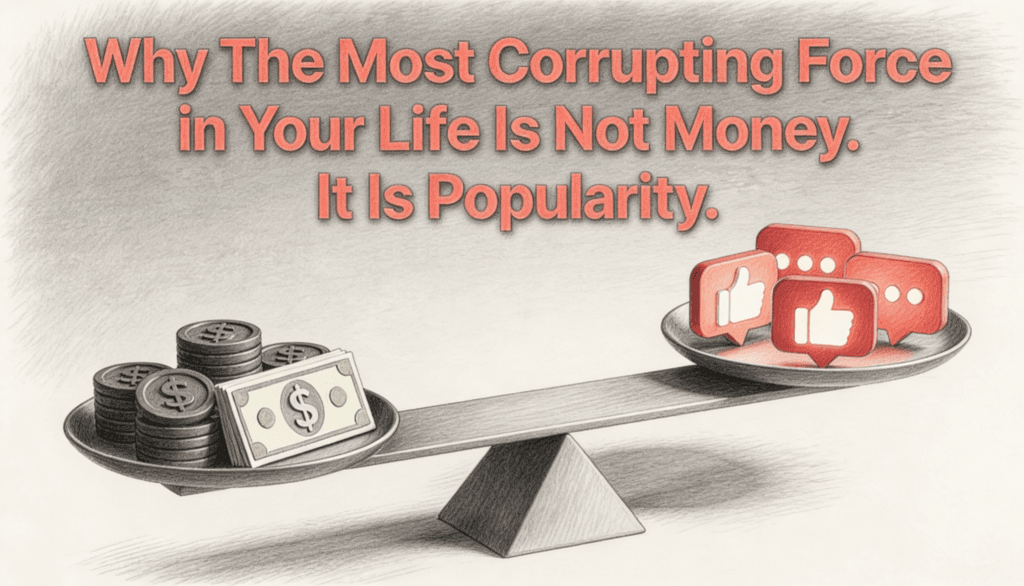
Seneca wrote a lot about money. He wrote about greed, about luxury, about the trap of chasing wealth until it owns you. But when he sat down to identify the single most dangerous influence on a human soul, he did not point at gold. He pointed at the crowd.
That should stop you for a moment. A man who lived in imperial Rome, surrounded by some of the most grotesque displays of wealth in human history, looked at all of it and said: the real problem is other people’s approval.
Two thousand years later, we have built entire industries around the thing he warned us about. We call it social media. We call it personal branding. We call it influence. We have taken the most corrupting force Seneca could identify and turned it into a career path.
Why Popularity Corrupts Differently Than Money
Money corrupts in obvious ways. You can see it happening. A person starts cutting corners, lying to clients, exploiting workers. The mechanism is visible. Someone wants more money, and they compromise their values to get it. We have stories, laws, and entire religious traditions built around warning us about this.
Popularity is sneakier.
When money corrupts you, you usually know it. There is a transaction. You can feel yourself choosing the paycheck over the principle. But when popularity corrupts you, it feels like growth. It feels like connection. It feels like you are finally becoming the person you were meant to be. That is what makes it so much more dangerous. You do not notice the corruption because it disguises itself as self improvement.
Seneca understood this distinction with remarkable clarity. In his letters to Lucilius, he repeatedly warned against shaping yourself to fit public expectation. Not because the public is evil, but because the public is a mirror that only reflects what it wants to see. And if you stare into that mirror long enough, you forget what you actually looked like before you started performing.
Think about it this way. A person who sells out for money can, in theory, buy back their integrity. They can quit the job, return the money, walk away. But a person who has slowly reshaped their entire personality to match what gets applause? What do they walk away from? Themselves?
The Audience Capture Problem
There is a concept in modern psychology and media theory called audience capture. It describes what happens when a person starts performing for an audience and gradually becomes the performance. The creator does not control the content. The audience does. Every laugh, every like, every share is a tiny vote that says: more of this, less of that.
Seneca did not have the term, but he described the phenomenon perfectly. He watched Roman politicians reshape their convictions based on crowd reactions. He watched philosophers soften their arguments to avoid unpopularity. He watched friends abandon honest speech because honesty does not trend.
The mechanism works like this. You say something true. Some people applaud. You say it again, but louder. More applause. You notice that a slightly exaggerated version gets even more applause. So you exaggerate. Then you notice that the exaggeration with a personal attack attached gets the most applause of all. So you attack. Within months, you are a different person. And the strangest part is that you feel more authentic than ever, because thousands of people are telling you so.
This is the corruption Seneca was talking about. Not the corruption of doing something you know is wrong, but the corruption of slowly losing the ability to know what is right because your internal compass has been replaced by a crowd.
The Stoic Diagnosis
The Stoics had a framework for understanding this. They divided things into what is up to us and what is not up to us. Your character, your judgments, your choices: those are up to you. Other people’s opinions? Not up to you. Not even a little.
Popularity sits entirely in the category of things that are not up to you. You cannot control whether people like you. You cannot control whether your work resonates. You can do good work, and the crowd may ignore it. You can do terrible work, and the crowd may love it. The relationship between quality and popularity is, at best, loosely correlated. Anyone who has watched a brilliant book go unread while a mediocre one sells millions already knows this.
So when you organize your life around popularity, you are building your house on someone else’s land. You are handing the keys to your identity to people who do not know you, do not care about you, and will forget you the moment someone more entertaining shows up.
Seneca would have found our modern obsession with followers and metrics genuinely horrifying. Not because he was a snob, but because he understood what it costs. Every hour you spend calculating how to be more likable is an hour you did not spend figuring out what you actually believe. Every opinion you soften to avoid backlash is a small piece of your intellectual independence that you will probably never get back.
The Paradox of Popularity and Loneliness
Here is something counterintuitive. The more popular you become, the lonelier you get.
This sounds wrong. Popular people are surrounded by others. They have followers, fans, audiences, communities. Their phones never stop buzzing. How could they possibly be lonely?
Because none of those people know them. They know the performance. They know the version that was optimized for engagement. And the person behind the performance knows this, even if they cannot articulate it. There is a persistent, low grade awareness that if they ever showed up as themselves, unfiltered and unoptimized, the crowd might leave.
So they keep performing. And the gap between who they are and who they pretend to be grows wider. And that gap is loneliness. Not the loneliness of being alone, but the much worse loneliness of being surrounded by people who love someone you are not.
Seneca wrote about this with a kind of pity. He described men who had achieved enormous public admiration and found it hollow. Not because they were ungrateful, but because admiration based on a fiction does not nourish the soul. It is like eating food in a dream. You go through all the motions, but you wake up hungry.
What This Looks Like in Practice
Let us bring this down from philosophy to a normal afternoon.
You are at work. You have an idea. It is a good idea, maybe even a great one, but it is unconventional. It would require arguing against the current consensus. You open your mouth to say it, and then you feel that little tug. The calculation. If I say this, will people think I am difficult? Will my manager see me as a team player? Will my colleagues still invite me to lunch?
So you say something safer. Something that sounds smart but does not challenge anything. Something designed for approval rather than truth. And everyone nods, and you feel a small, warm hit of social validation. And your idea dies quietly in the back of your mind.
That is popularity corruption at its most mundane. No dramatic sellout. No Faustian bargain. Just a slow, daily accumulation of moments where you chose to be liked over being honest.
Now multiply that by every meeting, every conversation, every social media post, every dinner party, every relationship for the next thirty years. That is the shape of a life bent around popularity. From the outside, it looks successful. From the inside, it feels like wearing a costume you can never take off.
The Uncomfortable Solution
So what did Seneca recommend? Withdrawal from society? Becoming a hermit? Ignoring everyone?
No. And this is where people often misread the Stoics. Seneca did not say you should avoid people. He said you should avoid needing their approval. There is an enormous difference.
You can be kind without being a people pleaser. You can be social without being socially dependent. You can share your work without making its reception the measure of its worth. The goal is not isolation. The goal is developing an internal standard that does not fluctuate with every comment, every review, every raised eyebrow in a meeting.
This is much harder than it sounds. We are social animals. Approval feels good on a neurological level. Rejection feels like physical pain. Studies in neuroscience have shown that social exclusion activates the same brain regions as actual physical injury. So when Seneca asks you to become indifferent to popularity, he is asking you to override some very deep wiring.
But he is not asking you to do it because it is easy. He is asking you to do it because the alternative is worse. The alternative is becoming a person you did not choose to be, shaped by forces you did not choose to obey, living a life that looks impressive to everyone except the one person who has to actually live it.
The Modern Test
Here is a simple test you can apply today. Think about the last opinion you expressed in public, whether on social media, in a meeting, or at dinner. Now ask yourself: would you have expressed that same opinion if you knew for certain that everyone present would disagree with you?
If the answer is yes, you are in decent shape. If the answer is no, or even if you hesitate, then you have some work to do. Because that gap between what you believe and what you are willing to say is exactly the territory where popularity corruption lives.
And it is not a gap you can fix once. It is a daily practice. Seneca compared it to physical training. You do not exercise once and call yourself fit. You show up every day. You build the muscle of independent judgment by using it, especially when it is uncomfortable. Especially when the crowd is watching.
The Final Irony
There is one last twist worth mentioning. The people we admire most across history are almost never the ones who chased popularity. They are the ones who said what they believed and let the chips fall. Socrates was not popular. He was executed. Galileo was not popular. He was imprisoned. Seneca himself was not popular at the end. He was ordered to kill himself by the emperor he once advised.
But we remember them. We read them. We name our children after them. We build statues.
Meanwhile, the people who were popular in their time, the crowd pleasers, the ones who said exactly what everyone wanted to hear, are almost entirely forgotten. We do not know their names. We do not study their ideas. They optimized for the approval of people who are now dust, and they got it, and it meant nothing.
Seneca would probably not be surprised by any of this. He would look at our world of followers and likes and viral moments and recognize it immediately. The same crowd. The same trap. The same slow erosion of the self in exchange for applause that fades before you even leave the stage.
The question he would ask you is the same one he asked himself: are you willing to be unpopular in exchange for being real? Because that is the trade. It always has been.
And most people, if they are being honest, are not sure they would take it. Which is exactly why popularity remains, two thousand years later, the most corrupting force in your life.