Table of Contents
Most people guard their money with elaborate systems. Passwords, vaults, insurance policies, diversified portfolios. They will argue with a waiter over a five dollar overcharge. They will drive twenty minutes out of the way to save three cents on gas. They will compare seventeen websites before buying a toaster.
Then those same people will hand over three hours of their evening to a television show they do not even enjoy. They will sit in a meeting that should have been an email. They will spend forty minutes arguing with a stranger on the internet about something neither of them will remember by next week.
Seneca noticed this roughly two thousand years ago, and it is somehow still the most relevant observation anyone has ever made about human behavior.
The Original Diagnosis
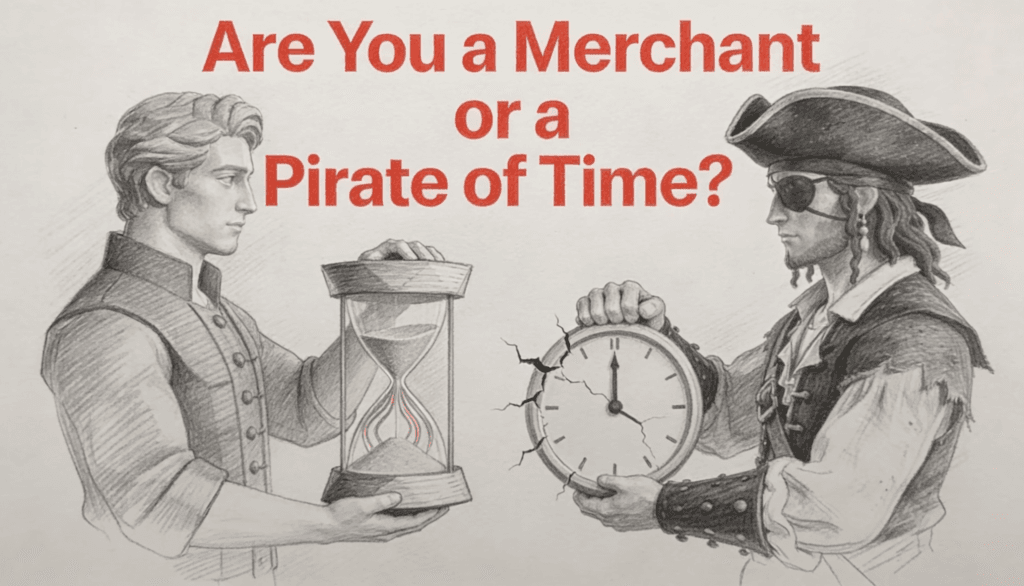
In his essay On the Shortness of Life, Seneca draws a line between two types of people. There are those who treat time like merchants treat inventory: they know what they have, they track what they spend, and they refuse to let anyone walk out the door without paying. Then there are those who treat time the way pirates treat stolen cargo: easy come, easy go, spend it recklessly because it was never really yours to begin with.
Seneca did not use the word “pirate,” of course. He was more diplomatic than that. But his meaning was sharp. He wrote that people are strict in guarding their patrimony but wasteful when it comes to time, the one thing about which it is right to be stingy.
That is the paradox he identified. We protect what can be replaced and squander what cannot.
The essay was addressed to Paulinus, a Roman official who presumably had somewhere important to be. Seneca told him, essentially, that life is not short. We just waste most of it. The problem is not that we have too little time. The problem is that we use so little of it well.
This was written around 49 AD. We have had nearly two millennia to take the advice. The results have not been encouraging.
What It Actually Means to Be a Merchant of Time
A merchant does not hate spending. Merchants spend constantly. That is their entire profession. But they spend with awareness. Every transaction is deliberate. Every exchange is measured against what it returns.
Being a merchant of time does not mean optimizing every second like some productivity robot who schedules bathroom breaks. That is a different pathology. The merchant of time simply knows the exchange rate. When you give an hour to something, you are buying whatever that hour produces. The merchant asks: is this purchase worth it?
Sometimes the answer is yes, and the purchase is doing absolutely nothing. Rest is not waste. Leisure is not laziness. Seneca himself was clear about this. He celebrated philosophical contemplation, long conversations with friends, and the study of nature. None of these would show up on a productivity guru’s task list.
The distinction is not between “productive” and “unproductive.” It is between chosen and unchosen. Between deliberate and default. The merchant chooses to rest. The pirate just drifts into it because there is nothing better to do, and then drifts out of it feeling vaguely guilty.
Here is a test that is almost unfairly simple. At the end of any given day, can you account for where your time went? Not in a spreadsheet. Just roughly. If the answer is yes, and you are satisfied with the trades you made, you are operating like a merchant. If the answer is a blank stare followed by the realization that somehow it is 11 PM and you have done nothing you intended to do, you may have a piracy problem.
The Pirate Psychology
Pirates of time do not set out to waste their lives. Nobody wakes up and thinks, “Today I will fritter away eight irreplaceable hours on things that bring me no joy and serve no purpose.” It happens through a series of small surrenders.
Someone asks for a favor you do not want to do. You say yes because saying no feels uncomfortable. That is thirty minutes gone. A notification pulls you into a social media feed. You intended to glance at it for ten seconds. That was forty minutes ago. A colleague starts a conversation about something you have no stake in. You stay because leaving feels rude. There goes another twenty minutes.
None of these individual moments seem significant. And that is exactly why they are dangerous. Seneca compared it to a fortune lost not through one catastrophic event but through a thousand tiny expenses. The money does not disappear in a robbery. It leaks away in coins dropped between the cushions.
The pirate psychology runs on a specific illusion: the feeling that there is always more time. Tomorrow will have hours. Next week will have days. Next year will have months. This sense of abundance makes it easy to be generous with what you have right now. You can afford to waste this hour because look at all the hours stretching ahead.
Seneca’s response to this was not gentle. He pointed out that people who are lavish with their time are often the same people who panic when illness arrives, or when they realize they are old, or when some crisis forces them to confront how few hours they may have left. They spent decades acting as though time were infinite and then are shocked, genuinely shocked, to discover it is not.
The Uncomfortable Economics
Here is where things get interesting, and slightly uncomfortable. Time is the only currency where everyone starts each day with the same amount. Twenty four hours. The billionaire and the bus driver get the same deposit. No one can earn more of it. No one can save it in an account for later. You cannot invest your Tuesday and get compound interest on it by Friday.
This makes time the most egalitarian resource in existence. It is also the only resource where the total supply is unknown. You know how much money you have. You do not know how much time you have. You are spending from a bank account where the balance is hidden.
Try running a business like that. Imagine a company that spends freely from an account but is not allowed to check the balance. The account could hold millions or it could be nearly empty. The company has no way to know. Any financial advisor would call this insanity. Yet this is exactly how most people manage their time.
The Social Pressure to Be a Pirate
Seneca understood something that modern culture has amplified to an absurd degree: other people are the primary pirates of your time. Not in a malicious way, usually. But the social contract has a hidden clause that says your time is available to anyone who asks for it with sufficient politeness.
Think about how difficult it is to decline an invitation, leave a conversation, skip a meeting, or simply say “I would rather not.” The social cost of protecting your time is often higher than the cost of wasting it. At least in the short term.
This creates a peculiar dynamic. The people who are best at guarding their time are often seen as difficult, or selfish. Meanwhile, the people who give their time to everyone and everything are praised as generous and accommodating. Society rewards the pirate and penalizes the merchant.
Seneca saw this clearly. He wrote about people who belong entirely to someone else. He was describing, without knowing it, the modern professional who has back to back meetings from nine to five, comes home exhausted, and somehow feels guilty for not doing more.
A Practical Framework That Is Not a Listicle
Rather than offering seven tips for time management (which would be ironic in an article about not wasting time), consider one shift in thinking.
Every time someone or something requests your time, translate the request into its true cost. Not in minutes or hours. In life.
Your coworker wants you to attend a meeting that will accomplish nothing. That is not one hour of your Tuesday. That is one hour of your life. Your life, which has a fixed and unknown number of hours in it. Does the meeting justify that exchange?
A streaming service auto plays the next episode. That is not “just one more episode.” That is another unit of your finite existence traded for a plot line you will forget within a month.
This is not meant to make every moment feel heavy. It is meant to make choices feel real. The merchant does not agonize over every purchase. The merchant simply stays aware that purchases are happening.
Game theory offers a useful parallel here. In repeated games, players who think about long term consequences make fundamentally different choices than players focused only on the current round. Most people treat time as a single round game. Whatever feels good now wins. The merchant treats it as what it actually is: a finite series of rounds where each choice shapes the rounds that follow.
Why This Still Matters at 2,000 Years Old
Philosophy that remains relevant across millennia is rare. Most ancient advice is interesting as history but useless as guidance. You would not consult a Roman text for medical advice or engineering principles. But Seneca’s observations about time have aged better than almost anything else from the ancient world because the underlying problem has not changed.
If anything, it has gotten worse. Seneca did not have a smartphone. He did not have an inbox with three hundred unread messages. He did not have algorithmically designed content competing for his attention every waking moment. He lived in a world with dramatically fewer demands on his time than ours, and he still thought people were terrible at managing it.
Imagine what he would write today.
The core insight remains as sharp as it was in 49 AD. You are not short on time. You are short on intention. The hours are there. They have always been there. The question is whether you are spending them or whether they are being spent for you. Whether you are a merchant making deliberate trades or a pirate drifting on currents you did not choose, spending treasure you did not earn, heading toward a destination you never picked.
Seneca would tell you to check your ledger. Not tomorrow. Not next week.
Now.
Because “now” is the only entry in the ledger you can still edit. And the balance, as always, is not something you get to see in advance.