Table of Contents
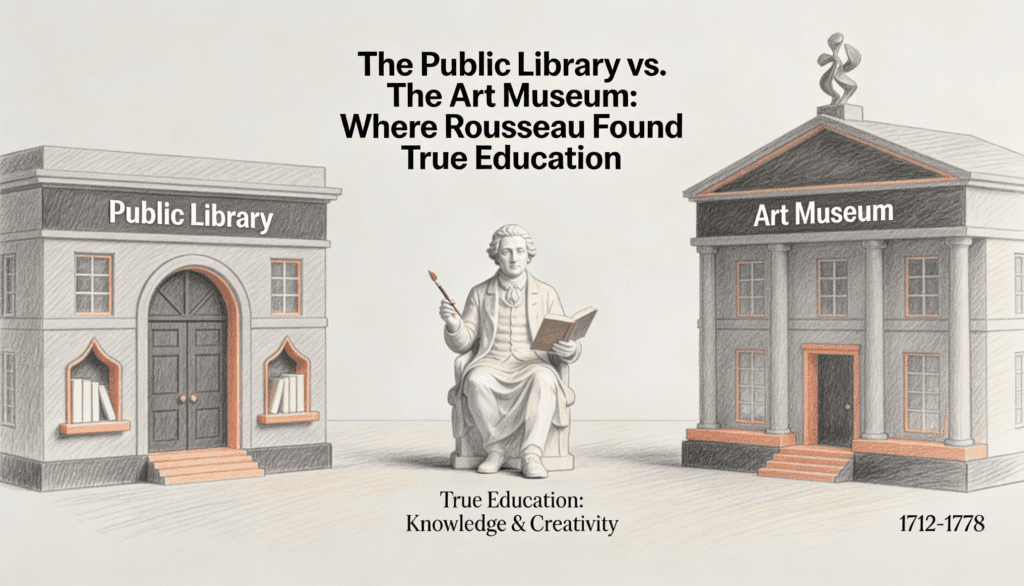
Jean-Jacques Rousseau never trusted a classroom. He did not trust the teacher standing at the front of it, either. He certainly did not trust the textbook sitting on the desk. What he trusted was experience, feeling, and the slow unfolding of a human being who had not yet been ruined by society. So when we ask where Rousseau would have found true education – in a public library or an art museum – we are really asking a deeper question. We are asking what education even is, and whether the places we built to house it have any idea what they are doing.
The answer, as with most things involving Rousseau, is not the one you would expect.
A Man Who Educated Himself Badly
Before we send Rousseau into a library or a museum, we should remember how he actually learned. He was, by almost any standard, a catastrophe of self-education. He read constantly as a child, devouring his dead mother’s romance novels before he turned ten. He then moved on to Plutarch, which is a bit like going from candy bars to philosophy lectures with no transition. He had no formal schooling worth mentioning. He apprenticed with an engraver who beat him. He wandered across Europe, slept in fields, converted religions for the sake of a meal, and somehow emerged from all of this as one of the most influential thinkers of the eighteenth century.
The lesson here is not that chaos produces genius. The lesson is that Rousseau believed education was something that happened to you, not something done to you. This distinction matters enormously when we compare the library and the museum, because the two spaces operate on fundamentally different theories of how a person comes to understand the world.
The Library: A Cathedral of Secondhand Experience
A public library is, at its core, a warehouse of other people’s thoughts. That is not an insult. It is a description. The shelves hold thousands of minds preserved in ink, organized by subject, and made available to anyone who walks through the door. The library democratizes knowledge. It is one of the finest inventions of civic life. Rousseau himself spent years reading in libraries and private collections, absorbing ideas that would later fuel his own explosive writing.
But here is the problem Rousseau would have identified immediately. A library is a place where you sit still and receive. You open a book. Words enter your mind. You process them through reason, memory, and whatever intellectual framework you brought with you. The experience is almost entirely cerebral. Your body is a transport device for your brain. You carry it to a chair, park it there, and forget about it for hours.
Rousseau was deeply suspicious of this. In Emile, his treatise on education, he argued that the young student should learn almost nothing from books until adolescence. The child should learn from nature, from direct contact with the physical world, from running and falling and touching and building. Books, Rousseau warned, teach us to use the reason of others rather than our own. They create people who know many things but understand very little.
This is a counterintuitive position for a man who wrote so many books. Rousseau was fully aware of the irony. He addressed it directly, noting that his own work was meant to be a guide for parents and tutors, not a replacement for lived experience. He was writing a book about why books are dangerous, and he knew exactly how ridiculous that looked. But he did it anyway, because the point was too important to leave unmade.
The library, then, represents what Rousseau considered the second stage of education. It is where you go after you have already developed your senses, your body, your capacity for feeling. It is not where you begin. And if you begin there, you risk producing what Rousseau most feared: a person who can recite facts but cannot feel truth.
The Art Museum: Where the Senses Go to Think
An art museum operates on different principles. You walk through it. You stand before objects. You look at colors, shapes, textures, and compositions that communicate without language. A painting does not argue with you. It does not present a thesis and defend it with evidence. It simply exists, and your job is to encounter it.
Rousseau would have found this much closer to his ideal of natural education. Not because art museums existed in his time – they largely did not, at least not in the public form we know today – but because the museum asks you to use your senses before your reason. You see the painting before you read the placard beside it. You feel something before you analyze anything. The experience moves from the body to the mind, which is precisely the direction Rousseau believed all genuine learning should travel.
There is a moment in Emile where Rousseau describes how a child should learn geography. He does not suggest maps or textbooks. He suggests taking the child outside and letting them observe the sunrise. From the movement of the sun, the child will begin to understand direction, orientation, and eventually the relationship between the earth and the sky. The knowledge arrives through sensation. It is anchored in something real. It cannot be forgotten because it was never merely memorized.
An art museum replicates this process in an urban setting. The visitor stands before a Caravaggio and feels the weight of darkness pressing against a sliver of light. They do not need to know the term “chiaroscuro” to understand what is happening. The painting teaches through presence. It demands attention, rewards patience, and communicates truths about human experience that no textbook chapter could deliver with equal force.
The Paradox of Organized Feeling
But Rousseau would not have loved the art museum without reservation. Here is where the analysis gets interesting.
Modern art museums are institutions. They are curated. Someone has decided which paintings you will see, in what order, with what lighting, and accompanied by what explanatory text. The museum experience, for all its sensory richness, is still a guided one. You are not wandering through a forest discovering things at random. You are walking a path that someone designed for you.
Rousseau hated this. He hated any educational structure that imposed an external logic on the learner. In Emile, the tutor is instructed to create situations where the child appears to learn freely, even though the tutor has carefully arranged the environment. The genius of Rousseau’s pedagogy is that the student never feels taught. The learning seems to arise from the student’s own curiosity, even when it has been quietly engineered.
This is where the comparison between the library and the museum reveals something unexpected. The library, despite its cerebral nature, actually offers more freedom than the museum. You can wander the stacks. You can pick up any book, read three pages, put it down, and grab another. Nobody is watching. Nobody has arranged the experience for you. The library is chaotic, and Rousseau respected chaos as a condition of genuine discovery.
The museum, by contrast, is orderly. It tells you where to stand. It tells you what to admire. It even tells you how to feel, through those little cards on the wall that explain the historical context and artistic significance of what you are looking at. Rousseau would have read one of those cards and then made a point of looking at the painting from across the room, just to spite the institution.
Education as Corruption: The Deeper Problem
To understand Rousseau’s real position, we need to address his most famous and most misunderstood idea. Rousseau believed that human beings are born good and that society corrupts them. This is usually reduced to a bumper sticker about noble savages, which misses the point entirely. Rousseau was not arguing that we should return to the wilderness. He was arguing that the institutions we build – schools, churches, governments, and yes, libraries and museums – tend to shape people into conformists rather than free thinkers.
Education, for Rousseau, was not about filling an empty vessel. It was about protecting a full one. The child already possesses everything they need: curiosity, sensation, the capacity for empathy, and an instinct for self-preservation. The job of education is to let these natural capacities develop without distorting them. Every institution that tries to educate runs the risk of doing the opposite.
This puts both the library and the museum in an awkward position. The library distorts by privileging reason over feeling. The museum distorts by organizing feeling into a curated spectacle. Neither is the open field where Emile runs barefoot and learns to swim by nearly drowning. Neither is nature.
But we do not live in nature. We live in cities, surrounded by institutions, drowning in information. And this is where Rousseau’s thinking becomes relevant in a way he never anticipated.
What Rousseau Would Choose Today
If forced to choose – library or museum – Rousseau would choose the museum. But not for the reasons you might think.
He would choose it because the museum still requires the body. You have to walk. You have to stand. You have to move your eyes across a surface and let your perception do work that your intellect cannot shortcut. In an age where nearly all information is delivered through screens and text, the museum remains one of the few public spaces where knowledge enters through the senses rather than through language.
The library has been largely absorbed by the internet. You can read almost anything from your couch. The physical library still matters – it is a public space, a refuge, a community resource – but its educational function has been replicated and expanded by digital technology. The museum has not been replicated. You cannot experience a Rothko on a phone screen. You can see a photograph of it, but that is like reading a description of a sunset and claiming you watched one.
Rousseau understood this distinction before anyone had a word for it. He understood that there is a difference between information and experience, between knowing about something and knowing it. The library gives you information. The museum gives you experience. And for Rousseau, experience was always the superior teacher.
There is a striking parallel here with how contemporary neuroscience has begun to validate what Rousseau intuited. Researchers studying embodied cognition have found that physical movement and sensory engagement are not separate from thinking – they are part of it. The body does not merely carry the brain around. It participates in understanding. When you stand before a sculpture and walk around it, your spatial reasoning, your emotional processing, and your aesthetic judgment are all firing together in ways that reading about that sculpture simply cannot replicate. Rousseau did not have brain scans to prove his point, but he did not need them.
The Education Nobody Wants
There is one final twist in this comparison that Rousseau would have appreciated. The kind of education he valued most is the kind that nobody actively seeks. It is not efficient. It is not measurable. It does not produce credentials or certificates. It cannot be listed on a resume. It is the slow, sometimes painful process of becoming a person who can feel accurately, think independently, and resist the pressure to become whatever society finds most convenient.
The library helps you become informed. The museum helps you become attentive. Rousseau would have said that attention is the more fundamental skill, because without it, information is just noise. You can read every book in the library and still understand nothing if you have never learned to be present with a single experience long enough to let it change you.
This is why Rousseau remains relevant, and why this comparison matters beyond academic exercise. We live in a world that treats education as data transfer. We measure it in test scores, graduation rates, and reading levels. We have built extraordinary libraries – physical and digital – that make more information available to more people than at any point in human history. And yet we seem no closer to producing the kind of wise, self-governing, emotionally intelligent citizens that Rousseau described.
Maybe the problem is not that we lack information. Maybe the problem is that we forgot how to stand still in front of a painting and let it ask us a question we were not prepared to answer.
Rousseau would have said that true education is not about finding answers. It is about becoming the kind of person who can live honestly with the questions. The library offers answers. The museum offers questions. And in that distinction, the museum wins – not because it is better, but because it is harder. And for Rousseau, difficulty was never the enemy of learning. It was the proof that learning was actually happening.