Table of Contents
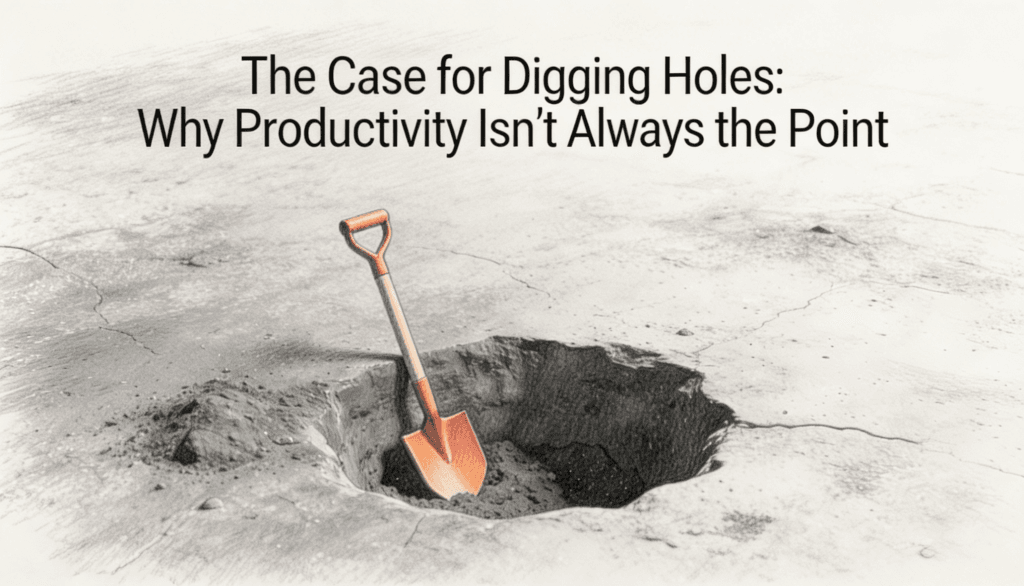
There is a famous passage in The General Theory of Employment, Interest and Money where John Maynard Keynes suggests that the government could bury banknotes in old coal mines, fill the mines with rubbish, and let private enterprise dig them back up. He was not joking. Or rather, he was joking, but the joke contained more economic truth than most serious proposals of his time.
The idea sounds absurd. Pay people to dig holes and fill them in again. Surely that is the definition of waste. Surely a society that rewards pointless labor has lost its mind. And yet Keynes argued that even this nonsense would be better than doing nothing while millions sat idle during a depression. The economy would move. Money would circulate. Demand would rise. People would eat.
This is the part where most people stop reading and start arguing. They should keep reading instead.
The Problem Keynes Was Actually Solving
To understand why a brilliant economist would advocate for digging holes, you need to understand the world he was looking at. The year was 1936. The Great Depression had dragged on for seven years. Classical economics said markets would correct themselves. Workers would accept lower wages, prices would fall, and equilibrium would return like a pendulum swinging back to center.
The pendulum was not swinging back.
Millions were unemployed. Factories sat empty. Banks had collapsed. The self correcting market was doing a remarkable impression of a broken clock. Classical economists kept insisting it would be right eventually, perhaps twice a day, but that was cold comfort to families who could not afford bread.
Keynes looked at this situation and asked a question that seems obvious now but was almost heretical then: What if the problem is not that workers cost too much, but that nobody is buying anything?
This was the birth of what economists now call demand side economics. The economy was not stuck because of some structural flaw in labor markets. It was stuck because everyone was terrified. Consumers would not spend because they might lose their jobs. Businesses would not invest because consumers were not spending. Banks would not lend because businesses were not investing. The whole system had frozen, each actor waiting for someone else to move first.
It was a coordination problem dressed up as a moral failing.
Why the Holes Matter More Than You Think
Here is where Keynes gets genuinely interesting, and where most summaries of his work get him wrong. The hole digging passage was not his actual policy recommendation. It was a thought experiment designed to illustrate a deeper point: in a depressed economy, almost any spending is better than no spending.
He would have preferred the government build hospitals, schools, and roads. He said so explicitly. But he also knew that political systems move slowly, that debates about which roads to build and which schools to fund could drag on for years while people starved. The holes were his way of saying that even the most useless expenditure would be superior to the status quo, because the status quo was an economy slowly eating itself.
Think of it like a car with a dead battery. The ideal solution is a new battery. But if you are stranded in the middle of nowhere, a jump start from a passing truck will do. Keynes was not arguing that jump starts are better than new batteries. He was arguing that sitting in the car waiting for a battery factory to appear was insane.
The mechanism behind this is what economists call the multiplier effect. When the government pays someone to dig a hole, that person spends their wages at a grocery store. The grocer uses that revenue to pay their employees. Those employees go to the barber, the cinema, the pub. Each dollar spent generates more than a dollar of economic activity as it passes from hand to hand. The hole itself is irrelevant. What matters is the chain of transactions it sets in motion.
The Paradox of Thrift and the Virtue That Kills
Keynes identified something deeply counterintuitive about economies, something that still makes people uncomfortable. He called it the paradox of thrift. In ordinary times, saving money is virtuous. Your grandmother was right: put something aside for a rainy day. But when everyone saves at the same time, in response to the same fear, the collective result is catastrophic.
If every household decides to save an extra ten percent of income simultaneously, total spending in the economy drops. Businesses see falling revenue and lay off workers. Those workers, now unemployed, spend even less. More businesses contract. More workers lose jobs. The attempt to save leads to a poorer society with less total savings than it started with.
This is one of those ideas that is obviously true once you hear it and almost impossible to accept emotionally. We are raised to believe that what is good for the individual must be good for the group. Keynes showed that this is sometimes exactly backwards. The economy is not a household budget scaled up. It is a fundamentally different kind of system, one where your spending is my income and my spending is yours.
The Moral Objection and Why It Misses the Point
The loudest objection to Keynes has always been a moral one. People should not be paid for useless work. Government spending is wasteful. The market, left alone, will sort things out. There is a deep strain of Calvinist thinking in this objection, a belief that economic suffering is somehow deserved, that recessions are nature’s way of purging excess, and that interfering with the process is not just inefficient but wrong.
Keynes had little patience for this view. He saw it as a confusion between morality and mechanics. An economy is a machine for producing and distributing goods. When the machine breaks down, fixing it is not a moral compromise. It is engineering.
But the moral objection has a more sophisticated version worth taking seriously. If the government can simply spend its way out of recessions, what prevents it from spending recklessly all the time? What stops the hole digging from becoming permanent? This is a legitimate concern, and Keynes addressed it. He argued that deficit spending should be countercyclical. Governments should spend during downturns and save during booms. The holes are for emergencies.
The problem, as history has shown, is that governments are much better at the spending part than the saving part. Running surpluses during good times requires a kind of political discipline that is spectacularly rare. This is not a flaw in Keynes’s theory. It is a flaw in political systems. Blaming Keynes for governments that only follow half his advice is like blaming a doctor whose patient takes the painkillers but skips the physical therapy.
What Productivity Actually Means
There is a deeper philosophical question buried in the hole digging metaphor that rarely gets examined. What do we actually mean by productive work?
We tend to assume that productivity means making things. Physical objects. Tangible outputs. A factory producing cars is productive. A man digging a hole that will be filled in again is not. This seems obviously correct until you think about it for more than thirty seconds.
Consider the modern economy. A significant portion of GDP in developed countries comes from services that produce nothing physical. A therapist produces no tangible object. Neither does a musician, a teacher, or a management consultant (though the consultant might produce a PowerPoint deck, which arguably has negative physical value). We do not call these professions unproductive. We recognize that they create value, even though that value cannot be held in your hand.
Now consider the man digging the hole. He is not producing anything useful with his shovel. But his wages allow him to buy food, pay rent, and maintain his dignity as a contributing member of society. The baker who sells him bread can now afford to buy shoes. The cobbler who sells the shoes can now afford to send his daughter to school. An entire chain of genuinely productive activity flows from the apparently pointless hole.
The hole is not the product. The hole is the excuse.
Keynes understood something that pure productivity metrics miss entirely. An economy is not just a machine for producing goods. It is a social system that gives people purpose, structure, and the means to participate in collective life. When that system breaks down, the damage goes far beyond lost output. It corrodes social trust, destroys families, and breeds political extremism. The cost of doing nothing is never zero. It is just invisible on a spreadsheet.
The Ghost of Keynes in the Modern World
It would be comforting to treat Keynes’s ideas as historical curiosities, relevant to the 1930s but safely outdated now. Unfortunately, they keep being relevant.
During the 2008 financial crisis, governments around the world faced almost exactly the same dilemma Keynes described. Demand collapsed. Banks froze. Unemployment surged. The countries that responded with aggressive fiscal stimulus, like the United States with its 2009 Recovery Act, generally recovered faster than those that pursued austerity, like much of the European Union. Greece, subjected to severe spending cuts as a condition of its bailout, experienced an economic contraction worse than the Great Depression itself.
The COVID 19 pandemic provided another test case. When governments sent checks directly to citizens and expanded unemployment benefits, consumer spending held up far better than anyone predicted. When those programs expired, spending softened. The Keynesian mechanism worked more or less as advertised, though the inflationary consequences that followed have given fresh ammunition to his critics.
This is worth acknowledging honestly. The inflation surge of 2021 and 2022 was at least partly the result of too much demand chasing too few goods, exactly the scenario Keynes’s critics warn about. But context matters. The alternative was allowing a pandemic to trigger a depression, and Keynes himself would have argued that overshoot is preferable to collapse. You can cool an overheating economy. Restarting a dead one is much harder.
The Real Lesson of the Holes
If you have read this far, you might be expecting a neat conclusion. Something about balance, perhaps, or the importance of pragmatism over ideology. Those conclusions would be true but boring.
Here is a more interesting one.
The reason Keynes’s hole digging metaphor still provokes people ninety years later is not that it is economically controversial. The basic mechanism he described is well established. Almost all economists, even those who disagree with specific Keynesian policies, accept that demand shortfalls can cause recessions and that government spending can help. The reason it provokes people is that it offends something deeper than economic logic. It offends the belief that the universe is fundamentally fair, that hard work is always rewarded, that suffering has meaning, and that waste is always wrong.
Keynes was telling us that sometimes the economy does not care about your values. Sometimes the most moral sounding policy produces the most suffering, and the most absurd sounding policy produces the most relief. Sometimes you have to dig holes to save a civilization.
That is an uncomfortable idea. It suggests that the world is messier than we want it to be, that good intentions do not guarantee good outcomes, and that the rules we live by as individuals do not scale neatly to societies. It is the kind of idea that makes people reach for simple certainties, for gold standards and balanced budgets and the reassuring fiction that if everyone just worked harder and saved more, everything would be fine.
Keynes spent his career arguing against that fiction. He was not always right. His theories have blind spots, and his policy prescriptions need updating for a world he never imagined. But his central insight remains as sharp as ever: an economy exists to serve people, not the other way around. And if serving people occasionally requires digging a few pointless holes, then hand me a shovel.