Table of Contents
Every revolution begins with a promise. The old guard will be swept away. The corrupt will be punished. Power will return to the people. And for a brief, intoxicating moment, it looks like it might actually happen.
Then something familiar settles in. New faces appear at the top. They wear different clothes, use different slogans, maybe even believe different things. But they sit in the same chairs. They guard the same doors. They eat at the same table. The menu has not changed. Only the guests have.
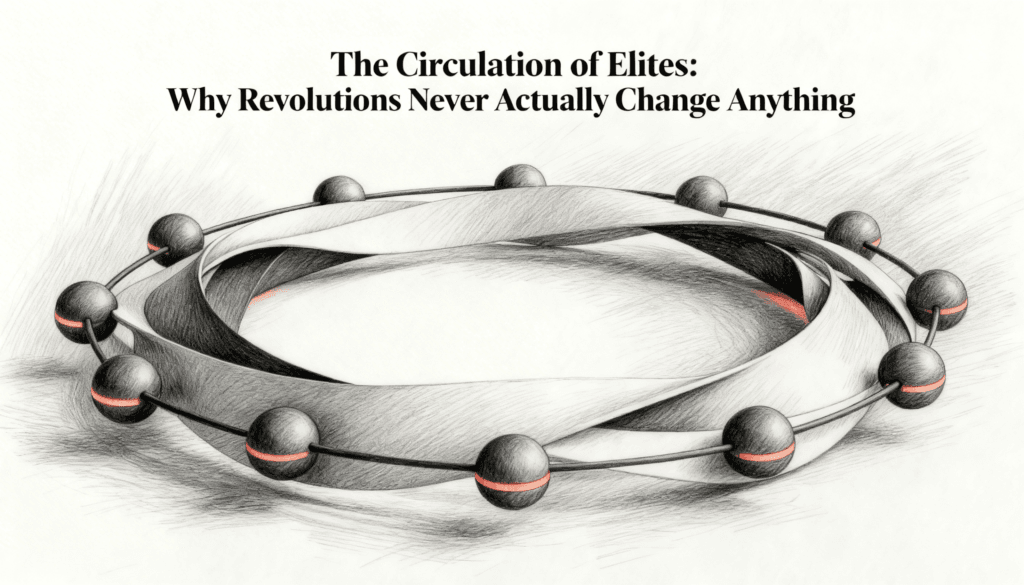
This observation, made over a century ago by the Italian economist and sociologist Vilfredo Pareto, remains one of the most uncomfortable ideas in political thought. He called it the circulation of elites, and it suggests something that no revolutionary wants to hear: the structure of power is not a bug of civilization. It is the operating system.
Who Was Vilfredo Pareto?
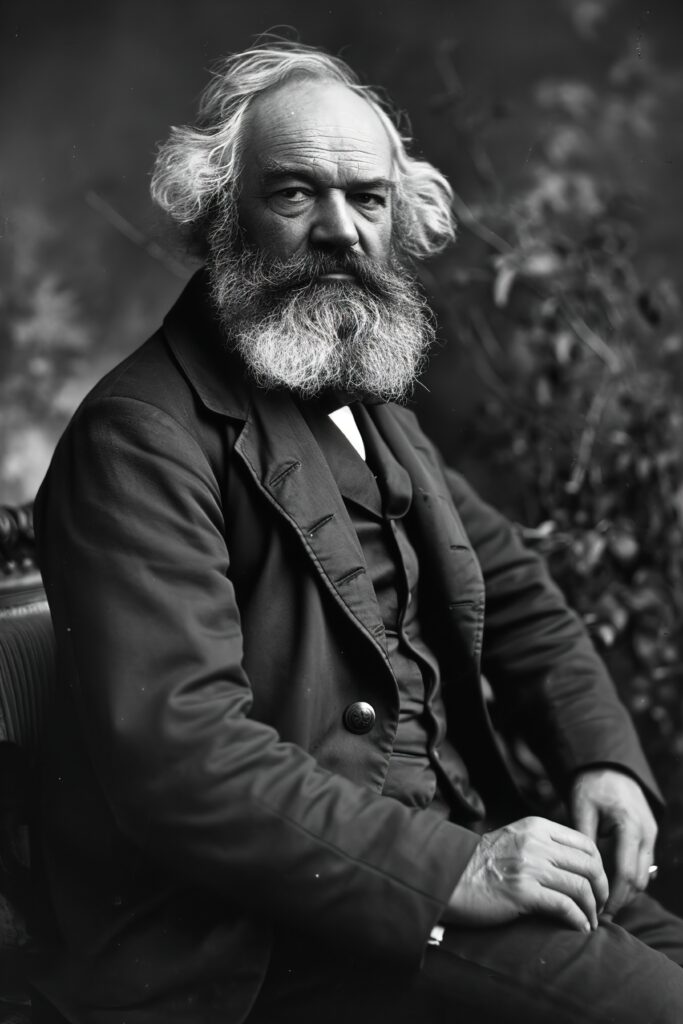
Before we get to why his ideas still sting, a bit of context helps. Pareto was born in 1848 in Paris to an Italian father and a French mother. He trained as an engineer, made his early career in the Italian railway industry, and only turned to economics and sociology in his forties. He was, in other words, not a lifelong academic dreaming up theories in a library. He had spent decades watching how institutions actually function, how contracts get awarded, how influence gets traded, and how people with power behave when no one is writing about them.
This background matters. Pareto did not arrive at his theory of elites through abstract reasoning. He arrived at it through observation. He watched Italian politics cycle through reform movements that changed nothing. He watched democracies produce oligarchies. He watched socialists seize power and immediately begin behaving like the aristocrats they had overthrown.
By the time he published his major sociological work, the Treatise on General Sociology, Pareto had become deeply skeptical of all political ideologies. Not because he thought they were wrong in their complaints. Many of them were right. But because he noticed that being right about the problem never seemed to prevent people from recreating it.
The Core Idea
Pareto’s argument can be stated simply. Every society, regardless of its political system, is governed by a small minority. This is not a conspiracy theory. It is a structural observation. Whether you organize a society around monarchy, democracy, communism, theocracy, or anarchism, a ruling class will emerge. It always does. The question is not whether elites will exist. The question is which elites, and for how long.
The circulation part of the theory is where things get interesting. Pareto argued that elites do not last forever. They decay. They grow complacent. They become more interested in preserving their position than in performing the functions that justified their position in the first place. When this happens, a new group of ambitious, capable, and often ruthless individuals rises to challenge them. Sometimes this transition is peaceful. A new political party wins an election. A new business model displaces an old industry. But sometimes the transition is violent. That is what we call a revolution.
Here is the key insight, though. Whether the transition is peaceful or violent, the result is the same. One elite replaces another. The masses, whose energy and suffering fueled the change, return to roughly the same position they occupied before. The revolution succeeds in changing who rules. It fails, almost every time, in changing the fact that someone rules.
Why Elites Always Form
This might sound cynical, but Pareto was making a claim about organizational reality, not about morality. His reasoning was straightforward. Any large group of people requires coordination. Coordination requires decision making. Decision making concentrates in the hands of those who are most willing and able to make decisions. Over time, these decision makers accumulate advantages. They control information. They build networks. They shape the rules to favor their continued involvement. They become, in a word, an elite.
This process is not unique to politics. It happens in corporations, universities, religious organizations, nonprofits, labor unions, and even revolutionary movements themselves. The pattern is so consistent that Pareto considered it something close to a natural law.
Think of it this way. Imagine a perfectly flat field. Rain falls evenly across the entire surface. You might expect the water to stay evenly distributed. But it does not. Small irregularities in the terrain cause water to collect in certain spots. Those spots get heavier. They press down further. They attract more water. Before long, you have streams and rivers, and the flat field is not flat anymore. Power works the same way. Even in systems designed to distribute it evenly, it pools.
The Two Types of Elites
Pareto did not just say elites exist. He categorized them. Drawing on Machiavelli, he described two fundamental types, which he called foxes and lions.
Foxes rule through cunning, manipulation, negotiation, and persuasion. They are the dealmakers, the diplomats, the politicians who always seem to find a compromise. They favor innovation, flexibility, and change. They are good at acquiring power because they are adaptable.
Lions rule through force, tradition, authority, and conviction. They are the generals, the true believers, the moral crusaders. They favor stability, order, and continuity. They are good at holding power because they are willing to use coercion.
Pareto argued that healthy societies need both types. Foxes keep things moving. Lions keep things together. The problem is that each type, when left unchecked, degrades in predictable ways. Foxes become so clever they lose all principle. They turn the state into a marketplace where everything is for sale. Lions become so rigid they lose all flexibility. They turn the state into a fortress where nothing can change.
The circulation of elites occurs when one type replaces the other. A society dominated by corrupt, deal making foxes eventually provokes a reaction. People crave authenticity, strength, and moral clarity. Lions rise. But a society dominated by rigid, authoritarian lions eventually provokes a different reaction. People crave freedom, flexibility, and innovation. Foxes rise. The wheel turns. The names change. The dynamic does not.
The Revolutionary Illusion
This is where Pareto’s theory becomes genuinely provocative. If you accept his framework, then revolutions are not what they claim to be. They are not transformations of the social order. They are personnel changes within an unchanging structure.
Consider the French Revolution. The monarchy fell. The aristocracy was dismantled. Liberty, equality, fraternity were declared. And within a decade, Napoleon had crowned himself emperor and established a new aristocracy based on military merit rather than bloodline. The titles changed. The pyramid did not.
Consider the Russian Revolution. The Tsar was overthrown. The Bolsheviks promised a classless society. Within a generation, the Soviet Union had produced one of the most rigidly hierarchical systems in human history, complete with special stores for party members, country homes for officials, and a vast secret police apparatus that would have made the Tsarist Okhrana jealous.
Consider the corporate world, which provides a less bloody but equally instructive example. The tech revolution of the late twentieth century promised to democratize information, flatten hierarchies, and empower individuals. And in many ways it did. But it also produced a new class of billionaire oligarchs whose influence over public life would make a nineteenth century railroad baron blush. The disruption disrupted everything except the existence of a ruling class.
Pareto would not have been surprised by any of this. He would have predicted it. Not because he was a pessimist, but because he believed the pattern was structural. You cannot eliminate elites any more than you can eliminate gravity. You can only replace one set with another and hope, perhaps naively, that the new set governs better than the old.
The Uncomfortable Implications
If Pareto is right, several things follow that most people would rather not think about.
First, democratic idealism has a ceiling. Democracy does not eliminate elites. It creates a mechanism for rotating them. This is valuable, perhaps even the best system available. But it is not what democracy’s most passionate defenders claim it is. It is not rule by the people. It is rule by elected elites, constrained by the need to periodically seek popular approval. The constraint matters. But so does the honesty about what the system actually is.
Second, revolutionary movements carry a built in contradiction. The very qualities that make a group effective at overthrowing the existing order, discipline, organization, ideological commitment, charismatic leadership, are the same qualities that make them capable of becoming the new ruling class. The revolution does not fail when it is betrayed by its leaders. It fails because success requires the creation of exactly the kind of hierarchical organization it set out to destroy.
Third, and this is perhaps the most counterintuitive point, gradual reform may accomplish more than violent revolution. If the circulation of elites is inevitable, then the question becomes not how to prevent it but how to manage it. Systems that allow for peaceful elite turnover, through elections, market competition, institutional checks, and social mobility, may be less dramatic than revolutions. But they tend to produce better outcomes for ordinary people because the transitions are less destructive.
Where Pareto Gets It Wrong
No theory explains everything, and Pareto’s has real limitations.
The most obvious is that he underestimates the degree to which the character of the elite matters. Yes, a ruling class will always exist. But it makes an enormous difference whether that ruling class is accountable to law, constrained by institutions, and drawn from a broad population, or whether it is hereditary, unchecked, and self serving. Saying that elites always exist is true but insufficient. It is like saying all houses have roofs. Correct, but it tells you nothing about whether the roof leaks.
Pareto also tends to treat the masses as essentially passive, a resource to be mobilized by competing elites rather than an independent force capable of shaping outcomes. This was a common blind spot among thinkers of his era, and subsequent history has shown it to be incomplete. Mass movements have, at times, genuinely expanded the boundaries of who counts as a full member of society. The abolition of slavery, the extension of voting rights, the labor movement: these were not simply cases of one elite replacing another. They represented real, structural changes in who was included and who was excluded.
Still, even these victories have a Paretian flavor. The movements that achieved them eventually produced their own institutions, leaders, and internal hierarchies. The labor movement created union bureaucracies. The civil rights movement created a professional advocacy class. Success, it turns out, is just another word for the formation of a new elite.
Why This Matters Now
Pareto’s theory has an odd relevance in the present moment. Across the political spectrum, there is a widespread sense that existing institutions are failing. Trust in governments, media, corporations, and experts has declined sharply. New movements, from populist nationalism to progressive activism to tech libertarianism, promise to sweep the old order away and build something better.
Pareto would listen to all of these movements with the same polite skepticism. Not because their grievances are invalid. Many of them are not. But because the pattern suggests that even successful movements will, over time, generate their own elites, their own insiders, their own gatekeepers. The question is not whether this will happen. The question is whether the new elites will be better or worse than the ones they replaced.
This is not a counsel of despair. It is a counsel of realism. Understanding the circulation of elites does not mean giving up on political engagement. It means engaging with clear eyes. It means judging movements not by the purity of their rhetoric but by the quality of the institutions they build. It means recognizing that the work of good governance is never finished, because the tendency toward elite capture is never extinguished.
Pareto saw something that most of us would prefer to ignore. The revolutionaries who storm the palace do not destroy the throne. They just refurbish it. Understanding this does not make you a cynic. It makes you someone who is less likely to be surprised when the new boss starts to look a lot like the old one.
And in politics, not being surprised is the first step toward not being fooled.