Table of Contents
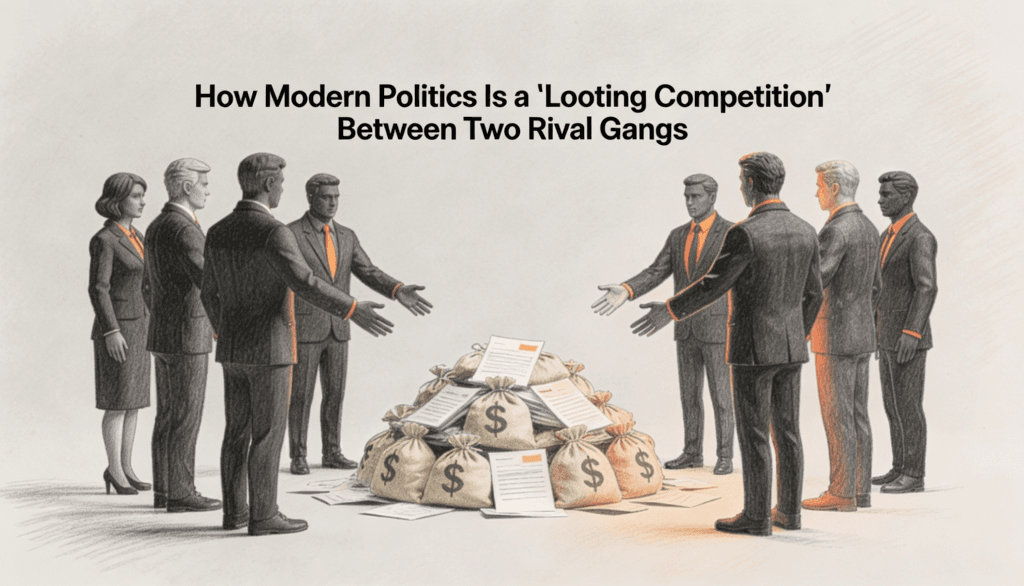
Most people watch election season the way they watch a football game. They pick a team, wear the colors, and scream at the television. They celebrate victories and mourn defeats as if something real just happened to them personally. Murray Rothbard, the economist and political theorist who spent decades dissecting the anatomy of state power, had a different view. He looked at the same spectacle and saw two gangs fighting over who gets to raid the treasury next.
That sounds extreme. It is meant to. But before you dismiss it, consider how the machinery actually works once the confetti is swept up and the winning candidate walks into office.
The Basic Setup
Rothbard built his thinking on a simple observation that most political theory tries very hard to avoid. Government does not produce wealth. It redistributes it. Every dollar that flows through a government program was first taken from someone through taxation, borrowing, or inflation. This is not a controversial economic claim. It is an accounting identity. The debate is never about whether redistribution happens. The debate is always about who gets to decide where the money lands.
Once you accept this framing, electoral politics starts to look less like a noble contest of ideas and more like a negotiation over the terms of extraction. Two coalitions form. Each one assembles a collection of interest groups, donors, industries, and voting blocs. Each promises its coalition members a larger share of the take. The campaign is the sales pitch. The election is the heist. And the legislative session is when the loot gets divided.
Rothbard did not invent this observation from thin air. He drew on a tradition stretching back to thinkers like Franz Oppenheimer, who distinguished between the “economic means” of acquiring wealth (production and voluntary exchange) and the “political means” (seizure through force or legal compulsion). The state, in Oppenheimer’s formulation, was simply the organization of the political means. Rothbard took this idea and applied it to democratic politics with uncomfortable precision.
How the Gangs Operate
Think about what a political party actually does in practice. It identifies groups of people who want something from the government. Farmers who want subsidies. Defense contractors who want procurement deals. Public sector unions who want pension guarantees. Banks who want favorable regulations that keep competitors out. Retirees who want their benefits untouched. Students who want loan forgiveness.
None of these groups are evil. Most of them are responding rationally to the incentives in front of them. If the government is going to hand out money regardless, you would be foolish not to show up with your hand out. The tragedy is structural, not moral. The system rewards coalition building around redistribution. It punishes anyone who suggests that maybe the pot should stop growing.
Each party packages these demands into a platform and sells it as a coherent philosophy. One side calls it “investing in the future.” The other side calls it “protecting hardworking families.” But strip away the branding and you find the same underlying dynamic. Resources are being moved from people who have less political influence to people who have more of it. The direction of the flow changes depending on which gang won the last election. The flow itself never stops.
This is where Rothbard’s analysis becomes genuinely uncomfortable, because it does not let anyone off the hook. Conservatives who claim to oppose big government routinely expand military budgets, farm subsidies, and corporate tax breaks that benefit their coalition. Progressives who claim to fight for the little guy create regulatory structures that entrench large corporations and lock out smaller competitors. Both sides increase the national debt. Both sides print money when it suits them. The disagreement is never about whether to loot. It is about the distribution plan.
The Illusion of Opposition
Here is perhaps the most counterintuitive part of Rothbard’s framework. The two parties need each other. A single ruling party would eventually face the full blame for every problem. But with two parties trading power every few cycles, each one can point at the other and say, “They broke it. We will fix it.” The voter, trapped in this back and forth, never stops to ask whether the entire arrangement is designed to prevent fixing.
Consider the pattern. Party A takes power and expands government in ways that benefit its coalition. Party B screams about fiscal responsibility from the opposition bench. Then Party B wins. Does it roll back Party A’s programs? Rarely. Instead, it layers its own expansions on top. Government grows under both parties. The ratchet only turns one way. But the theater of opposition keeps voters convinced that meaningful change is just one election away.
This is not cynicism for its own sake. It is a description of measurable reality. Look at federal spending over the last fifty years, adjusted for inflation. It has grown under every single administration, regardless of party. Look at the national debt. Same story. Look at the number of pages in the Federal Register, the document that tracks new regulations. It expands constantly. The rhetoric changes. The trajectory does not.
Rothbard would argue this is not a bug. It is the feature. The system works exactly as designed. Not designed by any single villain in a back room, but designed by the logic of incentives that governs democratic competition for control of a coercive institution.
What Game Theory Reveals
There is a fascinating parallel here with a concept from game theory called the “commons dilemma,” more popularly known as the tragedy of the commons. When a shared resource has no clear ownership, every rational actor has an incentive to extract as much as possible before someone else does. Restraint is punished. Greed is rewarded. The resource gets depleted.
The federal budget is a commons. Every interest group, every congressional district, every lobbying firm is a rational actor grazing on the same field. A senator who refuses to bring pork barrel spending back to her state does not get praised for fiscal virtue. She gets voted out and replaced by someone who will. A president who proposes genuine austerity does not win a Nobel Prize in governance. He loses his coalition partners, his legislative agenda, and probably his reelection.
The incentive structure makes looting the rational strategy for every individual player, even though it is collectively destructive. This is not a moral failure of politicians. It is a mathematical property of the game they are playing. Rothbard understood this, which is why he directed his criticism at the system itself rather than at any particular officeholder. Blaming a politician for spending taxpayer money is like blaming a wolf for eating sheep. You can be upset about it, but the wolf is just doing what wolves do. The question is why you built a system that puts wolves in charge of the flock.
The Voter’s Dilemma
This raises an awkward question that most political commentary works very hard to avoid. What is the voter actually doing in this system?
Rothbard’s answer was blunt. The voter is choosing which gang gets to do the looting. That is the full extent of democratic participation in a system built on redistribution. You do not get to vote for “no looting.” That option is not on the ballot. You get to vote for the coalition whose looting pattern benefits you, or at least harms you less.
This explains a phenomenon that puzzles commentators every election cycle. Why do voters keep supporting candidates who obviously do not serve their interests? The Rothbardian answer is that voters are not stupid. They are making the best choice available within a rigged menu. If the only options are Gang A and Gang B, you pick the one less likely to pick your pocket specifically. You do not get to pick “no gangs.” That door is locked.
It also explains why voter turnout is low and declining in many democracies. People sense, even if they cannot articulate it in theoretical terms, that the contest is largely performative. The real decisions about resource allocation are made in committee rooms, regulatory agencies, and lobbyist offices where no camera crews are present. The election is the halftime show. Entertaining, but not where the game is actually decided.
Where Rothbard Gets Pushback
No intellectual framework is without its critics, and Rothbard’s is no exception. The most common objection is that he overstates the case. Government does redistribute wealth, but it also provides genuine public goods that markets struggle to deliver. National defense, courts, infrastructure, public health measures during pandemics. These are real services with real value, and calling all government activity “looting” obscures the difference between wasteful pork and essential public functions.
This is a fair point, and Rothbard’s more radical conclusions (he was an anarcho-capitalist who believed all state functions could be privatized) remain deeply controversial even among libertarian economists. But you do not have to follow him all the way to the destination to find value in his map. The core observation, that democratic politics creates powerful incentives for organized wealth transfer, holds up regardless of whether you think some wealth transfer is justified.
Another criticism comes from the left. If Rothbard is right that politics is a looting competition, then the answer is not less government but more democratic government, meaning more transparency, more participation, more accountability. The looting happens, this argument goes, precisely because ordinary people have too little power, not too much. Corporate capture of the regulatory state is a failure of democracy, not a feature of it.
Rothbard would likely respond that this is like trying to fix a casino by giving every gambler a slightly better seat. The house edge is built into the structure. More participation just means more people competing for shares of the loot, which makes the competition fiercer without changing the underlying dynamic.
Why This Matters Now
You might wonder why a thinker who died in 1995 is worth reading today. The answer is that the trends he identified have accelerated dramatically.
Federal spending as a share of GDP has reached levels that were previously associated only with major wars. The national debt has passed figures that would have been considered science fiction a generation ago. Lobbying expenditures set records every cycle. The revolving door between government agencies and the industries they regulate spins faster than ever. Campaign costs have exploded, meaning that the price of entry into the looting competition keeps rising, which further concentrates power among those who can pay.
Meanwhile, public trust in government has collapsed. Depending on which poll you read, somewhere between 15 and 25 percent of Americans trust the federal government to do the right thing most of the time. This is not a partisan phenomenon. Trust has declined under both parties, across decades.
Rothbard would not be surprised. When a system is designed to transfer wealth from the less politically organized to the more politically organized, the people getting fleeced eventually notice. They may not have the vocabulary to describe what is happening. They may channel their frustration into culture war grievances or conspiracy theories. But the underlying sensation, that something is being taken from them and given to someone with better connections, is accurate. They are describing the looting competition in their own words.
The Uncomfortable Takeaway
Rothbard’s framework does not offer easy comfort. It does not tell you that if you just vote for the right candidate, everything will be fine. It does not tell you that one party is the problem and the other is the solution. It tells you that the problem is structural, baked into the incentive architecture of any system where a central authority has the power to redistribute wealth and two competing coalitions fight for control of that authority.
The value of this perspective is not that it makes you give up on politics. It is that it makes you stop expecting politics to save you. It shifts your attention from the theater to the machinery. It makes you ask different questions. Not “which candidate do I support?” but “why does this system keep producing candidates like these?” Not “how do we win the next election?” but “why does winning the election never seem to change the trajectory?”
These are not comfortable questions. But they are, if Rothbard was even partially right, the only questions worth asking.
And if you find yourself watching the next election cycle with a strange new detachment, unable to fully invest in the drama the way you once did, do not worry. That is not apathy.
That is clarity.