Table of Contents
There is a peculiar comfort in being the victim. You get sympathy. You get attention. You get, most importantly, an excuse. Nobody asks the victim what they could have done differently. Nobody expects the victim to build anything. The victim is simply owed. And in a culture that has turned victimhood into a currency more valuable than competence, Ayn Rand‘s brash, unapologetic philosophy lands like a cold bucket of water on a warm afternoon nap.
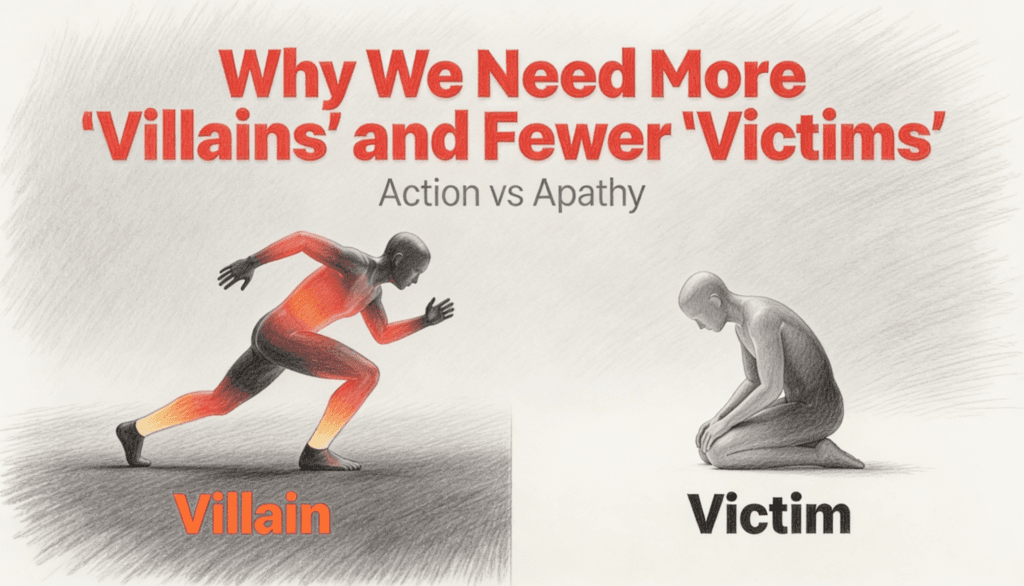
Rand would have looked at our current cultural moment and laughed. Not cruelly, but with the kind of exhausted amusement reserved for watching someone trip over the same rock for the fortieth time. She spent her career arguing that the people society labels as “villains,” the ambitious, the unapologetic, the builders, are the ones who actually move civilization forward. And the people we celebrate as “victims,” those who wear their suffering like a badge and demand the world rearrange itself around their pain, are the ones holding it back.
This is not a popular opinion. It was not popular in 1957 when she published Atlas Shrugged, and it is even less popular now. But popularity and truth have never been close friends.
The Factory of Victimhood
Let us be precise about something. Real victims exist. People suffer genuine injustice. Wars displace millions. Systems fail individuals in concrete, measurable ways. Rand herself fled the Soviet Union, where victimhood was not a lifestyle brand but a daily reality enforced at gunpoint. She knew what actual oppression looked like, which is perhaps why she had so little patience for its manufactured version.
The distinction she drew, and the one we keep refusing to draw, is between people who have suffered and people who have made suffering their identity. The first group deserves compassion. The second group, according to Rand, deserves a mirror and a stern conversation.
Modern culture has built an entire industry around the second group. Social media algorithms reward vulnerability performances. Publishing houses compete for memoirs of trauma. Political movements organize not around shared goals but around shared grievances. The person who stands up and says “I built this, and I am proud of it” is viewed with suspicion. The person who stands up and says “I was wronged, and you owe me” is handed a microphone.
Rand saw this coming with the kind of clarity that makes prophets unpopular at parties.
The Villain Who Builds the Bridge
In Rand’s novels, the so called villains are engineers, architects, and industrialists. Howard Roark in The Fountainhead refuses to compromise his vision. Hank Rearden in Atlas Shrugged invents a metal alloy that could transform civilization. Dagny Taggart keeps a railroad running through sheer willpower while everyone around her seems determined to let it collapse.
These characters are called selfish. They are called dangerous. They are told, repeatedly, that they owe their talent and their effort to people who have done nothing to earn it. And here is the part that makes Rand’s critics uncomfortable: she is not entirely wrong about the dynamic she describes.
Think about it through the lens of everyday life. The person who starts a business, employs fifty people, and works eighty hour weeks is rarely the one collecting praise. More often, they are the target. They should pay more. They should give more. They should feel guilty for succeeding while others have not. The narrative demands that success itself becomes a form of villainy.
Meanwhile, the person who has never risked anything, never built anything, never stayed up until three in the morning solving a problem nobody asked them to solve, gets to sit in moral judgment of those who have. This is the inversion Rand spent her life fighting against. And whether you love her or find her insufferable, the inversion is real.
The Psychology of the Comfortable Cage
There is a concept in behavioral psychology called learned helplessness. In the 1960s, Martin Seligman conducted experiments showing that when animals were repeatedly exposed to unpleasant situations they could not control, they eventually stopped trying to escape, even when escape became possible. They had learned that effort was pointless, so they gave up.
Rand never used this terminology, but she described the same phenomenon in human societies. When a culture tells people that their circumstances are entirely the product of external forces, that they have no agency, no responsibility, and no power to change their own lives, it creates a population of people who stop trying. Not because they cannot succeed, but because they have been taught that trying is either futile or, worse, a betrayal of their identity as someone who has been wronged.
This is the comfortable cage. It looks like compassion from the outside. It feels like solidarity. But it functions as a prison. And the jailer is not some external oppressor. The jailer is the story you tell yourself about why your life is someone else’s fault.
Rand’s “villains” are the people who refuse to enter the cage. They look at the open door, shrug, and walk out. They build things. They fail. They build again. And society, rather than celebrating this, calls them heartless.
Why Selfishness Got a Bad Reputation
Rand titled one of her essay collections The Virtue of Selfishness, which is either a stroke of marketing genius or a catastrophic miscalculation, depending on your perspective. The word “selfish” carries so much cultural baggage that most people stop listening the moment they hear it. But Rand was using the word in a very specific way that almost nobody bothers to understand before arguing against it.
For Rand, selfishness did not mean exploiting others. It did not mean hoarding resources while people starved. It meant placing your own rational self interest at the center of your moral life. It meant refusing to sacrifice your values, your work, and your happiness on the altar of someone else’s need. It meant that you are not a sacrificial animal, and neither is anyone else.
This is where the philosophy gets genuinely interesting, and where most critics miss the point entirely. Rand was not arguing for cruelty. She was arguing against the moral framework that treats self sacrifice as the highest good and self interest as inherently corrupt. In her view, a world full of people pursuing their own productive goals with integrity would be far more humane than a world full of people demanding sacrifices from each other.
Is she right? Partially. The real world is messier than her novels, and she had a tendency to ignore the parts of human experience that did not fit her framework. But the core insight, that turning self sacrifice into a moral obligation creates a culture of resentment and manipulation, is harder to dismiss than her critics would like.
The Problem With Rand (Because There Is One)
No honest assessment of Ayn Rand can ignore her blind spots, and they are significant. She had an almost allergic reaction to any form of collective action, even when collective action is clearly beneficial. She dismissed altruism entirely, when in reality, humans are social creatures who genuinely benefit from cooperation and mutual support. Her novels present a world divided cleanly into producers and parasites, and real life simply does not sort that neatly.
She also had a troubling tendency to aestheticize suffering. In her world, the strong suffer nobly and the weak whine. But strength and weakness are not permanent categories. The same person can be a builder in one season of life and desperately in need of help in another. Rand’s philosophy, taken to its extreme, has no room for this basic human reality.
But here is the thing about philosophical frameworks: you do not have to swallow them whole. You can take the useful parts and leave the rest. And the useful part of Rand’s thinking, the part that remains stubbornly relevant, is her insistence that agency matters more than grievance.
The Economy of Victimhood
There is a practical dimension to this that goes beyond philosophy. Economies do not run on sympathy. They run on production. Every society in history that has prioritized redistribution over creation has eventually run out of things to redistribute. This is not a political statement. It is arithmetic.
Rand understood this with the clarity of someone who had watched it happen in real time. The Soviet Union did not fail because it lacked natural resources or intelligent people. It failed because it systematically punished the “villains,” the innovators, the risk takers, the people with ideas, and rewarded the “victims,” the ones who claimed need as a moral right. When you punish creation and reward consumption, you get less of the first and more of the second. Eventually, the math catches up.
This does not mean we should abandon social safety nets or ignore structural inequality. It means we should stop treating ambition as a disease and dependence as a virtue. The two ideas are not in conflict, except in the minds of people who have decided that nuance is too much work.
What the “Villains” Actually Give Us
Consider a thought experiment. Remove every person from history who was called selfish, ruthless, or dangerously ambitious. Remove the industrialists who built railroads across continents. Remove the inventors who worked obsessively on problems everyone else had given up on. Remove the entrepreneurs who risked everything on an idea that sounded absurd.
What are you left with? A very quiet, very comfortable, very stagnant world. A world with no electricity, no medicine, no art worth remembering, and no progress worth measuring. The “villains” of Rand’s imagination are the people who drag civilization forward, often while civilization is actively trying to stop them.
This is not to romanticize ruthlessness. Plenty of ambitious people have done terrible things. But the solution to bad ambition is not no ambition. It is better ambition. And a culture that treats all ambition as suspect is a culture that is slowly choosing decline.
The Invitation Nobody Wants
Rand’s real provocation was not her defense of capitalism or her rejection of altruism. It was something more personal and more uncomfortable. She was asking each person to take full ownership of their life. Not partial ownership. Not ownership with caveats and exceptions and footnotes about systemic forces. Full ownership.
This is terrifying. It means you cannot blame your parents, your government, your boss, your circumstances, or the universe for where you are. It means that the story of your life is, in the final accounting, the story you chose to write. And if the story is not a good one, the pen is still in your hand.
Most people do not want this invitation. It is much easier to be the victim. The victim gets to rest. The victim gets to point fingers. The victim gets to be right without having to be effective.
But the “villain,” the one who builds, who creates, who refuses to apologize for wanting more out of life, that person gets something the victim never will.
They get to be free.
And freedom, as Rand understood better than almost anyone, is not given. It is built. Brick by brick, idea by idea, refusal by refusal. It is built by people who would rather be called selfish than be called helpless.
The world does not need more people who are comfortable being broken. It needs more people who are willing to be blamed for building something. That is the argument Ayn Rand made sixty years ago. It was unpopular then. It is unpopular now. And it remains, stubbornly and inconveniently, worth considering.