Table of Contents
In 1996, Samuel Huntington published The Clash of Civilizations and the Remaking of World Order and managed to irritate almost everyone. Liberals called him a fearmonger. Conservatives loved him until they realized he was not exactly cheerful about the West either. Academics dismissed the book as reductive. Then September 11 happened, and suddenly everyone was rereading it with a different expression on their face.
But the part of Huntington’s thesis that deserves the most attention today is not about Islam or Confucian Asia or any of the civilizational blocs he mapped out with such confidence. It is about Europe. Or more precisely, it is about what happens when a civilization stops believing it has a future.
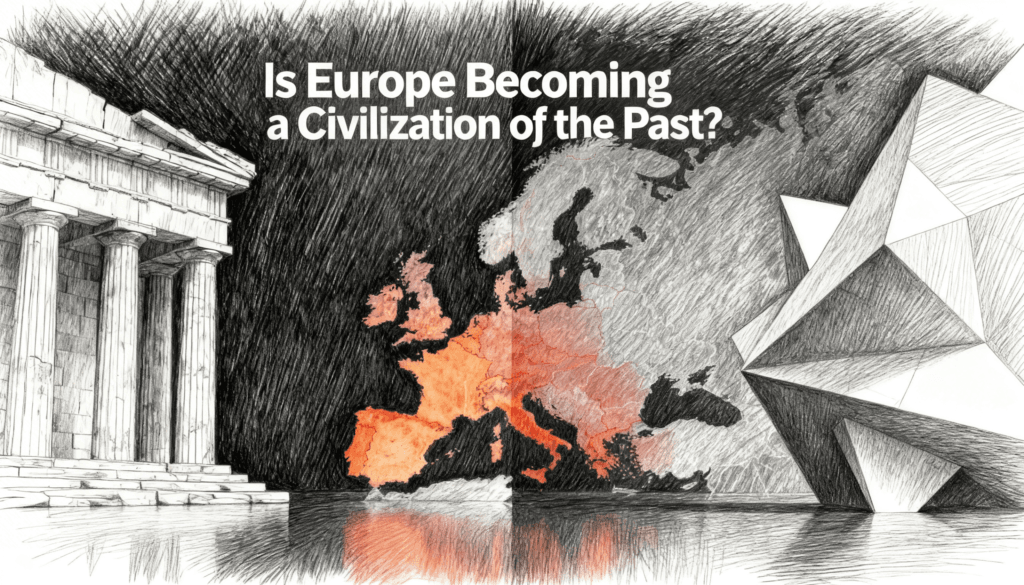
Huntington did not merely argue that civilizations would clash. He argued that some would fade. And he placed Western civilization, with Europe at its demographic and spiritual core, squarely in the category of decline. Not violent collapse. Not dramatic implosion. Something quieter and, in its own way, more unsettling: a slow, voluntary withdrawal from the stage of history.
So the question is not whether Huntington was right about everything. He was not. The question is whether he was right about this.
The Demography Problem Nobody Wants to Talk About
Let us start with the numbers, because numbers do not care about your feelings or your political orientation.
Europe’s total fertility rate hovers around 1.5 children per woman. Replacement level is 2.1. This is not a recent development. It has been the trend for decades. Italy, Spain, and Greece are particularly striking cases, with rates closer to 1.2 or 1.3. South Korea’s situation is worse, but South Korea is not trying to sustain a continental political project built on shared civilizational identity.
Huntington saw this coming. He argued that a civilization that does not reproduce is a civilization that has, on some fundamental level, lost confidence in itself. This is a provocative claim, and it is easy to dismiss as biological determinism. But consider it from a different angle. Throughout human history, societies that believed in their own future tended to have children. Not because they sat down and calculated dependency ratios, but because the future felt like something worth populating.
When an entire continent collectively decides that 1.3 children per couple is sufficient, something beyond economics is at work. Yes, housing is expensive. Yes, childcare is inadequate. Yes, careers demand flexibility. All of this is true. But Japan has many of the same pressures, and Huntington would point out that Japan, too, is a civilization in demographic retreat. The economic explanations are real, but they are not the whole story. They never are.
The counterintuitive aspect here is that Europe’s demographic decline is happening alongside unprecedented material prosperity. Europeans live longer, healthier, more comfortable lives than any generation before them. They have more freedom, more leisure, more choice. And they are choosing, in overwhelming numbers, not to have children. Huntington would say this is not a paradox at all. It is the logical endpoint of a civilization that has replaced transcendent purpose with individual comfort.
What Huntington Actually Meant by Civilization
Before we go further, it is worth clarifying what Huntington meant when he used the word civilization, because it is one of those terms that gets thrown around until it loses all meaning.
For Huntington, a civilization was not a country or an empire or a political system. It was the broadest cultural entity with which people identify. It was shaped by religion, history, language, customs, and institutions, but above all by religion. He was quite explicit about this. Western civilization, in his framework, was fundamentally a product of Western Christianity. The Enlightenment, the scientific revolution, liberal democracy, individual rights, the separation of church and state: all of these grew out of a specific religious and philosophical soil.
This is where Huntington becomes uncomfortable for modern Europeans. Because if Western civilization is rooted in Christianity, and Europe has largely abandoned Christianity, then what exactly is holding the civilization together?
The answer most Europeans would give is values. Democracy, human rights, rule of law, tolerance, equality. These are the pillars of the European project, and they are genuinely admirable. But Huntington would press the point: values derived from what? Sustained by what? A set of abstract principles, untethered from the cultural and religious traditions that produced them, is a remarkably thin foundation for a civilization. It is like cutting a flower from its roots and expecting it to keep blooming indefinitely.
This does not mean Europe needs to return to the pews. That ship has sailed, and trying to reverse it would be both futile and slightly absurd. But it does mean that Huntington’s question remains uncomfortable and largely unanswered. If a civilization defines itself primarily by what it is not (not authoritarian, not theocratic, not illiberal) rather than by what it is, can it sustain itself across generations?
The Institutional Skeleton
Europe’s institutional architecture is extraordinary. The European Union, whatever its flaws, represents one of the most ambitious political experiments in human history. Former enemies sharing a currency, a parliament, a court system, open borders. The fact that a German can wake up in Lisbon, pay for coffee in euros, and never show a passport is a genuine miracle of political engineering.
But Huntington would have looked at this and asked a very different question. He would have asked whether institutions can substitute for identity. And his answer would have been no.
The EU is, by design, a post-civilizational project. It was built to transcend the tribal loyalties and national identities that had torn the continent apart twice in thirty years. This was a noble and entirely rational response to catastrophe. But the result is a political entity that struggles to inspire the kind of loyalty that civilizations require to endure.
Nobody dies for the European Commission. Nobody writes poetry about the Maastricht Treaty. When crises hit, whether the 2008 financial collapse, the 2015 migration wave, or the pandemic, Europeans did not rally around a shared civilizational identity. They retreated to national ones. Germans became more German. Italians became more Italian. The EU held together, but through institutional inertia and economic self-interest, not through the kind of deep belonging that Huntington considered essential.
There is an interesting parallel here with the late Roman Empire, and it is worth drawing carefully because historical analogies are seductive and usually misleading. Rome, too, had extraordinary institutions. Roads, aqueducts, legal codes, a professional military, a common language of administration. What Rome lost, gradually and then suddenly, was the belief system that animated those institutions. By the fourth and fifth centuries, the Roman elite had largely stopped believing in the civic religion that had sustained the republic and early empire. Christianity filled the vacuum, but it was a different kind of civilizational energy, and it produced a different kind of civilization.
Europe today faces a similar vacuum, though the circumstances are obviously different. The institutions remain. The belief system that produced them is fading. And nothing has yet emerged to replace it.
The Migration Question
It is impossible to discuss Huntington and Europe without addressing migration, and it is equally impossible to do so without stepping into a minefield.
Huntington argued that large scale migration from non-Western civilizations into the West would create what he called “cleft societies,” divided along civilizational lines. He was particularly concerned about the capacity of Western societies to assimilate newcomers when those societies were no longer confident in the culture they were asking people to assimilate into.
This is the part of his thesis that generates the most heat and the least light. Critics accuse him of nativism. Supporters use him to justify restrictionism. Both sides tend to miss his actual point, which was more subtle than either camp acknowledges.
Huntington was not arguing that migration is inherently destructive. He was arguing that the success or failure of integration depends on the strength of the receiving culture’s self-understanding. A civilization that knows what it is can absorb newcomers and transform them into participants. A civilization that does not know what it is will struggle to integrate anyone, because there is nothing coherent to integrate into.
Consider France, which has the most explicitly assimilationist model in Europe. France asks newcomers to become French, to adopt republican values, to accept laïcité. But what does it mean to become French in 2026? If you ask ten French intellectuals, you will get twelve answers, and at least three of them will involve a cigarette and an existential shrug.
The integration challenges Europe faces are real, but they are symptoms of a deeper condition. A society that cannot articulate its own identity will inevitably struggle to transmit that identity to others.
The Confidence Gap
There is a concept in evolutionary biology called the “handicap principle.” It suggests that costly signals, like a peacock’s tail, are reliable precisely because they are expensive. Only a genuinely fit organism can afford to carry such a burden.
Civilizational confidence works in a similar way. A civilization that believes in itself projects that belief outward, not through propaganda, but through the everyday confidence of its members. It builds cathedrals that take centuries to complete. It launches expeditions into the unknown. It produces art that assumes it will be appreciated by future generations.
Modern Europe builds quickly, efficiently, and sustainably. It is very good at wind farms and bicycle infrastructure and data privacy regulations. These are genuinely important achievements. But they are the achievements of a civilization optimizing for the present, not one building for a future it expects to inhabit for centuries.
Huntington noticed this shift and interpreted it as a civilizational loss of nerve. Whether that is fair depends on your perspective. A European might reasonably respond that building for centuries is exactly how you get crusades and colonialism and world wars. The European project is, in many ways, a deliberate rejection of civilizational ambition, a conscious choice to be modest, sensible, and humane rather than grand.
But here is the difficulty. Modesty and sensibility do not generate the kind of civilizational energy that sustains a culture across centuries. They are admirable qualities in a person. In a civilization, they may be something closer to a retirement plan.
What Huntington Got Wrong
It would be intellectually dishonest to present Huntington’s thesis without noting its significant weaknesses.
His civilizational categories were far too neat. He drew borders between civilizations as if they were as clear as national boundaries, when in reality cultures blend, overlap, and influence each other constantly. The idea that there is a single “Western civilization” encompassing both a Finnish engineer and a Brazilian evangelical pastor is a stretch that requires considerable squinting.
He also underestimated the power of economics and technology to reshape identity. The internet has created transnational communities of interest that cut across every civilizational line Huntington drew. A gamer in Warsaw has more in common with a gamer in Seoul than with his own grandfather. Whether this constitutes a new form of civilization or merely a new form of distraction is an open question, but it complicates the picture significantly.
And he was too deterministic about decline. Civilizations have reinvented themselves before. The Renaissance was, quite literally, a rebirth. The fact that Europe is in demographic and spiritual decline today does not mean it will be in the same condition in fifty years. History is full of surprises, and predictions of civilizational death have a poor track record.
So Is Europe Becoming a Civilization of the Past?
The honest answer is that it depends on what we mean by Europe.
If we mean the Europe of cathedrals and crusades, of confident Christianity and imperial ambition, then yes, that Europe is already gone, and it is not coming back. Nor should it, frankly. Much of what made European civilization “great” in the traditional sense also made it spectacularly destructive.
If we mean the Europe of the Enlightenment, of individual rights and scientific inquiry and democratic governance, then the situation is more complicated. These ideas have been so successfully exported that they no longer belong to Europe in any meaningful sense. South Korea, Japan, Taiwan, and India are all democracies. The Enlightenment’s greatest triumph may have been making itself universal, which is another way of saying it made itself no longer distinctively European.
And if we mean Europe as a living civilization, a culture that reproduces itself, that inspires loyalty, that generates meaning for its members, then Huntington’s concerns remain disturbingly relevant. A civilization is not a museum. It is not a set of institutions. It is not even a collection of values written on parchment and stored in Brussels. It is a living thing, and living things need energy, purpose, and the will to continue.
Huntington may have been wrong about many of the details. He was not wrong to ask the question. And the fact that Europe has still not produced a convincing answer, thirty years after he posed it, is perhaps the most telling detail of all.
The continent is not dying. But it is not exactly sure what it is living for. And Huntington, wherever he is, would probably say that amounts to the same thing.