Table of Contents
Thorstein Veblen died in 1929, broke and largely forgotten, in a cabin outside Palo Alto. He would have appreciated the irony. The man who spent his career dissecting how the wealthy perform their wealth could not have imagined that nearly a century later, teenagers on a Chinese social media app would prove his theories with more precision than any academic journal ever did.
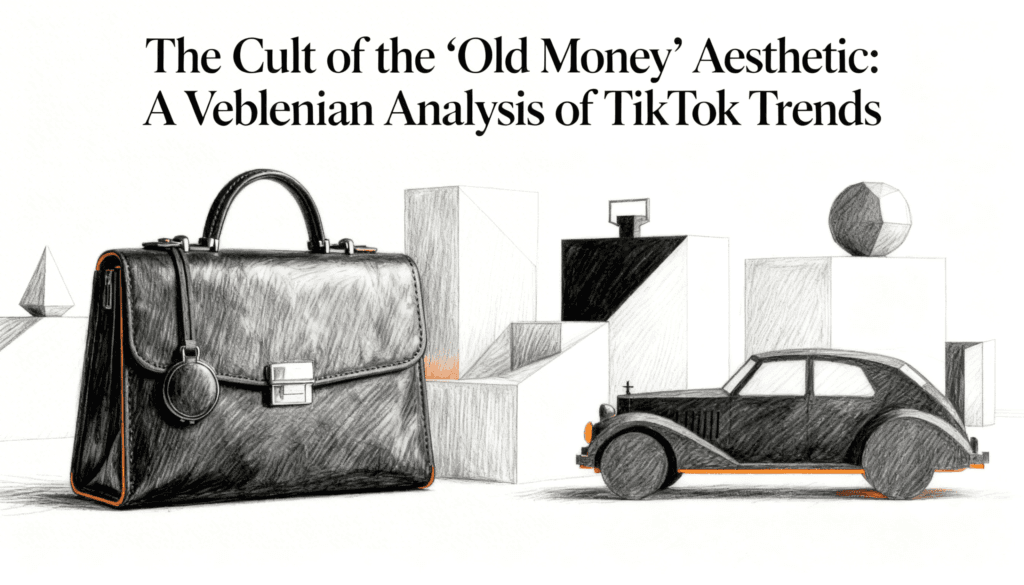
The “old money aesthetic” is one of the most persistent trends on TikTok. If you have somehow avoided it, here is the summary: young people, mostly without generational wealth, curate wardrobes and lifestyles designed to signal that they come from families who have had money for so long that they no longer need to prove it. Quiet fabrics. Neutral colors. Tennis clubs. Leather bound books placed just so on mahogany shelves. The goal is not to look rich. The goal is to look like you have always been rich and find the whole subject rather boring.
This is Veblen’s world. We are all just performing in it.
The Theory That Refuses to Age
In 1899, Thorstein Veblen published The Theory of the Leisure Class, a book that essentially argued that economic life is not really about survival or even comfort. It is about status. Veblen introduced the concept of “conspicuous consumption,” the idea that people buy things not because they need them but because ownership communicates their position in the social hierarchy. He also introduced “conspicuous leisure,” the notion that visibly not working is itself a status signal.
The old money aesthetic on TikTok is both of these concepts fused together and filtered through a ring light.
What makes this trend fascinating is not just that it exists. Status performance has always existed. What makes it worth examining is the specific mechanics of how it operates and the contradictions it cannot escape.
Veblen observed that the upper class of the Gilded Age engaged in elaborate rituals of waste. The point of a massive estate was not shelter. It was proof that you could afford to maintain something far beyond what you needed. The point of employing dozens of servants was not efficiency. It was the visual confirmation that your time was too valuable for domestic labor.
The old money aesthetic follows this logic perfectly, but with a twist Veblen did not anticipate. Today, the conspicuous consumption is not about showing what you bought. It is about showing what you did not need to buy. The entire performance rests on the idea of restraint as the ultimate luxury. A quiet cashmere sweater signals more wealth than a logo covered jacket because it implies that the wearer does not need your recognition.
This is Veblen’s insight turned inside out. The consumption is still conspicuous. It is just wearing a better disguise.
The Paradox of Performing Effortlessness
Here is where things get genuinely interesting. The old money aesthetic is built on a contradiction that would have made Veblen reach for his pen.
The entire point of the look is to appear as though you have not tried. Old money, the theory goes, does not think about fashion. It simply wears what it has always worn. The sweater is cashmere because of course it is. The watch is inherited because watches are inherited. There is no decision being made. There is only tradition flowing through generations like water through a well worn channel.
But the people creating and consuming this content on TikTok are trying extraordinarily hard. They are watching tutorials on how to look like they do not watch tutorials. They are buying affordable versions of garments designed to look like they were not purchased but simply always existed in a closet somewhere in Connecticut. They are studying, with genuine academic intensity, how to perform the absence of effort.
Veblen would have recognized this immediately. He wrote extensively about how the leisure class maintained its position not through raw displays of power but through cultivated taste. Taste, in Veblen’s framework, is never natural. It is learned behavior that has been practiced long enough to appear instinctive. The old money aesthetic crowd on TikTok is essentially trying to speed run a process that traditionally took generations.
And they are doing it on a platform owned by ByteDance, a company valued at roughly $550 billion. The irony is so thick you could spread it on toast.
Why Not New Money?
A reasonable question emerges. If the goal is to signal wealth, why not just signal wealth directly? Why this elaborate detour through understated beige and quiet luxury when you could simply post yourself next to expensive things?
The answer reveals something Veblen understood deeply but rarely gets credit for. Status competition is not static. It evolves. And it evolves specifically in response to what the level below is doing.
For decades, the aspirational aesthetic was loud. Gold chains. Visible logos. Brand names you could read from across a room. This was new money energy, and it worked because access to luxury goods was still relatively restricted. If you wore Gucci, it meant something, because most people could not.
Then two things happened simultaneously. Fast fashion made logo culture accessible to almost everyone. And social media made the display of purchased luxury feel common. When a teenager with a summer job can buy a belt with a recognizable buckle, the belt stops functioning as a status signal. The arms race of conspicuous consumption hit a wall.
So the game changed. The new status signal became the appearance of not playing the game at all.
This is not new behavior. Veblen documented the same pattern among the wealthy of his era. When industrial millionaires began imitating the spending habits of the old aristocracy, the aristocracy shifted to subtler signals. The millionaires bought the biggest houses. So the aristocrats started valuing the oldest houses. The millionaires wore the most expensive clothes. So the aristocrats started valuing clothes that looked like they had been worn for years.
TikTok is replaying this exact dynamic at digital speed. The old money aesthetic is not a rejection of status competition. It is the latest move in a game that has been running for centuries.
The Content Creator as Veblen’s Servant Class
There is another layer here that deserves attention, and it connects to one of Veblen’s less discussed ideas: vicarious consumption.
Veblen argued that the wealthy did not just consume conspicuously themselves. They employed others to consume on their behalf. Servants wore fine uniforms not for their own benefit but to reflect the status of their employer. Wives, in Veblen’s deeply patriarchal era, were expected to display leisure and refinement as a proxy for their husband’s economic power.
TikTok content creators who build audiences around the old money aesthetic are performing a modern version of vicarious consumption, but with a structural difference that Veblen could not have predicted. They are not employed by the wealthy. They are employed, in a sense, by the algorithm. Their labor is to perform a lifestyle on behalf of an audience that wants to consume the fantasy without the financial commitment.
The creator films herself in a linen dress walking through a garden. Millions of viewers experience a vicarious participation in old money life. The creator earns revenue from views. The platform earns revenue from attention. The viewers earn a momentary feeling of belonging to a class they were not born into.
Everyone gets something. No one gets what they actually want.
The Sociology of Beige
It is worth pausing to consider the actual visual language of the old money aesthetic, because the choices are not arbitrary.
The palette is almost exclusively neutral. Beige, cream, navy, forest green, charcoal. There is an absence of bright color that functions as its own kind of statement. In color psychology, neutral tones are associated with stability, tradition, and timelessness. They resist trend cycles by definition. You cannot date a beige sweater the way you can date a neon jacket.
But there is something more going on. The rejection of color is also a rejection of individual expression. The old money aesthetic is deliberately impersonal. It does not want you to stand out. It wants you to blend into a context, a library, a sailing club, a family estate, that itself communicates status. You are not the signal. Your environment is the signal. You are merely proof that you belong there.
This is a radical departure from the dominant logic of social media, which typically rewards individual distinctiveness. The most successful TikTok creators in other genres are the ones who are most uniquely themselves. The old money aesthetic inverts this. It rewards the ability to disappear into a type.
Veblen would connect this to what he called the “instinct of workmanship,” the human desire to be seen as competent and useful within a community. The old money aesthetic redefines competence not as skill or productivity but as belonging. You are not demonstrating what you can do. You are demonstrating where you are from. And “where you are from” is doing an enormous amount of economic and social lifting in that sentence.
What Veblen Missed (and What TikTok Reveals)
For all his brilliance, Veblen had blind spots. His framework assumed that status competition was primarily about the relationship between classes. The wealthy performed for each other and for the classes below them. The lower classes either imitated the wealthy or accepted their position.
TikTok complicates this picture in ways that are genuinely new.
The old money aesthetic is not really being produced for the actual old money class. People with generational wealth are not, by and large, watching TikTok tutorials on how to dress like people with generational wealth. The content is produced by and for the middle class. It is a closed loop of aspiration where the reference point, actual old money families, are largely absent from the conversation.
This creates something Veblen did not theorize: a simulation of class performance that operates independently from the class it claims to represent. The old money aesthetic on TikTok may have very little to do with how genuinely wealthy families actually live. It is a mythology, constructed collectively by people who are imagining what effortless wealth looks like, based on movies, novels, and each other’s TikTok posts.
In this sense, the trend has more in common with fan fiction than with sociology. It is a collaborative fantasy about a world that may not exist in the form being depicted. The Kennedys probably did not spend much time thinking about whether their collar was rolled correctly.
The Uncomfortable Truth
Here is what sits at the bottom of all this, and it is not comfortable.
The old money aesthetic is, at its core, an expression of class anxiety. It emerges from a generation facing genuine economic precarity. Home ownership feels impossible. Student debt is crushing. Career stability is a concept from a different era. In this context, the fantasy of being born into wealth that simply exists, that does not need to be earned or defended, is not just appealing. It is a form of emotional self medication.
Veblen, for all his clinical detachment, understood this. He wrote that the desire for status was not vanity. It was a survival strategy. In a society organized around economic competition, your perceived position determines your access to resources, relationships, and opportunities. Performing status is not shallow. It is rational.
The young people curating their old money feeds are not stupid or superficial. They are navigating a system that has always rewarded the appearance of belonging to the right class. They are just doing it with the tools available to them, which happen to be a smartphone and a $40 sweater from Zara that looks like it could be cashmere if you do not touch it.
Veblen died without money or recognition, in a region that would later become the global capital of new money. His book about the performance of wealth is now itself performed, cited in TikTok videos by creators who may or may not have read it, used as intellectual decoration in the same way a leather bound book is used as visual decoration on a carefully arranged shelf.
The theory of the leisure class is alive and well. It just has a ring light now.