Table of Contents
You woke up this morning as a reasonably decent person. You recycled. You held the door for someone. You even let that car merge in traffic, which practically makes you a saint. Then you opened Instagram, scrolled for eleven minutes, and somehow ended up coveting your neighbor’s kitchen renovation, resenting your best friend’s vacation, and seriously considering buying a $74 candle that smells like “quiet luxury.”
What happened to you?
According to Dan Ariely, behavioral economist and professional chronicler of human irrationality, nothing unusual happened at all. You just did what humans always do when placed inside a carefully engineered environment designed to dissolve your judgment. Your moral compass did not break. It simply got recalibrated by an app that knows more about your weaknesses than your therapist does.
The Honest Truth About Dishonesty
Ariely has spent decades studying why good people do bad things. His research, most notably captured in his book The Predictably Irrational and his work on dishonesty, reveals something uncomfortable. We do not abandon our ethics in one dramatic moment. We erode them in tiny increments so small we barely notice. He calls this the “fudge factor,” the psychological wiggle room we give ourselves to act against our own values while still feeling like moral people.
Here is the key insight. Everyone cheats a little. Almost nobody cheats a lot. In experiment after experiment, Ariely found that people will steal small amounts, cut small corners, tell small lies, but most will not cross into territory that forces them to update their self image from “good person” to “bad person.” We are not trying to maximize our dishonesty. We are trying to maximize our dishonesty while maintaining our self concept as decent human beings.
Now drop that finding into the slot machine of social media, and watch what happens.
The Scroll as a Slow Erosion
Instagram does not ask you to commit a single large moral failing. It never does. That would be too obvious, and you would resist. Instead, it serves you hundreds of micro moments per session, each one gently tugging your values a few degrees off center. A comparison here. A pang of envy there. A tiny lie you tell yourself about why you need something you absolutely do not need.
This is where Ariely’s work connects so precisely to the design of social media. The whole system is built on the fudge factor. You are not doing anything obviously wrong when you scroll. You are just passively consuming content. But each piece of content is a small test of your values, and most of the time, you do not even realize the test is happening.
Consider the way Instagram presents consumption. You see a friend’s new car, and you feel a flicker of something. It is not full blown envy. It is more like a mild dissatisfaction with your own perfectly functional car, which was fine until thirty seconds ago. That flicker is so small it does not register as a moral event. You do not think of yourself as envious. You just scroll past. But the flicker lands somewhere in your brain, and it accumulates alongside the next flicker and the one after that.
By the end of a twenty minute session, your baseline has shifted. Your satisfaction with your own life has dropped a few points. Your desire for things you did not want this morning has increased. Your capacity to feel grateful for what you actually have has been quietly undermined. None of this happened because you made a conscious moral choice. It happened because you were placed in an environment specifically designed to produce this effect.
The Distance Between You and the Consequence
One of Ariely’s most important findings is that dishonesty increases as the distance between the person and the consequence grows. When people deal with actual cash, they cheat less. When they deal with tokens that represent cash, they cheat more. Add one layer of abstraction, and ethical behavior starts to decay.
Social media is an abstraction machine. Everything on it is one or two steps removed from reality. The person you are comparing yourself to is not standing in front of you. They are a curated image on a screen. The envy you feel is not directed at a real experience. It is directed at a photograph of a carefully arranged moment that may not represent anything close to the truth. The purchase you are about to make is not happening in a store where you hand over physical money. It is a tap on a screen that triggers a number changing in your bank account.
Every layer of abstraction that Instagram introduces makes it easier for your moral compass to drift. You are not being cruel to a real person. You are leaving a snarky comment under a post. You are not lying to yourself. You are just engaging with aspirational content. You are not wasting money. You are investing in self care.
The language itself provides cover. And that is exactly how the fudge factor works. You give yourself a slightly different frame for the behavior, and suddenly the behavior feels acceptable.
The Moral Licensing Trap
There is another piece of Ariely’s research that maps perfectly onto the Instagram experience. Moral licensing. This is the phenomenon where doing something good gives you unconscious permission to do something bad afterward. You went to the gym this morning, so you deserve that dessert. You donated to charity, so it is fine to cut corners on your taxes.
Instagram has turned moral licensing into a spectator sport. You watch someone post about their sustainability efforts, and you feel a warm glow of association. You liked the post. You shared the story. You are basically an environmentalist now. Except you have not actually changed any of your own behavior. You have just consumed the aesthetic of moral action and given yourself credit for it.
This is not a small thing. Ariely’s research suggests that moral licensing can actually reduce the total amount of ethical behavior in a system. When people feel they have already done their good deed, they become less likely to do the next one. Instagram creates an endless supply of opportunities to feel morally licensed without ever doing anything morally meaningful.
You reshare a post about ocean plastic. You feel good. You order something from a fast fashion brand that same evening. The two actions feel entirely unconnected to you, but they are linked by a psychological mechanism that social media exploits with ruthless efficiency.
The Peer Effect, Supercharged
Ariely also demonstrated that dishonesty is contagious. When people see others cheating, especially others they identify with, they cheat more themselves. The social norm shifts. If everyone is doing it, the moral cost feels lower.
Instagram is essentially a machine for broadcasting social norms at scale. And the norms it broadcasts are not random. They are curated by an algorithm that has learned what captures your attention, which tends to be content that triggers comparison, aspiration, or outrage. The algorithm does not care about your values. It cares about your engagement. And it turns out that mild moral erosion is extremely engaging.
When you see influencer after influencer promoting products they have never used, exaggerating results they never achieved, selling lifestyles they do not actually live, it normalizes dishonesty. Not the big, dramatic kind. The small, everyday kind that Ariely’s research focuses on. The kind where everyone is stretching the truth just a little, and because everyone is doing it, it stops feeling like stretching the truth at all.
This creates a ratchet effect. The norms shift. What felt like an exaggeration last year feels like standard practice this year. The moral baseline moves, and it moves for everyone simultaneously, which means no individual person feels like they have moved at all.
The Confession Booth That Absolves Nothing
Here is where it gets genuinely interesting. Ariely found that giving people the opportunity to confess or reset their moral slate actually reduced subsequent cheating. When people acknowledged their transgressions, even privately, it restored their moral compass. The act of recognition itself had power.
Social media offers a twisted version of this mechanism. People regularly post about their screen time guilt, their comparison spirals, their shopping habits. The language of self awareness is everywhere. “I know I should not care about this, but…” “I am so bad, I just spent three hours scrolling.” “I really need to do a digital detox.”
But this awareness does not function as a genuine moral reset. It functions as another form of the fudge factor. You acknowledge the problem, which makes you feel honest about it, which gives you permission to continue doing it. The confession becomes a feature of the cycle, not a disruption of it.
Ariely’s research would predict exactly this. A confession only works as a reset if it is followed by a genuine change in behavior. If the confession itself becomes part of the routine, it loses its corrective power and becomes another layer of self deception.
What Game Theory Reveals Here
There is a fascinating parallel between Ariely’s moral erosion research and what happens in game theory when you introduce repeated interactions with imperfect information. In classic game theory, the prisoner’s dilemma shows that two rational actors will often choose betrayal even when cooperation would benefit them both. But in repeated games, cooperation can emerge because players can punish defection over time.
Social media breaks this mechanism. The interactions are so fragmented, so numerous, and so fleeting that there is no meaningful reputation cost for small defections. You cannot punish an influencer for mildly exaggerating the effectiveness of a serum. There are too many of them, the exaggerations are too small, and you will forget about it in four minutes because the next piece of content has already appeared. The conditions that allow cooperation and honesty to emerge in repeated social interactions are precisely the conditions that Instagram’s design eliminates.
The Real Problem Is Not Weakness
What makes Ariely’s framework so valuable for understanding social media is that it removes the morality tale. The standard narrative about people and their phones is that we are weak, addicted, and lacking in discipline. If we just tried harder, we would scroll less, compare less, buy less.
But Ariely’s research tells a different story. The problem is not individual weakness. The problem is environmental design. Humans have predictable patterns of moral behavior, and those patterns respond to context. Change the context, and you change the behavior. It does not matter how principled you are. Place any person in an environment engineered to exploit the fudge factor, and the fudge factor will activate.
This is both the most discouraging and the most liberating insight from this research. Discouraging because it means you cannot simply willpower your way out of the problem. Your moral compass is not a fixed instrument. It is a sensitive device that responds to its surroundings, and your surroundings are being designed by people whose financial incentives are directly opposed to your psychological wellbeing.
But it is liberating because it means you are not morally deficient for feeling the pull. Every human in the history of the species would feel the same pull in the same environment. The question is not whether you are a good enough person to resist Instagram. The question is whether you are strategic enough to change your relationship with it.
Redesigning Your Own Environment
Ariely’s work consistently points toward the same conclusion. If you want to change behavior, change the environment. Do not rely on motivation. Do not rely on willpower. Change the structural conditions that shape the behavior in the first place.
For social media, this means the most effective interventions are not the ones that require you to be stronger. They are the ones that reduce your exposure to the triggers. Unfollow accounts that consistently make you feel worse. Set time limits that are enforced by your phone, not by your good intentions. Move the app off your home screen. Replace the habit loop with something that does not feed the comparison engine.
None of this is groundbreaking advice. But it is advice that is grounded in a specific understanding of why the problem exists. You are not fighting your own weakness. You are redesigning your environment to stop exploiting a predictable feature of human moral psychology.
The Compass Is Not Broken
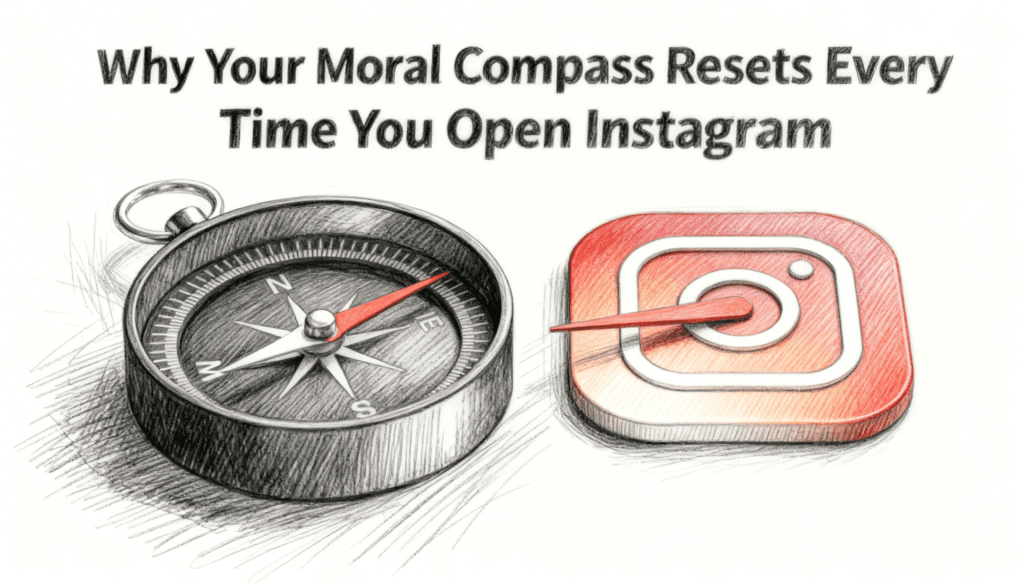
Your moral compass works fine. It has always worked fine. The issue is that you are carrying it through a magnetic field every time you open that app, and magnetic fields make compasses spin. You do not need a new compass. You do not need to be a better person. You need to stop walking through the field and wondering why north keeps moving.
Dan Ariely did not study Instagram specifically. But he studied you. And the you he described, the one who cheats a little, who rationalizes effortlessly, who responds to context more than conscience, that is the exact person Instagram was designed to engage. Not the best version of you. Not the worst version. Just the most predictable one.
The good news is that predictability works both ways. If you can predict the drift, you can correct for it. But only if you stop pretending the drift is not happening. And that might require something more radical than a digital detox. It might require you to sit with the uncomfortable truth that your values are not as fixed as you thought they were, and that the first step to protecting them is admitting how easily they move.