Table of Contents
There is a certain comfort in watching diplomats sign documents. The pens are expensive. The tables are long and polished. Everyone wears serious faces and shakes hands for the cameras. And then, somewhere between the champagne toast and the morning news cycle, the document starts to decay. Not physically. Physically it will be preserved in some climate controlled archive for centuries. But its authority, its actual force in the world, begins to evaporate the moment the balance of power shifts beneath it.
Thucydides understood this roughly 2,400 years ago. Writing about the Peloponnesian War, the Athenian historian laid out a vision of international relations so bleak and so persistent that we are still catching up to it. His core observation was deceptively simple: the strong do what they can, and the weak suffer what they must. Treaties, alliances, and sworn oaths were not irrelevant in his world. They were just not the foundation. The foundation was always power. Military power, specifically. Everything else was decoration.
This is not a comfortable idea. It is, however, an idea that refuses to die, mostly because history keeps proving it right.
The Melian Dialogue and the Polite Fiction of Fairness
The most famous passage in Thucydides is probably the Melian Dialogue, and it deserves its reputation. The island of Melos wanted to remain neutral during the war between Athens and Sparta. The Athenians arrived with a fleet and made their position clear. They did not bother with moral arguments. They did not claim the gods were on their side. They simply pointed out that Melos was weak and Athens was strong, and that this fact alone determined what would happen next.
The Melians appealed to justice. The Athenians essentially replied that justice is a concept that only operates between equals. Between the strong and the weak, the only relevant question is capability.
Melos refused to surrender. Athens destroyed it. The men were killed, the women and children enslaved.
Now, it would be easy to read this as a story about ancient cruelty, something we have moved past. But consider the structure of the argument rather than the specific brutality. Strip away the siege engines and the triremes. What remains is a pattern that plays out in boardrooms, trade negotiations, and United Nations sessions with remarkable consistency. The party with more leverage dictates terms. The party with less leverage can accept those terms, or it can resist and face consequences. The treaty, if one gets signed at all, reflects the power imbalance. It does not correct it.
Paper Promises: A Brief Tour of Broken Agreements
If treaties were genuinely binding in some absolute sense, history would look very different. Consider a few examples.
The Treaty of Versailles was supposed to end all major European wars. It was comprehensive, punitive, and signed by all the relevant parties. It lasted about twenty years before the continent was on fire again. The treaty did not fail because of a drafting error. It failed because Germany rebuilt its military capacity and decided the terms were no longer acceptable. The document could not enforce itself. It needed France, Britain, and their allies to enforce it. When those nations lacked the will or the readiness to do so, the paper became meaningless.
The Munich Agreement of 1938 is almost a parody of treaty faith. Neville Chamberlain waved that piece of paper and declared peace for our time. Hitler had signed it. Within months, the agreement was worthless. Not because the language was ambiguous, but because one party had the military strength to ignore it and the other lacked the military will to enforce it.
Move forward to the Budapest Memorandum of 1994. Ukraine gave up its nuclear arsenal, the third largest in the world, in exchange for security assurances from Russia, the United States, and the United Kingdom. Russia signed. Everyone signed. In 2014, Russia annexed Crimea. The memorandum did not prevent this. It could not. A document without a credible enforcement mechanism is a suggestion, not a guarantee. Ukraine learned this lesson at extraordinary cost.
The pattern is not subtle. Treaties hold when the power behind them holds. When the power shifts or erodes, the treaty follows.
The Realist Tradition: Thucydides to Kissinger
Thucydides was not writing self help advice for city states. He was describing what he considered the permanent structure of human conflict. Centuries later, this line of thinking became known as political realism, and it has attracted some of the sharpest and most controversial minds in political thought.
Thomas Hobbes translated Thucydides into English and built an entire political philosophy on a similar foundation. Without a sovereign power to enforce agreements, Hobbes argued, promises are just words. The “state of nature” was not a historical period but a permanent condition lurking beneath every social contract, ready to reassert itself the moment enforcement disappeared.
Niccolò Machiavelli, writing in Renaissance Florence, put it even more directly. A prince must know how to use force, because those who rely solely on agreements will find themselves outmaneuvered by those who do not. Machiavelli was not celebrating violence. He was noting, with the clinical detachment of a coroner, what actually happens when idealism meets power.
In the twentieth century, Hans Morgenthau and later Henry Kissinger carried this tradition into modern international relations theory. Morgenthau argued that the desire for power is a fundamental human drive, and that international politics is therefore a constant struggle for advantage. Kissinger practiced what Morgenthau preached, conducting diplomacy that was always calibrated to the balance of military and economic force.
What connects all these thinkers across millennia is a shared skepticism about the independent force of agreements. They do not say treaties are useless. They say treaties are symptoms. They reflect existing power arrangements. They do not create new ones.
The Counterargument: Does International Law Matter at All?
Here is where things get interesting, because the pure realist position has a problem. If treaties are truly nothing more than power dressed in formal language, then why does anyone bother signing them? Why do nations spend enormous diplomatic energy negotiating terms, debating clauses, and establishing international institutions?
The liberal internationalist tradition offers a genuine counter. Institutions like the European Union, the World Trade Organization, and various arms control regimes have, in many cases, changed state behavior in ways that pure power calculations would not predict. France and Germany have not gone to war since 1945, and while the presence of NATO and American military power certainly contributed, the dense web of economic and legal integration between them also matters. It is hard to invade your largest trading partner. The cost benefit analysis changes when your economies are entangled.
There is also what scholars call the “audience cost” of breaking treaties. When a government signs an agreement, it stakes its reputation. Breaking that agreement carries a diplomatic price. Other nations take note. Future negotiations become harder. This is not a trivial consideration, especially for nations that depend on a network of alliances and trade relationships.
So the counterargument is real. But notice something important: even the most successful international institutions work best when they are backed by credible power. The EU’s foundational peace rests, in no small part, on the American security umbrella. The WTO’s dispute resolution mechanism works because major economies have incentives, including economic and military ones, to maintain the trading system. Remove the power structure underneath these institutions, and their authority becomes an open question.
The counterargument does not refute Thucydides. It complicates him. That is a useful distinction.
A Lesson From Game Theory
There is a fascinating connection here to a completely different field. In game theory, the concept of a “credible commitment” is central. A promise is only meaningful if the party making it has both the ability and the incentive to follow through. If I promise to punish you for cheating but I lack the means to do so, my promise is not credible, and you will cheat.
This maps almost perfectly onto Thucydides. A treaty is a form of mutual promise. Its credibility depends entirely on whether the signatories can and will enforce its terms. The army behind the treaty is not a metaphor here. It is the literal mechanism of credible commitment. Without it, the treaty is what game theorists would call “cheap talk,” costless signaling that rational actors will ignore when it suits them.
Thomas Schelling, the Nobel Prize winning economist who studied nuclear strategy, made this point with terrifying clarity during the Cold War. Deterrence worked not because of treaties but because both the United States and the Soviet Union maintained the capability and the apparent willingness to use nuclear weapons. The various arms control agreements between them were useful, but they were downstream of the military reality. If either side had disarmed unilaterally, no piece of paper would have prevented the other from exploiting the advantage.
The Cold War, in this reading, was Thucydides with thermonuclear weapons. The technology changed. The logic did not.
The Uncomfortable Present
Apply this framework to the present and the implications are sobering. The rules based international order that emerged after World War II is under significant strain. Not because anyone has formally renounced the United Nations Charter, but because the distribution of power that underwrote that order is shifting.
China’s military expansion in the South China Sea proceeds despite multiple international rulings against it. Russia’s invasion of Ukraine continues despite near universal condemnation. Various arms control agreements have collapsed or been abandoned. In each case, the pattern is the same. The agreements remain on paper. The power dynamics have moved elsewhere.
This is not a call for cynicism. Understanding that treaties require enforcement is not the same as saying we should abandon treaties. It is closer to saying we should stop treating them as independent forces and start treating them as tools that require maintenance. A treaty without the military, economic, and political will to enforce it is not a safeguard. It is a comfort blanket.
What Thucydides Actually Offers
The great irony of Thucydides is that he is often read as a pessimist, but his work is more useful than that. Pessimism says nothing can be done. Thucydides says something very different. He says: look clearly at how power operates, and you will make better decisions.
The Athenians at Melos were not admirable. Thucydides does not present them as such. But they were honest about the mechanics of their world in a way that the Melians, clinging to abstract justice, were not. And that honesty, however brutal, is itself a form of knowledge.
The lesson for modern statecraft is not that might makes right. It is that right without might is precarious. If you want your agreements to hold, you need more than good language and good intentions. You need the capacity to make defection costly.
This is why nations maintain armies even during peacetime. This is why alliances like NATO require member states to meet defense spending targets. This is why nuclear powers do not give up their arsenals on the basis of promises alone. The people running these systems may not have read Thucydides, but they operate within the world he described.
The Final Thought
There is something almost poetic about the durability of Thucydides. He wrote about a war between Greek city states that most people could not locate on a map. And yet his observations about power, agreements, and human nature keep surfacing in contexts he could never have imagined.
Nuclear deterrence. Trade wars. Cyber conflict. The technology changes. The venues change. The fundamental dynamics remain stubbornly intact.
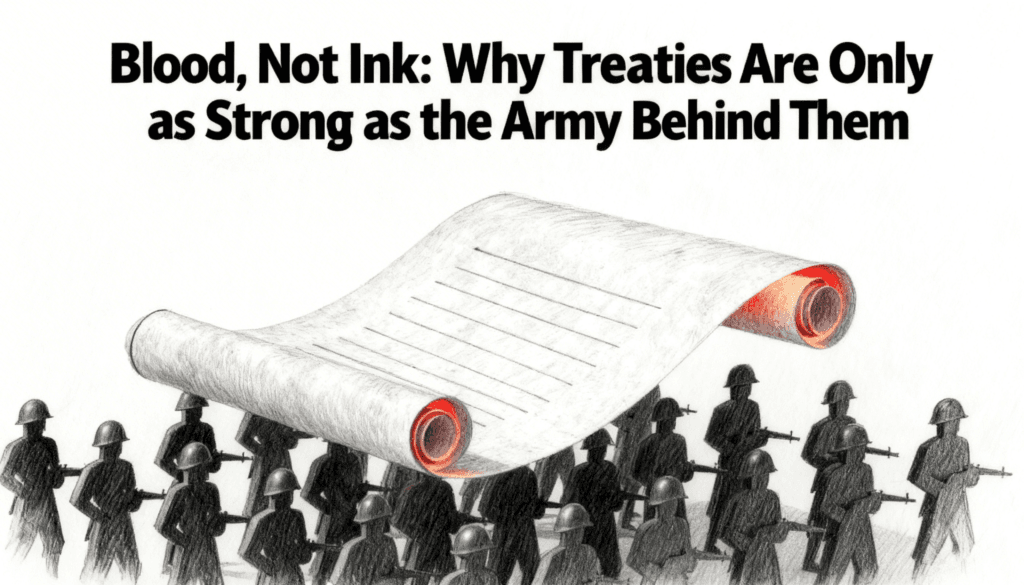
Treaties are not worthless. But they are not magic either. They are contracts, and like all contracts, they are only as good as the enforcement behind them. The ink on the page means nothing without the blood, or at least the credible threat of it, standing behind every clause.
Thucydides did not write this to make us feel good. He wrote it to make us see clearly. Twenty four centuries later, clear vision remains in short supply. But the need for it has not diminished by a single degree.