Table of Contents
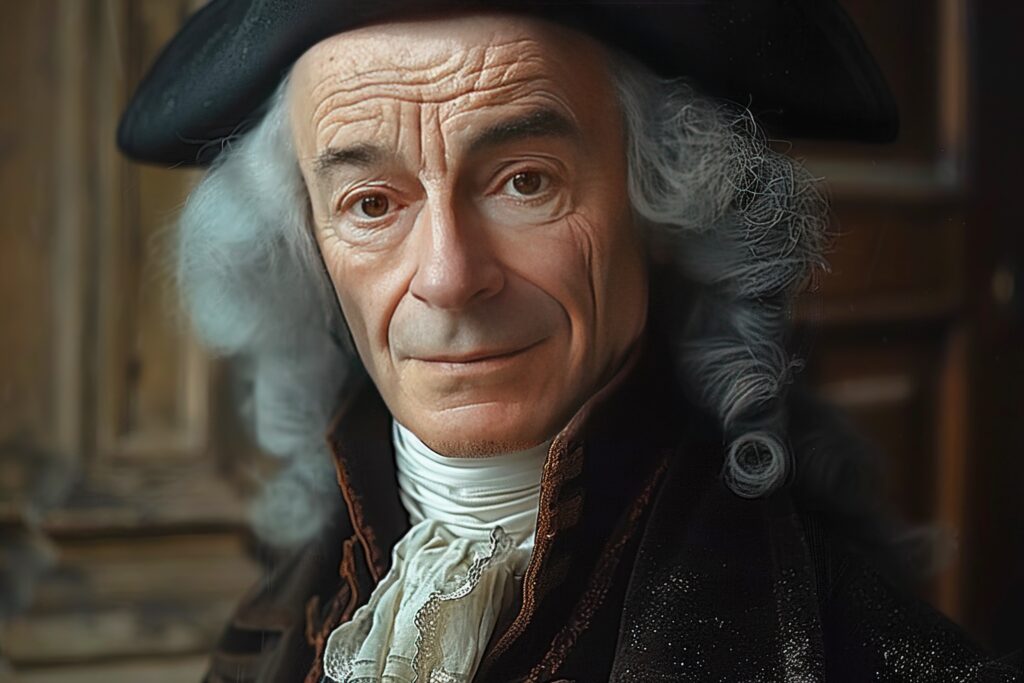
Voltaire never actually said “I disapprove of what you say, but I will defend to the death your right to say it.” That line was written by his biographer, Evelyn Beatrice Hall, summarizing his attitude. Which is fitting, really. We live in an age where misattributed quotes travel faster than verified ones, and where the spirit of what someone meant matters less than whether the words they used might offend someone, somewhere, at some point in time.
But Voltaire did say plenty. He spent years in exile. He was imprisoned in the Bastille. Twice. His books were burned. He was banned from Paris for mocking the regent. The man knew what it meant to have his speech policed by people who believed they were protecting the moral order. He would have recognized our current moment immediately. Not because it is identical to 18th century France, but because the underlying mechanics are eerily familiar.
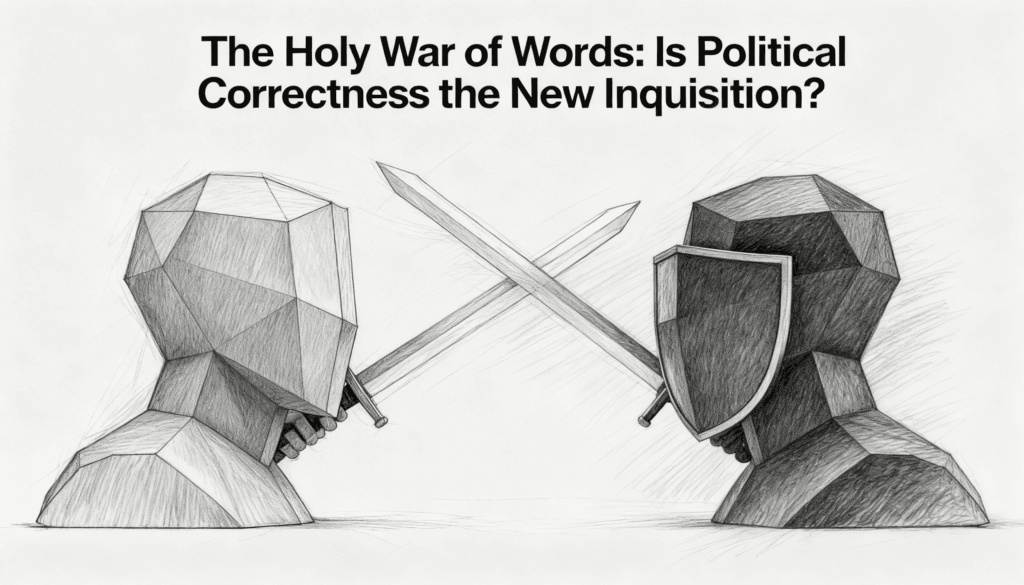
The question is not whether political correctness exists. It obviously does. The question is whether it has crossed a line from reasonable social expectation into something that resembles, however loosely, the inquisitorial impulse: the desire to enforce orthodoxy through punishment, public shame, and the careful monitoring of language for signs of heresy.
The Original Inquisition Had Paperwork Too
The Spanish Inquisition was not just men in robes shouting about blasphemy. It was a bureaucracy. It had rules of evidence, formal proceedings, designated investigators, and an entire system designed to identify, categorize, and punish deviation from accepted belief. The accused often did not know who had reported them. The charges were sometimes vague. And the punishment was not always physical. Social death, the destruction of reputation, the loss of livelihood, these were tools in the inquisitor’s kit long before anyone coined the term “cancel culture.”
This is not to say that being criticized on Twitter is the same as being tortured on a rack. That comparison is absurd and insulting to the people who actually suffered under religious persecution. But systems of enforced conformity do not need to be equally brutal to share structural similarities. A parking ticket is not a prison sentence, but both involve the state penalizing behavior it deems unacceptable. Scale matters. Proportion matters. But pattern recognition is not the same as false equivalence.
What Voltaire would have noticed is the procedural nature of modern speech policing. There are formal complaints. There are investigations. There are tribunals, sometimes literally, in universities and workplaces. There are designated officers whose job is to receive reports of offensive language. There are lists of words and phrases that have been deemed unacceptable, lists that shift and expand with remarkable speed. The infrastructure exists. The question is whether the infrastructure serves justice or merely serves itself.
When Protection Becomes Control
Here is where it gets interesting, and where honest people should be willing to sit with discomfort.
Political correctness, in its original and best form, was a corrective. Language does shape thought. The words we use to describe people do affect how we treat them. Eliminating slurs from public discourse, insisting on basic dignity in how we refer to marginalized groups, challenging the casual cruelty embedded in everyday speech: these were genuine moral achievements. Nobody serious argues that we should return to an era where bigoted language carried no social consequences.
But correctives have a tendency to overcorrect. Resistance movements have a tendency to become the thing they resisted. Voltaire saw this happen with the French Catholic Church, which had itself been a persecuted minority under Rome before becoming one of the most powerful instruments of persecution in European history. The pattern is not unique to religion. It is human.
The shift from “we should not use slurs” to “we should carefully monitor all language for potential harm” is not a small step. It is a category change. The first is a reasonable social norm. The second is an epistemological project. It assumes that harm can be reliably identified in advance, that intent is irrelevant, that the subjective experience of the listener is the final authority on meaning, and that language can and should be engineered to prevent discomfort.
These are enormous assumptions. And they are rarely examined because examining them has itself become suspect.
The Paradox of Tolerance, Except It Is Not Really a Paradox
Karl Popper gets cited constantly in these debates. His “paradox of tolerance,” the idea that unlimited tolerance leads to the destruction of tolerance, has become a kind of philosophical permission slip for shutting down speech that someone, somewhere, has classified as intolerant.
But Popper was more careful than his internet disciples. He specifically said that suppression of intolerant speech should be a last resort, used only when rational argument has failed and when the intolerant party has resorted to violence. He did not argue that uncomfortable ideas should be preemptively silenced because they might, theoretically, contribute to a climate that could, eventually, lead to harm.
The distance between Popper’s actual argument and how it gets deployed today is roughly the distance between “we should have a fire department” and “we should burn down every building that might one day catch fire.” The precautionary principle, applied without limits, becomes indistinguishable from paranoia.
Voltaire would have appreciated this irony. He spent his career arguing that the Church’s desire to prevent heresy was itself the greater threat to human welfare. The inquisitors believed they were protecting souls. They believed the stakes were infinite: eternal damnation versus eternal salvation. When you believe the stakes are infinite, any means of prevention seems justified. When you believe that words are violence, that speech can be a form of assault, you have created your own version of infinite stakes. And the logic of prevention takes over.
The Economics of Outrage
There is a dimension to this that Voltaire, for all his brilliance, could not have anticipated: the market.
Modern outrage is not just a moral phenomenon. It is an economic one. Social media platforms are designed to maximize engagement. Engagement is maximized by emotional intensity. Emotional intensity is maximized by conflict. Conflict is maximized by outrage. Outrage is maximized by the perception that someone has violated a sacred norm.
This means there is a financial incentive, built into the architecture of our communication systems, to identify violations, amplify them, and punish transgressors. The inquisitor at least had to travel to the village and conduct an investigation. The modern equivalent can be accomplished in thirty seconds with a screenshot and a caption. The accusation is the trial. The retweet is the verdict. The algorithm is the executioner.
This is not a conspiracy. Nobody designed it this way on purpose. It is an emergent property of systems optimized for attention. But the effect is that speech policing has been industrialized and privatized simultaneously. It does not need a central authority because the crowd functions as a distributed one. Voltaire had to worry about the King and the Church. A contemporary writer has to worry about everyone, all at once, all the time.
The result is something that looks less like an inquisition and more like a stock market. The value of words rises and falls. Terms that were acceptable yesterday become toxic overnight. Phrases that were neutral become loaded. And nobody publishes the updated price list in advance. You find out a word has been devalued when the portfolio of your reputation crashes.
The Chilling Effect Is the Point
Free speech advocates often talk about the “chilling effect,” the idea that even without formal censorship, the fear of punishment causes people to self-censor. Critics of this argument say the chilling effect is exaggerated, that people are still saying controversial things all the time, that the real issue is that powerful people do not like being criticized.
Both sides are partially right. Powerful people absolutely do hide behind free speech rhetoric to avoid accountability. And self-censorship is absolutely increasing among ordinary people who are not powerful and who have real things to lose.
But here is the part that rarely gets said: for some advocates of political correctness, the chilling effect is not an unfortunate side effect. It is the desired outcome. The entire point is to make people think twice before they speak. The entire point is to create social consequences that deter certain kinds of expression. This is stated openly. “Think before you speak” is the polite version. The less polite version is “speak at your own risk.”
This is where the inquisition comparison gains some real traction. The purpose of the Inquisition was not primarily to punish heretics. It was to prevent heresy by making the cost of deviation so high that most people would conform voluntarily. The auto-da-fé was a spectacle designed to educate the public about what happens when you stray. The modern equivalent is the viral destruction of someone’s career over a poorly worded tweet. The audience is meant to learn from the example.
Voltaire understood this mechanism perfectly. He wrote in a letter: “It is dangerous to be right in matters where established men are wrong.” Substitute “established men” with “established consensus” and the sentence does not need updating.
Here is something that might surprise both sides of this debate: the most effective tool against genuine bigotry is not speech control. It is more speech. And the evidence for this is not theoretical. It is historical.
The civil rights movement did not succeed by silencing racists. It succeeded by speaking louder, more clearly, and more persuasively than the opposition. It changed minds by exposing injustice to public view, not by preventing racists from expressing their views. Martin Luther King Jr. did not call for his opponents to be deplatformed. He called for them to be confronted, debated, and defeated in the arena of public opinion.
The same is true of the feminist movement, the gay rights movement, and virtually every successful social justice campaign in modern history. They won by expanding discourse, not restricting it. They won because their arguments were better, not because their opponents were silenced.
This suggests something uncomfortable for the modern speech police: the impulse to control language may not only be illiberal. It may also be ineffective. Suppressed ideas do not disappear. They go underground, where they ferment without challenge. Banned books become more attractive, not less. Forbidden thoughts gain the allure of the transgressive. The Inquisition did not eliminate heresy. It drove it into the shadows where it grew teeth.
Where Voltaire Would Stand
Voltaire was not a saint. He was an elitist, frequently cruel in his personal dealings, and held views on race that would rightly be condemned today. He was, in other words, a complicated human being who was capable of both profound insight and significant moral failure. Like most of us.
But on the question of speech, his position was remarkably consistent. He believed that the free exchange of ideas was the foundation of human progress. He believed that authorities, whether religious, political, or cultural, should not have the power to determine which ideas were permissible. He believed that bad ideas should be defeated by better ideas, not by force.
He also believed that the people most eager to silence others were usually the people most afraid of what those others might say. The censor reveals more about his own fears than about the danger of the censored material.
If Voltaire were alive today, he would almost certainly find much of the current discourse exhausting. He would mock the purity spirals, the competitive victimhood, the performative outrage. He would also mock the people who invoke free speech to avoid all criticism, the grifters who monetize controversy, the politicians who confuse being offensive with being brave.
He would, in short, be an equal opportunity irritant. Which is precisely what we need.
The Real Question
Political correctness is not the new Inquisition. The comparison flatters both sides: it makes the speech police sound more powerful than they are, and it makes their critics sound more persecuted than they are.
But the inquisitorial impulse, the desire to enforce orthodoxy, to punish deviation, to monitor language for signs of incorrect thought, that impulse is real. It is ancient. And it does not belong to any one political tribe. The right has its own orthodoxies, its own heresies, its own mechanisms of punishment. The left has merely been more successful at institutionalizing its version in recent decades.
The answer is not to abandon standards of decency. The answer is not to pretend that words have no consequences or that all speech is equally valuable. The answer is to resist the temptation to build systems of enforcement that are more dangerous than the problems they claim to solve.
Voltaire spent his life arguing that the cure for bad speech is better speech, not silence. Two and a half centuries later, we are still arguing about it. The fact that we can argue about it at all is proof that, so far, his side is winning.
But only so far.