Table of Contents
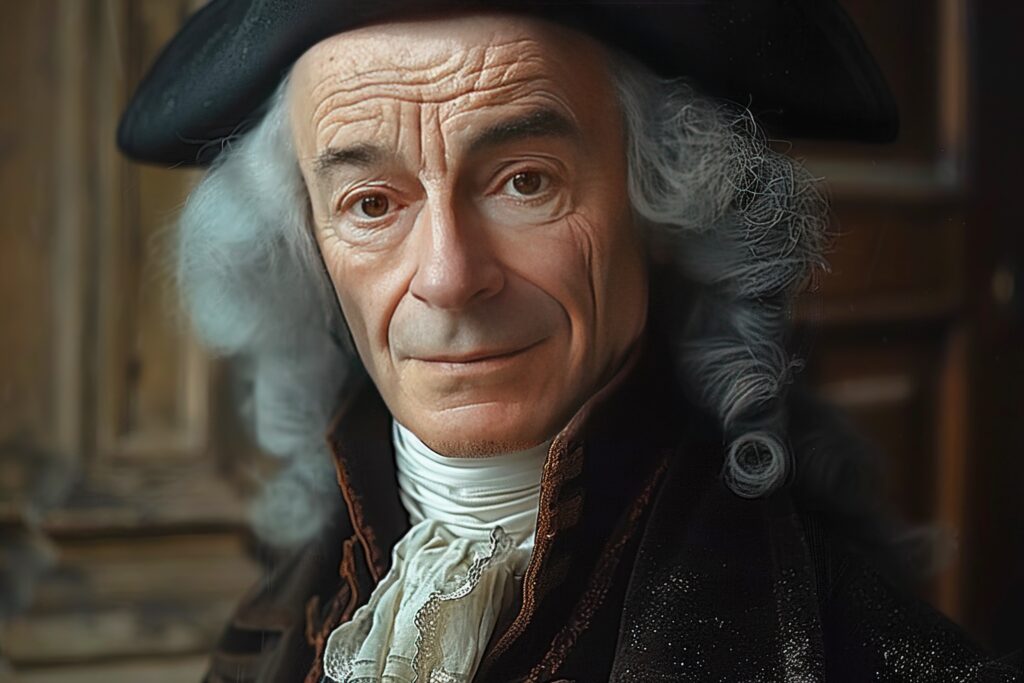
In 1803, a French economist named Jean-Baptiste Say made a claim that most people ignored for about two hundred years. He argued that the entrepreneur’s real job was not to own land or accumulate capital. It was to combine knowledge, judgment, and imagination into something the world did not yet know it needed. He called this the act of the entrepreneur. Everyone else called it philosophy and went back to counting gold coins.
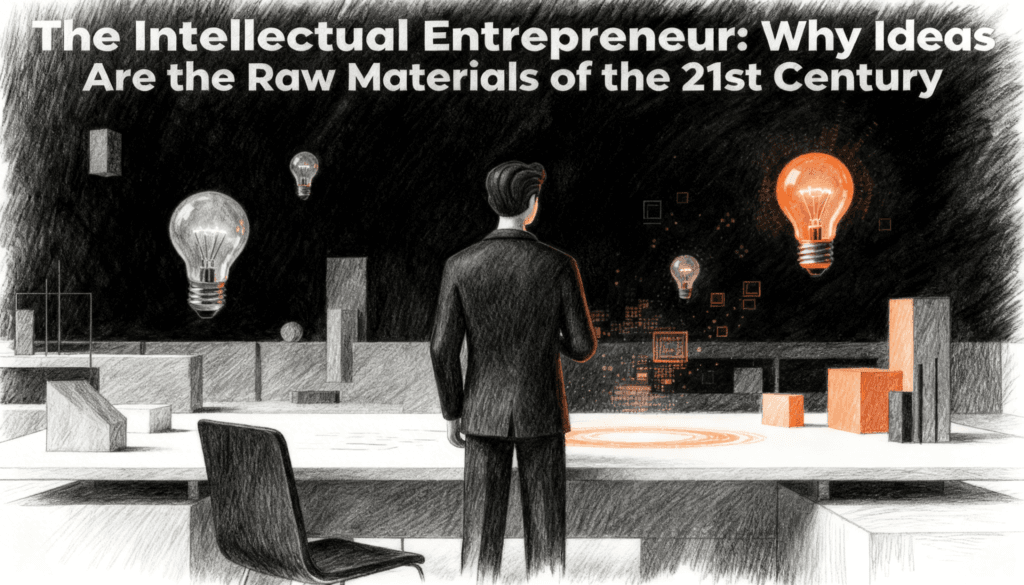
Two centuries later, we are finally catching up to what Say understood. The most valuable companies on the planet do not mine copper or drill for oil as their primary act of creation. They architect ideas. They design systems of thought. They sell, in the most literal sense, organized information. The raw materials of this century are not raw at all. They are refined, abstract, and absurdly powerful.
This is the age of the intellectual entrepreneur. And if you are still thinking about business as a game of physical resources, you are playing checkers on a chess board.
What Say Actually Meant
Most people who cite Jean-Baptiste Say do so to invoke “Say’s Law,” the often misquoted principle that supply creates its own demand. But Say’s more radical insight had nothing to do with macroeconomic equilibrium. It had to do with the nature of the entrepreneur.
Say divided the economic world into three ingredients: human industry, capital, and natural agents. But he insisted that the entrepreneur was not merely someone who combined these inputs mechanically. The entrepreneur was the person who applied knowledge and judgment to create value where none existed before. The factory owner who simply ran machines was not an entrepreneur in Say’s framework. The person who saw a new use for those machines, who reimagined the factory itself, was.
This distinction matters enormously. Say was not describing a manager. He was describing a thinker. Someone whose primary contribution was intellectual, not operational. In his time, this was a strange thing to say. Land was wealth. Gold was wealth. The idea that a person’s mental framework could be the most important factor of production was, frankly, bizarre.
It is not bizarre anymore.
The Strange Economics of Weightless Goods
Here is something that should bother any traditional economist. The most valuable product Microsoft has ever created weighs nothing. It occupies no warehouse. It requires no shipping container. Windows, Office, Azure: these are patterns of logic encoded in electrical signals. The marginal cost of producing one more copy is so close to zero that it might as well be a rounding error.
This is not a minor footnote in economic history. It is a fundamental rupture. For most of human civilization, wealth creation was bound to physical constraints. You needed land to grow wheat. You needed iron to make steel. You needed lumber to build ships. Every act of production was, at its core, an act of transformation upon matter.
The intellectual entrepreneur operates under different physics. Ideas do not deplete when shared. They do not degrade with use. In fact, they often become more valuable the more widely they spread. A piece of software used by one person is a curiosity. The same software used by a billion people is an ecosystem. This is the opposite of how oil works. Nobody has ever said that petroleum becomes more useful the more of it you burn.
This inversion creates a peculiar economic landscape. The scarce resource is no longer the material. It is the idea that organizes the material. It is the concept, the framework, the architecture of thought that determines what gets built and why. Say would have recognized this immediately. Most of his contemporaries would have asked him to please stop talking and go inspect the textile mill.
Why Execution Without Ideas Is Just Expensive Movement
There is a popular saying in startup culture: ideas are worthless, execution is everything. This sounds practical and tough minded. It is also, upon examination, almost completely wrong.
Execution without a governing idea is just activity. It is motion without direction. You can execute brilliantly on a terrible concept and produce a beautifully engineered product that nobody wants. The history of business is littered with companies that executed flawlessly and failed spectacularly because the foundational idea was broken.
Consider Quibi, the short form streaming platform that launched in 2020 with $1.75 billion in funding, Hollywood talent, and a leadership team with decades of experience. The execution was professional. The technology worked. The content was polished. The idea, that people wanted to pay for premium ten minute videos on their phones, turned out to be wrong. Six months later, Quibi shut down. All that execution, all that capital, all that operational excellence, could not compensate for an idea that did not fit reality.
Now consider the opposite. Wikipedia launched with almost no funding, no professional staff, and a concept that every expert said was absurd: let random strangers write an encyclopedia. The execution in the early years was rough. The interface was ugly. The organizational structure was chaotic. But the idea was so powerful, so aligned with how people actually behave online, that it overwhelmed every limitation. Today it is the largest reference work in human history.
The intellectual entrepreneur understands something that the “execution is everything” crowd misses. Execution is the vehicle. The idea is the destination. You can have the finest car ever built, but if you are driving toward a cliff, the quality of the engine is not your most pressing concern.
The Invisible Factory
Say wrote about entrepreneurs in the context of visible, physical enterprises. Factories, farms, trading houses. But his logic points toward something he could not have fully anticipated: the rise of the invisible factory.
Every major technology company today operates what is essentially a factory of ideas. Google does not manufacture a product you can hold. It manufactures relevance. It takes the chaos of all human information online and organizes it into something you can navigate in fractions of a second. The “raw material” is data. But data without an organizing intelligence is just noise. What Google actually produces is a framework for making sense of things.
Amazon started as a bookstore. But its real innovation was never about books. It was about the idea that logistics could be reimagined as a computational problem. That every step between a customer’s desire and a product’s arrival could be optimized through information architecture. The warehouses are real. The trucks are real. But the intellectual framework that coordinates them is the actual source of value. Remove the algorithms and the data systems and you do not have Amazon. You have a very large building full of miscellaneous products and no way to get them anywhere.
This is what Say was gesturing toward. The entrepreneur’s judgment, the capacity to see connections that others miss, is not an accessory to production. It is the core of production. The physical infrastructure is the accessory.
The Democratization Problem
Here is where things get interesting and slightly uncomfortable. If ideas are the primary raw material of the modern economy, then access to the means of production has theoretically been democratized in a way that Marx could never have imagined. You do not need to own a factory to produce an idea. You do not need inherited wealth or aristocratic connections. You need a functioning mind and, increasingly, an internet connection.
This should be liberating. And in many ways it is. A teenager in Lagos can build a software product that competes with something made in Silicon Valley. A researcher in Bangalore can publish a paper that reshapes a field. The barriers to intellectual production are lower than they have ever been in human history.
But here is the counterintuitive part. The democratization of idea production has not led to a democratization of idea capture. The ability to generate valuable ideas is more widely distributed than ever. The ability to profit from those ideas remains stubbornly concentrated. This is because ideas, unlike physical goods, require specific institutional and economic structures to convert into wealth. A brilliant algorithm is worthless without the infrastructure to deploy it. A revolutionary business concept means nothing without the capital to test it.
Say understood that the entrepreneur needed more than just ideas. The entrepreneur needed judgment about how to combine ideas with available resources. In the 21st century, that judgment increasingly includes knowing how to navigate systems of intellectual property, venture capital, platform economics, and network effects that determine which ideas survive and which disappear.
The raw material is abundant. The refinery is not.
What Biology Can Teach Entrepreneurs About Ideas
There is a useful parallel in evolutionary biology that illuminates how ideas function in economies. In nature, genetic mutations are essentially “ideas” that organisms test against reality. Most mutations are neutral or harmful. A tiny fraction turn out to be advantageous. But here is the critical insight: the value of a mutation is not intrinsic. It depends entirely on the environment.
A gene that helps you survive in the Arctic might kill you in the Sahara. The mutation itself is neither good nor bad. Its value is relational, determined by the context in which it operates.
Ideas in business work the same way. The concept behind Airbnb, letting strangers sleep in your house, would have been considered insane in 1995. Not because it was a bad idea in some absolute sense, but because the environment was wrong. There was no smartphone in every pocket. There was no culture of online reviews building trust between strangers. There was no generation comfortable with sharing economy logic. The idea needed the right ecosystem to survive.
Intellectual entrepreneurs do not just generate ideas. They read environments. They sense when conditions have shifted enough for a previously impossible concept to become viable. This is what Say meant by judgment. It is not just about having the idea. It is about knowing when the world is ready for it.
The Paradox of Abundant Ideas
We live in a time of extraordinary idea abundance. More patents are filed each year than in entire previous centuries. More research papers are published. More startups are launched. More creative works are produced. By any quantitative measure, the factory of human ideas is running at full capacity.
And yet there is a persistent feeling that we are not making progress proportional to this output. The economist Tyler Cowen calls this “The Great Stagnation.” Despite our flood of ideas, transformative innovation in many sectors has slowed. We have more ideas than ever and, arguably, less transformative impact per idea.
This paradox makes sense if you accept Say’s framework. Ideas are raw materials. But raw materials require processing, combination, and application to become valuable. A mine full of ore is not wealth. A forest full of timber is not a house. Similarly, a culture overflowing with ideas but lacking the entrepreneurial judgment to synthesize and deploy them will feel stagnant despite its apparent productivity.
The bottleneck is not idea generation. It is idea integration. The intellectual entrepreneur of the 21st century is not the person who has the most ideas. It is the person who can connect disparate ideas into something coherent and functional. The person who can look at developments in artificial intelligence, shifts in consumer behavior, changes in regulatory environments, and emerging cultural values, and synthesize them into a business that works.
This is harder than having ideas. Much harder. And it is exactly what Say described as the entrepreneur’s essential function.
The Uncomfortable Conclusion
If ideas are truly the raw materials of our era, then we need to reckon with an uncomfortable implication. We have built educational systems, corporate structures, and economic incentives that are still largely optimized for a world of physical production. We train people to follow procedures, not to think originally. We reward compliance more reliably than creativity. We fund proven models more readily than novel ones.
Say argued that the entrepreneur was the most important figure in the economy. Not the landlord. Not the capitalist. Not the worker. The entrepreneur, the person who applied intelligence to the act of creation. If he was right, and the evidence increasingly suggests he was, then our most important economic policy is not about tax rates or trade agreements. It is about how we cultivate, support, and unleash the human capacity to think.
The raw materials of the 21st century are not buried in the ground. They are not floating in the ocean. They are sitting in classrooms, coffee shops, late night conversations, and quiet moments of unexpected connection. They are everywhere. The question is not whether we have enough of them.
The question is whether we have enough people with the judgment to know what to do with them. Say asked that question in 1803. We are still working on the answer every single day.