Table of Contents
There is a number deposited into your bank account every two weeks. You probably think of it as your worth. You have been trained to think this way since the first time someone asked you that oddly intimate question at a dinner party: “So, what do you make?”
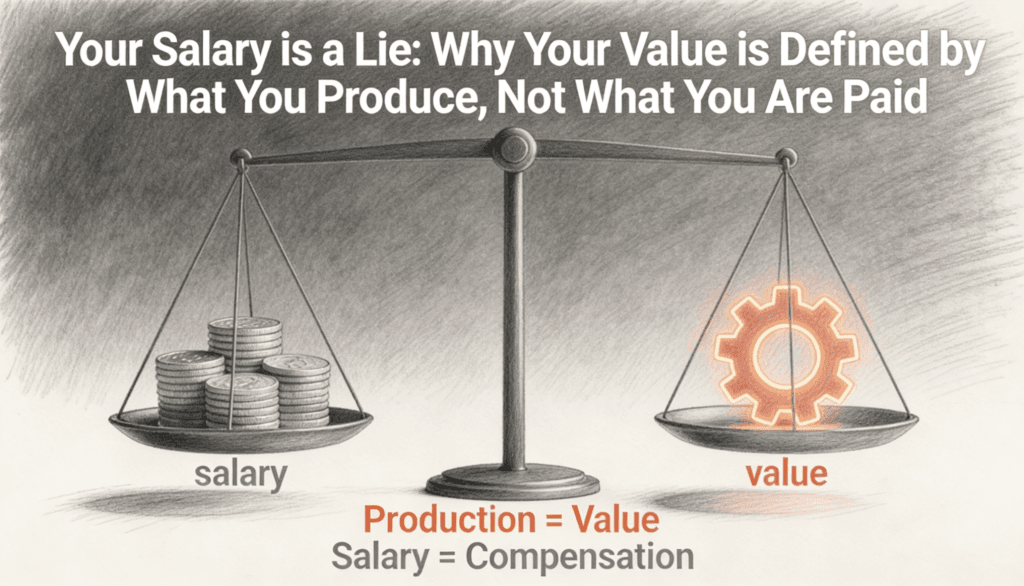
Here is the uncomfortable truth. That number is not your value. It never was. It is a negotiated fiction, a placeholder agreed upon in a room where you had less information than the person sitting across from you. And a French economist figured this out over two hundred years ago, long before LinkedIn existed.
His name was Jean-Baptiste Say. And his core insight was so simple it is almost offensive: you are not valuable because you get paid. You get paid because you produce something valuable. The arrow of causation runs in the opposite direction from what most people assume.
This might sound like a minor distinction. It is not. It is the difference between sleepwalking through your career and actually understanding the economic forces that shape your life.
The Man Who Flipped the Script
Jean-Baptiste Say was born in 1767 in Lyon, France. He lived through the French Revolution, watched empires rise and collapse, and somehow found time to write one of the most influential economics treatises in history. His “Treatise on Political Economy,” published in 1803, did something radical. It shifted the conversation from what things cost to what things create.
Say is best known for what later economists called Say’s Law, often simplified to “supply creates its own demand.” But the deeper principle beneath that famous phrase is what matters here. Say understood that production is the source of all economic value. Not money. Not wages. Not titles. Production.
Think about that for a moment. In Say’s framework, the economy is not a pool of money waiting to be distributed. It is a web of people creating things that other people want. Your salary is just one imperfect measurement of your small thread in that web. And like most measurements, it can be wildly inaccurate.
Why Your Paycheck Lies to You
Your salary is the result of a negotiation. And negotiations are shaped by dozens of factors that have nothing to do with what you actually produce. Let us count a few.
Timing. If you were hired during a recession, you probably accepted less money than someone hired for the same role during a boom. Your output could be identical. Your paycheck will not be.
Information asymmetry. Your employer almost certainly knows more about the salary range for your position than you do. They know what your colleagues earn. They know the budget. You are guessing, and you are probably guessing low.
Inertia. Most raises are incremental. Three percent here, four percent there. They are based on what you earned last year, not on what you produced this year. Your salary carries the fossil record of every undervaluation you have ever accepted.
Social dynamics. Research consistently shows that people who negotiate aggressively earn more, regardless of performance. Your salary reflects your comfort with confrontation as much as it reflects your contribution.
None of these factors measure production. They measure circumstance, leverage, and personality. Say would have found this absurd. The entire point of his economic philosophy was that value originates in creation, not in the administrative machinery that distributes rewards after the fact.
The Producer versus the Employee
Here is where Say’s thinking gets genuinely interesting. He drew a clear line between what we might call the producer mindset and the employee mindset.
The employee mindset says: I trade my time for money. I show up, I perform tasks, I receive compensation. The relationship is transactional. Value flows from the employer to me in the form of a paycheck.
The producer mindset says something entirely different. I create value through what I make, solve, build, or improve. Money flows to me as a consequence of that creation. The paycheck is not the point. It is a side effect.
This is not motivational poster nonsense. It is a fundamental reorientation of how you understand your economic existence. And it has practical consequences that are almost immediate.
When you think like an employee, you optimize for hours, presence, and compliance. You ask: what does this role require? When you think like a producer, you optimize for output, impact, and leverage. You ask: what can I create that people actually need?
Say argued that every person in an economy is fundamentally a producer. The farmer produces grain. The merchant produces access to goods. The manufacturer produces finished products. Even the laborer, in Say’s view, produces something: the application of effort and skill to raw materials. What they earn should reflect what they produce. In practice, it rarely does.
The Quiet Scandal of Misaligned Compensation
Consider the teacher who shapes the intellectual foundation of hundreds of future professionals over the course of a career. Now consider the mid-level marketing manager who optimizes click-through rates on banner ads for a software company. In most economies, the marketing manager earns two to three times what the teacher earns.
Does this mean the marketing manager produces more value? Say would say: not necessarily. It means the market where the marketing manager operates is better at capturing and pricing value than the market where the teacher operates. The teacher’s production is enormous but diffuse. It is spread across decades and across the lives of students who will never write a check back to their fourth grade classroom. The marketing manager’s production is narrow but immediately measurable. Every click has a dollar sign next to it.
This is not a flaw in Say’s theory. It is a confirmation of it. Value is determined by production, but the systems that translate production into compensation are full of distortions, delays, and blind spots. Your salary reflects the system’s ability to price your work, not the actual worth of what you create.
And that gap between real production and nominal compensation is where most of the frustration in modern working life actually lives.
What Say Got Wrong (And Why It Still Matters)
Say was not perfect. No thinker from 1803 could have anticipated gig economies, intellectual property law, or the strange reality that someone can earn millions by filming themselves eating lunch on camera.
His famous law, that supply creates its own demand, was challenged convincingly by Keynes and others who pointed out that economies can and do get stuck. People can produce things nobody wants to buy. Gluts happen. Recessions happen. Say’s elegant theory did not account well for the messiness of real markets.
But here is what the critics often miss. Say’s insight about individual value was never really about macroeconomics. It was about how you should think about your own economic life. And on that level, it remains remarkably useful.
Even Keynes, who dismantled Say’s Law at the macro level, would not have argued that an individual worker’s long-term economic trajectory is determined by anything other than what they create. Recessions are temporary. Your productive capacity is the constant.
The Production Audit You Have Never Done
If Say’s framework is correct, and your value is defined by what you produce rather than what you are paid, then most people are walking around with a massive blind spot. They know their salary down to the cent. They have no idea what they actually produce.
Try this thought experiment. Sit down and write out, in concrete terms, what you created in the last twelve months. Not what you did. Not what meetings you attended or what emails you sent. What did you produce? What exists now that did not exist before because of your effort? What problem is solved? What revenue was generated? What cost was avoided?
If you struggle with this exercise, that is the point. Most jobs are structured to obscure individual production. You are part of a team, a department, an organization. Credit is diffused. Accountability is shared. And in that fog, the connection between what you create and what you earn becomes nearly invisible.
Say would argue that this invisibility is exactly where you lose economic power. If you cannot articulate what you produce, you cannot argue for what you are worth. And if you cannot argue for what you are worth, you will accept whatever number someone else assigns to you.
Reclaiming Your Actual Value
So what do you do with this information? Here is where Say’s philosophy becomes genuinely practical.
First, separate your identity from your salary. This is harder than it sounds because modern culture has spent decades fusing the two together. Your compensation is a data point, not a verdict. It tells you what one employer, in one market, at one moment in time, was willing to pay. That is all.
Second, become obsessively clear about what you produce. Not what you do. What you produce. There is a difference between “I manage a team of eight people” and “I built a system that reduced customer churn by fourteen percent.” The first describes activity. The second describes production. Say cared about the second.
Third, invest in your productive capacity rather than your credentials. Another degree, another certification, another line on the resume: these are signals. They are not production. Say was skeptical of anything that looked impressive but did not actually create value. He was surrounded by French aristocrats who had exquisite titles and produced absolutely nothing. He was not impressed.
Fourth, understand that the market’s valuation of your work is not the final word. If you are a nurse, a teacher, a social worker, or anyone whose production is massive but poorly priced by existing systems, that mismatch is real but it is not a reflection of your value. It is a reflection of the system’s limitations. Say’s theory actually validates your worth more than your paycheck does.
The Final Note
The deepest lie your salary tells is not about money. It is about agency. A paycheck suggests that value flows from institutions to individuals. That companies create value and distribute it to workers. That you are a recipient.
Say saw it the other way around. Individuals produce value. Institutions are just the structures that organize and capture that production. Without producers, there are no profits, no salaries, no economy at all. The entire apparatus depends on what individuals create.
This is not a call to quit your job and start a business. Not everyone should, and Say himself did not think entrepreneurship was the only legitimate form of production. It is a call to stop letting a number on a pay stub define what you are worth.
You are not your salary. You are what you produce. And the sooner you understand that distinction, the sooner you can start closing the gap between the two.
Jean-Baptiste Say figured this out in 1803 with a quill pen and no internet. You have every tool imaginable. The only question is whether you will use them to create something, or keep waiting for someone to tell you what you are worth.