Table of Contents
There is a particular kind of magic trick that management consultants have perfected over the last century. You take an old idea, give it a new name, wrap it in certifications and colored belts, and sell it back to organizations as if it just fell from the sky. Lean Six Sigma is perhaps the most successful version of this trick ever performed.
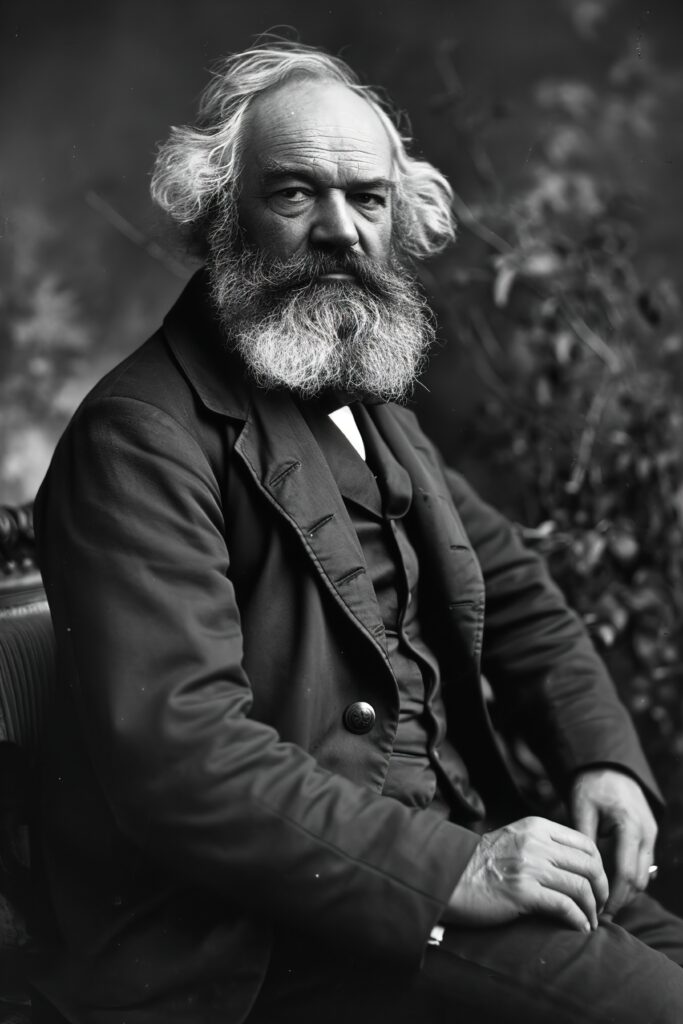
Before the pitchforks come out, let me be clear. I am not saying Lean Six Sigma does not work. It often does. What I am saying is that its intellectual DNA traces back to a man who died in 1915, a man most Lean Six Sigma practitioners would rather not be associated with. His name was Frederick Winslow Taylor, and he essentially invented the idea that work could be scientifically optimized. Everything that followed, including the methodology your company probably paid a consultant six figures to implement, is a descendant of his thinking.
Let us pull the thread.
The Ghost in the Machine
Frederick Taylor was an engineer at Bethlehem Steel in the late 1800s. He watched workers shovel pig iron and became obsessed with a question that sounds almost comically simple: is there a best way to shovel? He studied movements, timed tasks, experimented with shovel sizes, and concluded that yes, there was an optimal method. Workers who followed his prescribed technique moved significantly more material per day.
Taylor called his approach Scientific Management. The core premise was that work should not be left to the discretion of workers. Instead, managers should study each task, break it down into components, measure everything, determine the single best method, and then enforce that method across the workforce. Efficiency was the supreme value. Variation was the enemy.
Now read that last paragraph again and tell me it does not sound exactly like a Lean Six Sigma project charter.
The philosophy underneath Lean Six Sigma is built on the same pillars. Define the process. Measure it obsessively. Analyze the data to find where things go wrong. Improve by eliminating variation. Control to make sure the improvements stick. This is the famous DMAIC framework, and it is Taylor’s method wearing a lab coat instead of a stopwatch.
The Rebranding No One Talks About
Here is where the story gets interesting. Taylorism fell out of favor. Workers hated it because it reduced them to interchangeable parts. Unions fought it. Congress actually held hearings on it in 1912 after a strike at a government arsenal. Taylor himself was called to testify. The word “Taylorism” became associated with dehumanization, exploitation, and the worst impulses of industrial capitalism.
So the ideas went underground. Not because they stopped being useful, but because the brand was toxic.
What emerged over the following decades was a series of repackagings. Statistical Process Control in the 1920s. Total Quality Management in the 1950s. The Toyota Production System in the 1960s and 70s. Six Sigma at Motorola in the 1980s. Lean manufacturing as a Western interpretation of Toyota. And finally, the merger: Lean Six Sigma, which combined waste reduction with variation reduction into one comprehensive methodology.
Each iteration added genuine innovations. Walter Shewhart contributed control charts. W. Edwards Deming added systems thinking and an emphasis on continuous improvement. Taiichi Ohno at Toyota contributed the idea of pulling production based on demand rather than pushing it based on forecasts. These were real intellectual advances.
But the skeleton underneath never changed. The fundamental belief remained: work is a process, processes can be measured, measurement reveals waste and variation, and eliminating both leads to better outcomes. That is Taylorism. Everything else is ornamentation.
The Belt System and the Illusion of Revolution
One of the more clever moves in the Lean Six Sigma playbook was borrowing the belt ranking system from martial arts. You start as a White Belt, progress to Yellow, then Green, then Black, and if you are truly devoted, Master Black Belt. It is a genius piece of organizational psychology. It creates a hierarchy of expertise, a sense of progression, and most importantly, it makes people feel like they are learning something entirely new.
But think about what a Green Belt actually learns. They learn to map processes. They learn to collect data. They learn to identify bottlenecks. They learn to standardize work. They learn to create documentation that ensures everyone follows the same procedure.
Taylor was doing all of this in 1899. He just did not have a colored belt for it.
The belt system does something else that is worth noting. It creates a priesthood. In any organization running Lean Six Sigma, the Black Belts become the interpreters of the methodology. They speak a specialized language. They run the projects. They have the authority to redesign how other people work. This is not fundamentally different from what Taylor envisioned when he argued for a “planning department” that would sit above the workers and dictate the methods of production.
The language has changed. The power structure has not.
The Kaizen Disguise
One of the most commonly cited differences between Lean Six Sigma and Taylorism is the concept of Kaizen, or continuous improvement driven by the workers themselves. Proponents will argue that unlike Taylor, who imposed methods from the top down, Lean Six Sigma empowers frontline employees to identify problems and suggest solutions.
This is partially true and mostly theater.
In practice, Kaizen events are structured, time boxed, and facilitated by Belt holders. The suggestions workers make are filtered through the methodology’s framework. Ideas that do not align with the data, the process maps, or the project scope are politely set aside. The worker’s voice is welcome, but only within the boundaries that management has already drawn.
This is the equivalent of letting someone choose the color of the walls in a room whose dimensions have already been fixed. It feels like participation. It functions as control.
Taylor, for what it is worth, also believed in engaging workers. He just did not pretend it was democracy. He was upfront about the fact that management would determine the best method and workers would follow it. One could argue that his honesty, however brutal, was at least more transparent than a system that packages top down standardization as grassroots empowerment.
The Measurement Obsession
There is a line attributed to Peter Drucker that says “what gets measured gets managed.” Lean Six Sigma has taken this idea and turned it into a religion. Every project begins with data. Every improvement must be validated by data. Every control mechanism relies on data. The methodology is almost allergic to decisions made on intuition, experience, or judgment.
Taylor would have loved this. His entire philosophy was built on replacing the worker’s rule of thumb with scientific measurement. He literally stood behind workers with a stopwatch, recording how long each movement took, then used those numbers to design the “one best way.”
The tools have gotten more sophisticated. Instead of stopwatches, we now have process mining software, statistical analysis packages, and dashboards that update in real time. But the underlying assumption is identical: if you can measure it, you can improve it, and if you cannot measure it, it probably does not matter.
This creates a blind spot that neither Taylor nor Lean Six Sigma handles well. Some of the most valuable work in any organization is difficult or impossible to measure. The quality of a mentoring conversation. The trust built during an informal hallway exchange. The creative insight that comes from letting someone experiment without a clear deliverable. These things resist quantification, and systems that worship measurement tend to quietly devalue them.
It is the managerial equivalent of looking for your keys under the streetlight because that is where the light is, even though you dropped them in the dark.
The Efficiency Trap
Here is where Taylorism and Lean Six Sigma share a deeper, more troubling assumption. Both treat efficiency as an unqualified good. Waste is bad. Variation is bad. Idle time is bad. Every minute should be productive. Every process should be streamlined.
This sounds reasonable until you consider what gets lost. Biological systems, which have been optimizing for roughly four billion years, maintain enormous amounts of apparent waste. Redundant organs. Duplicate genes. Energy spent on activities with no immediate survival benefit. Evolution figured out long ago that systems which are too efficient become fragile. Slack is not waste. It is insurance.
Organizations that pursue Lean Six Sigma to its logical extreme often discover this the hard way. They strip out every buffer, eliminate every redundancy, and optimize every process. Then something unexpected happens. A supply chain disruption. A sudden spike in demand. A pandemic. And the beautifully lean organization discovers it has no capacity to absorb the shock.
Toyota, the company most associated with lean manufacturing, learned this lesson after the 2011 earthquake and tsunami in Japan devastated its supply chain. The company that had pioneered just in time inventory found itself unable to produce vehicles because it had optimized away the safety stock that would have kept lines running. After that, Toyota quietly started keeping more inventory on hand. The masters of lean became a little less lean, because reality demanded it.
Taylor never confronted this problem because the world of 1900 was more predictable. Demand was simpler. Supply chains were shorter. Markets moved slowly. In that context, pure efficiency was a reasonable goal. In a world of constant disruption, it is a vulnerability disguised as a virtue.
What We Are Really Doing
Let me offer a more generous interpretation. Perhaps Lean Six Sigma is not a cynical repackaging of Taylorism. Perhaps it is something more interesting: the gradual humanization of an idea that started in a dehumanizing form.
Taylor saw workers as machines to be optimized. Lean Six Sigma, at its best, sees workers as partners in optimization. Taylor cared only about output. Lean Six Sigma, at its best, considers quality from the customer’s perspective. Taylor operated in a world of physical labor. Lean Six Sigma has adapted to knowledge work, services, and healthcare.
These are meaningful differences. But they are differences of degree, not kind. The philosophical foundation remains: work is a process, variation is the enemy, measurement is the path to truth, and standardization is the goal. You can dress these ideas in the language of empowerment, wrap them in certifications, and teach them at prestigious universities, but they are still the ideas of a man who stood behind steelworkers with a clipboard and a stopwatch.
And that is not necessarily a condemnation. Taylor was onto something real. Work can be improved through systematic study. Waste can be reduced. Quality can be enhanced. These are valuable insights. The problem is not the ideas themselves. The problem is pretending they are new.
Why This Matters
The reason this lineage matters is not academic. It is practical.
When organizations adopt Lean Six Sigma without understanding its roots, they tend to repeat the same mistakes Taylor’s followers made. They overemphasize measurement at the expense of judgment. They pursue efficiency past the point of resilience. They create hierarchies of expertise that silence the people closest to the actual work. They confuse process compliance with genuine improvement.
Understanding that Lean Six Sigma is Taylorism’s grandchild allows you to be more thoughtful about how you apply it. You can use the tools without buying the entire philosophy. You can measure what matters without assuming that only what is measured matters. You can standardize where it creates value without standardizing where it kills creativity.
The methodology is a tool, not a truth. And like all tools, it works best when you understand not just how to use it, but where it came from and what assumptions it carries.
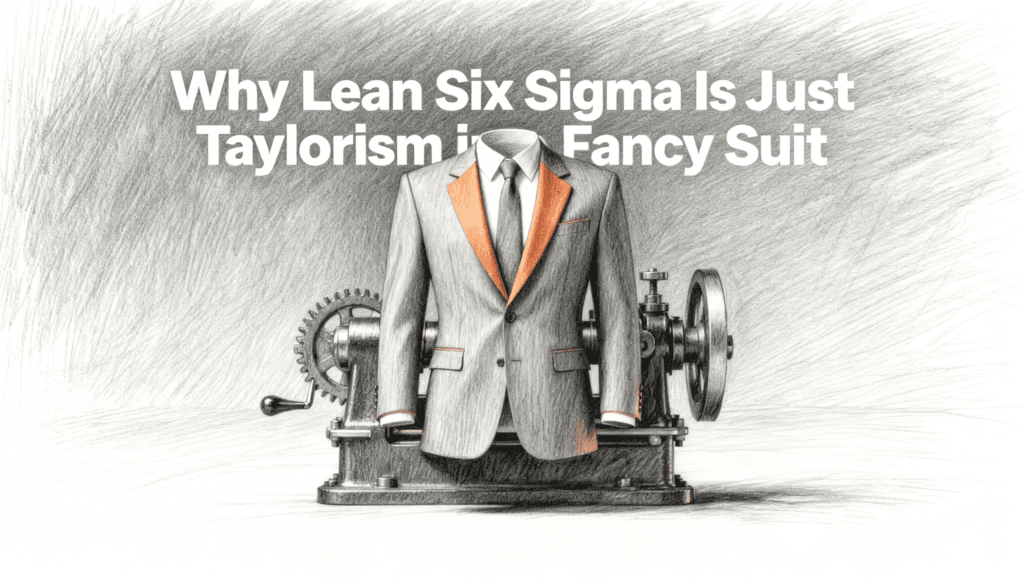
So the next time someone walks into your organization with a Black Belt, a project charter, and a promise to transform your operations, remember that the transformation they are selling has been sold before. Under different names, with different colored belts, across different decades. The suit keeps changing. The body underneath has stayed remarkably the same.
Taylor would be proud. He might even call it the one best way.