Table of Contents
Most people think of Sun Tzu as a military strategist. A guy who wrote about war two and a half thousand years ago. Useful for generals, maybe for CEOs who want to sound smart in meetings. Not exactly the first name you reach for when your inbox is overflowing, your sleep is broken, and your body has started keeping score of every shortcut you have taken with your health.
But here is the thing. Sun Tzu was not really writing about war. He was writing about conflict. And the most relentless conflict most of us will ever face is not on a battlefield. It is the one between who we are and what our lives demand of us. That grinding, daily siege of obligations, anxieties, and reactions that slowly eats through our walls.
So let us talk about stress the way a Chinese military philosopher would. Not with breathing exercises. Not with gratitude journals. With strategy.
You Are Not Fighting a Battle. You Are Under Siege.
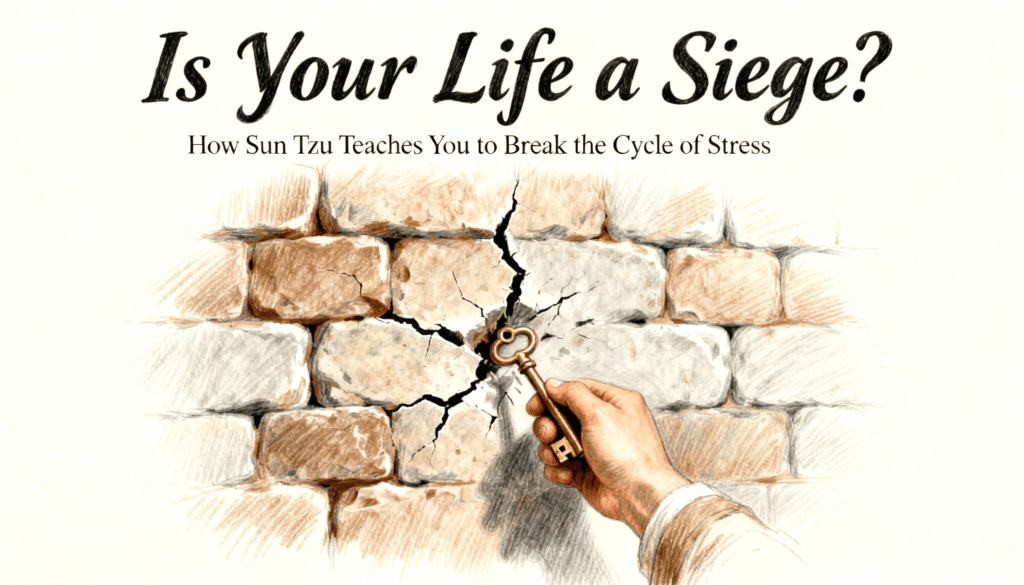
There is a critical distinction in The Art of War between a battle and a siege. A battle is a concentrated event. It has a beginning, a climax, and a resolution. A siege is different. A siege is slow. It is designed to exhaust you. The enemy does not need to break your gate if they can simply wait until you run out of food.
Most people treat their stress like a series of battles. They think in terms of individual problems. The difficult boss. The argument with a partner. The unexpected bill. They fight each one, recover, and brace for the next.
But what if the real problem is not any single fight? What if your entire life has been structured as a siege, and you have not noticed because you are too busy defending the walls?
Chronic stress operates exactly like a siege. It does not come in one dramatic assault. It applies constant, low grade pressure. It cuts off your supply lines: your sleep, your relationships, your sense of purpose. And the longer it goes on, the weaker your position becomes, until something that should have been manageable becomes the thing that finally breaks through.
Sun Tzu had a very specific opinion about sieges. He hated them. He considered them the worst possible strategy, for both sides. His exact reasoning was that a siege wastes time, burns resources, and often destroys the very thing you were trying to capture. Sound familiar?
The Highest Victory Is the One That Costs You Nothing
The most famous idea in The Art of War is also the most misunderstood. Sun Tzu said the supreme art of war is to subdue the enemy without fighting. People love to quote this. They rarely think about what it actually means in practical terms.
It does not mean being passive. It does not mean avoiding confrontation. It means you should never engage in a conflict on terms that drain you more than they drain the problem. The goal is not to win the fight. The goal is to make the fight unnecessary.
Now translate that to the way most people handle stress. What do they do? They push through. They grind. They wear their exhaustion like a medal. They respond to every provocation, accept every demand, and treat rest as something they will earn later, once everything is handled. Spoiler: everything is never handled.
This approach is what Sun Tzu would call fighting every battle on the enemy’s terms. You are letting stress choose the time, the place, and the rules of engagement. And then you are surprised when you keep losing.
The strategic alternative is not to fight harder. It is to stop engaging with conflicts that do not need your involvement. That meeting that could have been an email? That argument where you already know nobody will change their mind? That commitment you said yes to because you felt guilty? Those are traps. And walking into a trap is not brave. It is just poor planning.
Know the Terrain Before You Move
Sun Tzu was obsessed with terrain. He devoted entire chapters to it. Understand the ground you are standing on before you take a single step. Most people, when stressed, do the opposite. They react first and assess later. They make decisions from inside the fog.
In psychology, this maps almost perfectly to what researchers call cognitive appraisal theory. The idea is straightforward. Stress is not caused by events. It is caused by how you evaluate those events relative to your resources. The same situation that devastates one person barely registers for another. The difference is not toughness. It is assessment.
Sun Tzu would have loved this concept. He basically said the same thing, just without the academic language. He argued that a general who knows both himself and his enemy will not be endangered in a hundred battles. A general who knows only himself but not the enemy will win half and lose half. A general who knows neither will lose every time.
So here is the question most people never bother to ask: what are you actually stressed about? Not the surface complaint. The real thing. Because often what looks like a work problem is actually a control problem. What looks like a money problem is actually a fear problem. What looks like a relationship problem is actually a communication problem you have been avoiding for years.
You cannot navigate terrain you have not surveyed. And most people are trying to fight their way through a landscape they have never honestly examined.
The Enemy Is Not What You Think It Is
In most stress narratives, there is a villain. The toxic job. The difficult family member. The broken system. And sometimes those things are genuinely harmful. But Sun Tzu would push you to think differently.
He argued that the greatest danger is not the enemy you can see. It is the disorder within your own camp. Armies do not usually lose because the opponent was overwhelmingly strong. They lose because their own structure fell apart. Poor communication. Bad logistics. Leaders who could not adapt.
This is uncomfortable to hear, but most of the stress in your life is not being inflicted on you. It is being generated by you. By the systems you have built, the commitments you have accepted, the habits you have let solidify into walls around your days. You built the fortress. And now you are trapped inside it.
This is not about blame. It is about agency. If stress is something the world does to you, you are powerless. If stress is something your own internal architecture produces, you can redesign it. Sun Tzu would choose the second framing every time. Not because it is more comforting, but because it gives you something to work with.
Move Like Water, Not Like a Wall
One of the most elegant passages in The Art of War compares ideal strategy to water. Water does not fight obstacles. It flows around them. It finds the lowest point and fills it. It is shapeless and yet it shapes everything it touches.
Compare this to how most people respond to mounting pressure. They become rigid. They double down. They build routines so tight that a single disruption sends everything cascading. They become walls, and walls do one thing very well: they crack.
Sun Tzu would tell you to stop optimizing and start adapting. Do not build a schedule that only works if everything goes right. Build one that still functions when three things go wrong. Do not tie your emotional stability to a single outcome. Distribute it across purposes, relationships, and practices that can absorb shock.
Retreat Is Not Defeat
Here is something modern culture absolutely refuses to accept: sometimes the best move is to pull back. Sun Tzu was explicit about this. If the situation is not favorable, retreat. Regroup. Wait for conditions to change. There is no honor in holding a position that is killing you.
But we live in a culture that has turned relentlessness into a virtue. Quit your job? You lack grit. Set a boundary? You are being difficult. Admit you cannot handle everything? Weakness. The result is that people hold their ground long after the ground has stopped being worth holding.
Sun Tzu would find this baffling. A general who refuses to retreat when retreat is clearly the right move is not courageous. He is incompetent. He is sacrificing his army for his ego. And that is exactly what many people do with their own health, their own relationships, and their own peace of mind. They sacrifice real things to maintain the appearance of having it all together.
Strategic retreat means choosing to disengage from something that is costing you more than it is giving you. It could be a job, a friendship, a goal that made sense five years ago but does not anymore. It is not giving up. It is redeploying your resources to a position where they actually do some good.
Deception, But Not the Kind You Think
Sun Tzu is famous for advocating deception. All warfare is based on deception, he wrote. This sounds manipulative until you understand what he actually meant. He was not talking about lying to others. He was talking about controlling the information environment. Appearing weak when you are strong. Appearing far when you are near. Shaping perception so the real move is invisible.
Now think about the way stress operates in your mind. It deceives you constantly. It tells you everything is urgent. It tells you that resting is falling behind. It tells you that worry is the same as preparation. None of these things are true, but they feel true, and feeling true is more than enough to drive behavior.
The strategic response is to become a better deceiver than your own anxiety. Not through denial. Through deliberate reframing. When your mind says this is a crisis, you say no, this is an inconvenience. When your stress says you have to respond right now, you say actually, I do not. When the pressure says you are falling behind, you take a breath and ask: behind what? Whose timeline? Whose definition of progress?
This is not positive thinking. Positive thinking is pretending the siege is not happening. This is strategic thinking. It is seeing the siege clearly and choosing not to play by its rules.
The War You Win Is the One You Choose
The final lesson from Sun Tzu might be the most important one, and it is deceptively simple. He argued that the wise general chooses his battles. Not all conflicts deserve your engagement. Not all problems require your intervention. Not all stress deserves the dignity of your attention.
This is where most people fail. They treat every demand as equally valid. Every email as equally urgent. Every obligation as equally binding. And so they spread themselves across a hundred fronts, winning nothing, exhausted everywhere.
The strategic alternative is brutal prioritization. Look at everything competing for your energy and ask a very cold question: what actually matters? Not what feels urgent. Not what other people expect. What will matter in a year? In five years? In the story of your life?
Most of it will not. Most of the things consuming you right now are noise dressed up as signal. And the courage is not in fighting all of it. The courage is in walking away from the fights that do not deserve you.
Sun Tzu did not write a self help book. He wrote a manual for surviving conflict with the minimum possible cost. But the principles transfer with almost eerie precision. Stop treating your stress like individual battles. Recognize the siege. Survey the terrain honestly. Fix the disorder in your own camp before blaming the enemy. Move like water. Retreat when holding the position is destroying you. Choose your fights with ruthless clarity.
The goal was never to win every battle. The goal was to win the war. And the war, in this case, is not against stress itself. Stress will always exist. The war is against the unconscious, reactive, undisciplined way most of us engage with it.
Sun Tzu figured this out twenty five centuries ago. It would be embarrassing to take another twenty five to catch up.