Table of Contents
The Enlightenment had a problem. It told everyone to think for themselves, question authority, and trust reason. Wonderful advice. But after a few decades of everyone thinking for themselves, Europe found itself drowning in revolutions, guillotines, and philosophical arguments that went nowhere. Freedom of thought, it turned out, was excellent at tearing things down. It was less good at building anything back up.
Enter Auguste Comte, a French philosopher born in 1798, right in the wreckage. He looked at the mess the Enlightenment left behind and asked a question nobody else seemed to be asking: what if reason alone is not enough? What if we need something more disciplined, more structured, more scientific than just telling people to think?
His answer would reshape how we understand knowledge, society, and the very idea of progress. It would also, in one of history’s richer ironies, lead him to create his own religion. But we will get to that.
The Young Man in a Collapsing World
To understand Comte, you need to understand what France looked like when he was growing up. The Revolution of 1789 had promised liberty, equality, and fraternity. What it delivered was the Terror, Napoleon, the Restoration, and then more revolutions. France changed governments the way some people change clothes. The intellectual class was split between those who wanted to go back to the old Catholic monarchy and those who wanted to push forward into some vaguely defined rational future.
Comte was born in Montpellier to a Catholic royalist family. He rejected both their Catholicism and their royalism before he was old enough to shave. At sixteen, he entered the prestigious École Polytechnique in Paris, a school designed to produce engineers and scientists. This mattered enormously. Comte did not come up through the traditional philosophy pipeline of theology and classics. He came up through mathematics and physics. He thought like an engineer. And engineers, when they see a broken system, do not write poems about it. They try to fix it.
At the Polytechnique, Comte absorbed the spirit of the place: the conviction that the methods which had unlocked the secrets of gravity and chemistry could be turned on human society itself. If Newton could find the laws governing planets, surely someone could find the laws governing people.
This idea was not entirely new. The Enlightenment thinkers had gestured toward it. But they had gestured the way someone gestures at a mountain they have no intention of climbing. Comte intended to climb.
The Secretary Who Outgrew His Master
In 1817, Comte became secretary to Henri de Saint-Simon, one of the most fascinating and eccentric thinkers of the era. Saint-Simon was a nobleman who had fought in the American Revolution, made and lost a fortune during the French Revolution, and spent his later years dreaming up schemes for reorganizing society along industrial and scientific lines.
Working for Saint-Simon gave Comte two things. First, it gave him the core idea that society could be studied and organized scientifically. Second, it gave him someone to argue with. The two men eventually had a bitter falling out, each accusing the other of stealing ideas. The details of who stole what from whom are murky and, frankly, not very interesting. What matters is that Comte walked away from the relationship convinced he could do better. He could be more systematic, more rigorous, more thorough.
He was right. Whatever Saint-Simon had in vision, Comte had in discipline. And discipline, as it turns out, is what separates a fascinating dinner party guest from someone who actually changes how people think.
The Law of Three Stages
Comte’s big idea, the one that made his reputation, was the Law of Three Stages. It sounds simple. That is part of its genius.
Comte argued that every branch of human knowledge passes through three stages. First comes the theological stage, where people explain the world through gods, spirits, and supernatural forces. Why does lightning strike? Because Zeus is angry. Why do crops fail? Because we offended the harvest deity. This is humanity in its childhood, making up stories to explain what it cannot understand.
Second comes the metaphysical stage. Here, people replace gods with abstract forces and essences. Instead of Zeus throwing lightning bolts, we get vague talk about “the nature of electricity” or “vital forces.” The gods are gone, but the habit of explaining things through invisible, untestable entities remains. Comte saw this stage as an improvement but also as a kind of intellectual halfway house. You have stopped believing in the old answers but have not yet figured out the new ones.
Third comes the positive stage. This is where humanity finally grows up. In the positive stage, we stop asking why things happen in some ultimate, cosmic sense and start asking how they happen. We observe, we measure, we find regularities, we formulate laws. We do not ask why gravity exists. We describe how it behaves. We predict. We test.
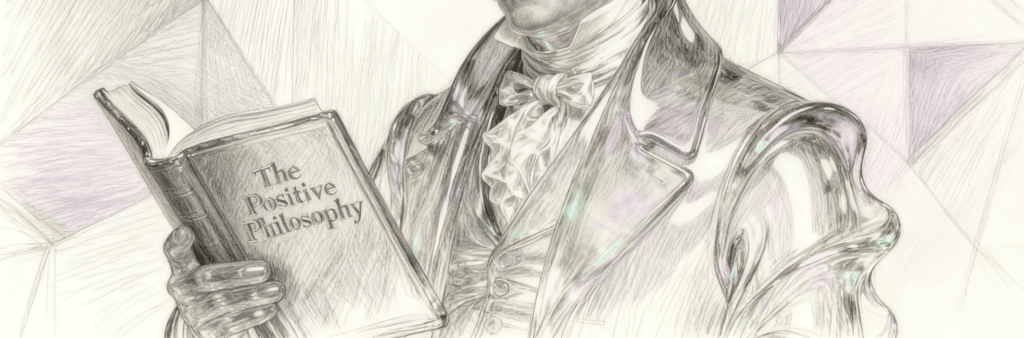
The word “positive” here does not mean optimistic. It means grounded in observable facts. Comte coined the term “positivism” to describe this approach. Knowledge, he insisted, must be based on what we can actually observe and verify. Everything else is speculation dressed up in fancy vocabulary.
Now, here is what made this framework genuinely powerful: Comte did not just apply it to physics or chemistry. He applied it to human knowledge as a whole. He argued that different sciences had reached the positive stage at different times. Astronomy got there first, then physics, then chemistry, then biology. Each science had to wait for the ones before it to mature, because each built on the foundations laid by its predecessors.
And at the end of this progression, waiting to be born, was the science Comte believed the world desperately needed: the science of society itself.
Inventing Sociology
Comte did not just theorize about a science of society. He named it. He originally called it “social physics,” but when he discovered that a Belgian statistician named Adolphe Quetelet was already using that term, he coined a new one: sociology.
The word itself is a bit of a mongrel, half Latin (socius, meaning companion) and half Greek (logos, meaning study). Purists hated it then and some still wince at it now. But the word stuck, and more importantly, the idea behind it stuck.
Comte’s vision for sociology was ambitious to the point of audacity. He believed we could study society with the same rigor we study chemical reactions. Not by reducing people to atoms, but by finding the patterns, the regularities, the laws that govern how societies form, change, and break down. He divided sociology into two parts: social statics, which studied the structure of society at any given moment, and social dynamics, which studied how societies change over time.
This distinction, between structure and change, between how things are and how they got that way, remains fundamental to sociology today. Every time someone studies social institutions or analyzes historical trends, they are, whether they know it or not, working within a framework Comte built.
There is something almost paradoxical about this legacy. Comte wanted to make the study of society as precise as physics. Modern sociologists would say that goal was naive, maybe even a little absurd. Human societies are not planetary orbits. They are messier, more unpredictable, more resistant to neat mathematical laws. And yet the attempt itself, the insistence that society can be studied systematically rather than just debated philosophically, opened up an entire field of knowledge. Sometimes the most productive mistakes are the ones that aim too high.
The Hierarchy of Sciences
One of Comte’s most elegant contributions was his classification of the sciences. He arranged them in a hierarchy: mathematics at the base, then astronomy, physics, chemistry, biology, and finally sociology at the top. Each science was more complex than the one below it and depended on the discoveries of its predecessors.
This was not just intellectual taxonomy. It was a theory about the structure of knowledge itself. You cannot do chemistry without physics. You cannot do biology without chemistry. And you cannot do sociology without all of them. Each level introduces new phenomena that cannot be fully reduced to the level below. A living cell obeys the laws of chemistry, but knowing all the chemistry in the world will not tell you why cells divide or organisms evolve.
This idea, that higher levels of organization have their own principles that cannot be reduced to lower levels, is something that modern complexity science would eventually rediscover. Comte did not have the mathematical tools to formalize it. But he saw it clearly, almost two centuries before the Santa Fe Institute started holding conferences about emergence and complexity.
The Dark Turn
And now we arrive at the part of Comte’s story that makes his admirers uncomfortable.
In the 1840s, Comte fell desperately in love with Clotilde de Vaux, a woman trapped in a miserable marriage to a convicted forger. Their relationship was intense, largely unconsummated, and brief. Clotilde died of tuberculosis in 1846. Comte was shattered.
What happened next is either deeply moving or deeply strange, depending on your temperament. Comte, the man who had spent his career insisting on observable facts and scientific rigor, decided to create a new religion. He called it the Religion of Humanity. It had everything a proper religion should have: rituals, a calendar of secular saints (including Shakespeare, Dante, and Frederick the Great), a priesthood, and a catechism. The object of worship was not God but Humanity itself, understood as the collective achievement of the human species across time.
- John Stuart Mill, who had been one of Comte’s greatest admirers, read about the Religion of Humanity and politely but firmly walked away.
- Thomas Huxley, Darwin’s famous defender, dismissed it as “Catholicism minus Christianity.”
Comte had essentially taken the structure of the Catholic Church, removed the theology, and replaced it with sociology.
There is something almost tragically predictable about this. Comte had identified, correctly, that the Enlightenment’s destruction of traditional religion left a void. People need community, ritual, shared purpose, a sense of meaning that goes beyond individual reason. His mistake was thinking he could manufacture those things from scratch, in his study, with a pen. Religions that actually take hold tend to emerge organically from the lived experience of communities. They do not get designed by philosophers, however brilliant.
The Legacy That Outlived the Man
Comte died in 1857, relatively poor and increasingly isolated. His Religion of Humanity attracted a small but devoted following, particularly in Brazil, where positivism became enormously influential. The Brazilian flag still carries the positivist motto: Ordem e Progresso, Order and Progress. It is quite possibly the most successful piece of philosophical branding in history.
But Comte’s real legacy is not the religion. It is not even sociology as a specific discipline, though that would be enough. His real legacy is the idea that the scientific method is not just a tool for understanding nature. It is a tool for understanding ourselves.
Before Comte, the dominant assumption was that human affairs belonged to a different category than natural phenomena. History was the province of narrative, not law. Society was the domain of moral philosophy, not empirical investigation. Comte insisted, stubbornly and systematically, that this division was wrong. That human behavior follows patterns. That those patterns can be discovered. That discovering them is not just intellectually interesting but practically necessary if we want to build a world that actually works.
He was wrong about many of the details. His hierarchy of sciences is too rigid. His faith that sociology would achieve the precision of physics looks, from our vantage point, charmingly optimistic. His Religion of Humanity is a cautionary tale about what happens when a rationalist tries to build a church.
But the core insight endures. We live in a world shaped by social science, for better and worse. Every time a government consults polling data, every time a tech company runs an A/B test, every time an economist models a recession or a psychologist studies bias, they are operating within a tradition that Comte did more than anyone to establish.
He took the Enlightenment’s vague faith in reason and gave it a method. He took the Romantic era’s anxiety about the loss of meaning and tried, however clumsily, to address it. He built the bridge between the eighteenth century’s optimism and the nineteenth century’s demand for evidence.
And if the bridge creaks a little when you walk across it, well, most bridges do. The important thing is that it holds. And that someone had the nerve to build it in the first place.