Table of Contents
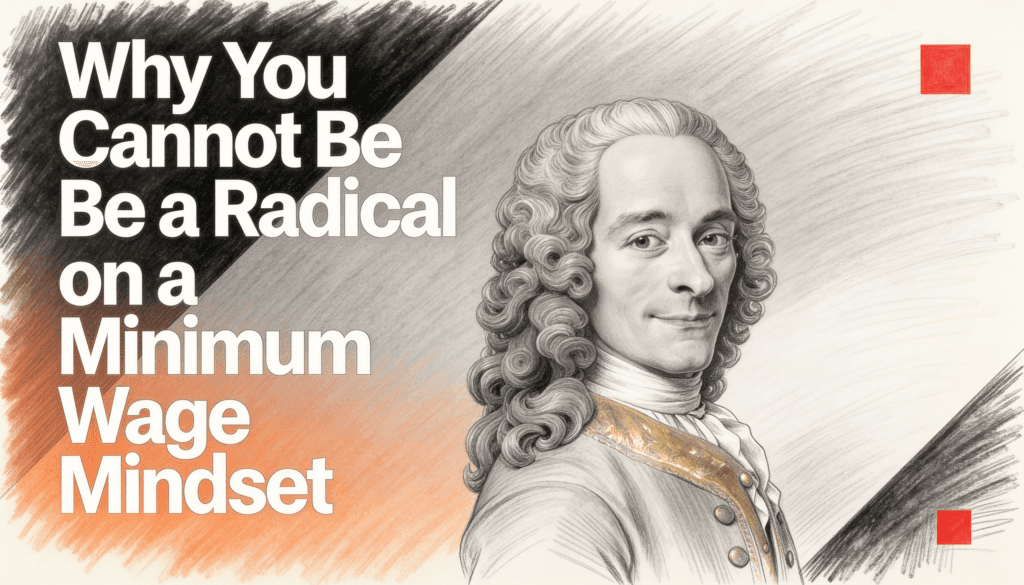
Voltaire once said something that still slaps centuries later. The line, paraphrased through time, goes roughly like this: it is dangerous to be right when the government is wrong. He spent his life writing things that got him jailed, exiled, and chased across borders by people with titles and swords. He did not survive that lifestyle by being polite. He survived it by being rich.
That last part is the secret most people skip when they admire him.
Voltaire was a radical thinker, but he was also one of the wealthiest writers of his century. He invested in lotteries, lent money to royals, ran a watch factory, and held shares in maritime trade. He had estates. He had options. When the king got angry, Voltaire crossed a border and kept writing. When publishers got nervous, he funded his own printings. His ideas were free, but the freedom to publish them was not.
This is the part of intellectual history that nobody romanticizes. We love the rebel, but we forget the rebel needs rent money. You cannot afford to challenge the system if you are one missed paycheck away from begging it for mercy.
That is the uncomfortable truth behind the phrase: you cannot be a radical on a minimum wage mindset.
The Cost of an Opinion
Most people think opinions are free. They are not. Opinions have a price, and the price is paid in opportunities you will lose, relationships you will strain, and risks you will need to absorb if things go wrong.
Imagine you work at a company and you notice something deeply unethical happening. You have a choice. You can speak up and possibly lose your job, or you can stay quiet and keep your salary. Now ask yourself, honestly, what would you do if you had three months of rent saved versus three years?
The answer is not about courage. It is about runway.
Courage without runway is just a slower form of self destruction. People with no savings, no skills outside their current role, and no network beyond their immediate coworkers do not have the luxury of principled resignation. They have bills. Bills do not care about your ethics.
This is why the most radical voices in history have almost always been backed by some form of independence. Sometimes it was inherited wealth. Sometimes it was a patron. Sometimes it was a side hustle that paid the rent while the main work shook the world. But the pattern is consistent. Free speech, in practice, requires financial slack.
The Minimum Wage Mindset is Not About Money
Now, before this turns into a lecture about getting a second job, let us be clear. A minimum wage mindset is not the same as a minimum wage salary. Plenty of people earning very little think like emperors, and plenty of people earning a lot think like servants. The mindset is the issue, not the paycheck.
A minimum wage mindset is the belief that your time, your ideas, and your energy are worth only what someone else is willing to pay you for them today. It is the assumption that value comes from above, handed down by a boss, a client, or a market. It is the quiet conviction that without permission, you have nothing.
People with this mindset cannot be radicals. Not because they are weak, but because their entire identity depends on the approval of the system they would need to challenge. They are not free to think dangerous thoughts because dangerous thoughts cost money, and they have arranged their life so that every dollar is already spoken for.
It is a structural trap. And the system, whatever system we are talking about, prefers people who live inside it.
Why Systems Love the Compliant
Every system, whether it is a corporation, a government, or a cultural movement, has the same interest in its members. It wants you stable, predictable, and slightly afraid. Not terrified. Terrified people do strange things. Just nervous enough to keep showing up and not making waves.
Stability sounds wonderful until you realize what is being stabilized. Your debts. Your dependencies. Your sense that things could fall apart if you pushed too hard.
Voltaire understood this in his own century. He saw the church, the monarchy, and the publishing trade as interlocking systems that fed off the obedience of the educated middle class. Smart people who could read Latin and write essays were the most useful tools of the regime, precisely because they had enough comfort to lose and not enough independence to fight back. They were the perfect bureaucrats of conformity.
His response was not to renounce wealth. It was to acquire so much of it that no individual gatekeeper could hurt him. He understood that money was not the goal. Money was the moat.
The Modern Version
Today, the moat looks different, but the logic is identical. You do not need an estate in the French countryside. You need optionality.
Optionality means having more than one source of income, more than one place you could live, more than one type of work you could do, and more than one community that would have you if your current one turned against you. It is not about being rich. It is about being hard to threaten.
A person with optionality can speak. A person without it can only nod.
Consider how this plays out in everyday life. A junior employee with no savings, one industry contact, and a family to support is not going to challenge the boss on a flawed strategy, even if he knows he is right. A senior employee with multiple offers, healthy savings, and a side project that earns half his salary, however, will absolutely speak up. Same workplace. Same brain. Different relationship to risk.
The second person is not braver. He is just less capturable.
The Trap of Performative Radicalism
Here is where it gets a little awkward. A lot of what passes for radicalism today is actually the opposite. It is performance for safety.
Posting opinions online that perfectly match the views of your immediate social group is not radical. It is camouflage. It looks like dissent, but it is actually loyalty. Real dissent is when you say something that costs you something in the room you are currently in. If your opinions only get applause, you are not challenging anything. You are entertaining.
This is why so many supposedly bold voices collapse the moment they face actual consequences. They built an identity on rebellion but never built the financial or psychological independence to sustain it. The moment a sponsor pulls out or a platform suspends them, they fold. They never had the runway. They only had the costume.
Voltaire had the costume too, by the way. He was charming, witty, theatrical, and good at making fun of powerful people. But underneath the performance was a businessman who had calculated, very carefully, how to never be at the mercy of anyone he criticized. The wit got the attention. The wealth bought the safety.
What This Means for You
If you want to think freely, speak honestly, or build something that pushes against the easy current, you have to engineer the conditions for it. You cannot just feel brave. You have to be hard to punish.
This starts in small, almost boring ways.
Save more than you spend, even when it feels slow. The slowness is the point. Each saved dollar is a small piece of armor. It is permission to walk away from situations that would otherwise own you. It is the difference between an opinion you can hold and an opinion you can voice.
Develop skills that work outside your current job. If everything you know how to do is useful only inside one company, then that company effectively owns your future. Learn a trade. Build a portfolio. Write something. Make something. Anything that proves you could earn elsewhere is an insurance policy against silence.
Build relationships outside your immediate world. If all your friends, mentors, and allies come from one industry or one ideology, you have no exit. You have a clubhouse. Clubhouses are warm, but they are also closed. Real intellectual independence requires people in your life who would still take your call if your tribe disowned you.
Spend less than you could. This sounds obvious until you notice how much of modern life is designed to do the opposite. Lifestyle inflation is the most efficient way to convert freedom into obligation. Every upgrade is a leash. Every status purchase is a hostage exchange. You traded a future option for a present impression.
None of this is exciting. None of it makes a good post. But this is what intellectual freedom actually looks like behind the curtain. It looks like a boring spreadsheet, a second skill, and a small group of people who do not need you to agree with them to love you.
The Quiet Discipline of a Radical Life
So if you want to be the kind of person who can actually say something true when it matters, start with the unglamorous parts. Build the runway. Lower the stakes of your honesty. Make yourself hard to threaten.
A radical is not someone who shouts more than others. A radical is someone who can afford to be honest when honesty is expensive.
The minimum wage mindset is the belief that the world will keep you small unless you beg it to make you bigger. The radical mindset is the patient construction of a life where you no longer need to beg at all.
Voltaire did not become the voice of the Enlightenment by being braver than his peers. He became it by being harder to silence. He paid for that with decades of careful work, quiet investments, and a refusal to let any one master own his bread.
You can have ideas without doing any of that. You can even feel like a rebel. But if your survival depends entirely on the approval of the world you say you want to change, you are not its critic. You are its employee.
And employees, no matter how loud, do not get to write the rules.