Table of Contents
Imagine sending the IRS after a bank robber.
You file the paperwork. You request his quarterly earnings statement. You ask, politely, for him to declare his stolen income on line 21 under “other earnings.” You remind him about self employment tax.
The absurdity is the point. We do not tax criminals because criminals do not file. They steal, they hide, they vanish. The state cannot collect a percentage of an activity it refuses to acknowledge in the first place.
And yet, tucked inside this absurdity is one of the most powerful ideas in modern economics. It came from a man named Gary Becker, who once got a parking ticket and started thinking about murder.
The Parking Ticket That Changed Everything
In 1968, Becker was running late to a student’s oral exam at Columbia. He had to decide whether to park legally and risk being late, or park illegally and risk a ticket. He did the math in his head. The probability of getting caught, multiplied by the cost of the fine, was lower than the cost of being late and looking unprofessional. He parked illegally.
Then he sat down with the student and asked him questions about crime.
That walk to the exam became the seed of a paper called Crime and Punishment: An Economic Approach. The idea was simple but radical for its time. Criminals, Becker argued, are not monsters from another planet. They are people. They weigh costs and benefits like the rest of us. The mugger calculates. The embezzler calculates. The kid shoplifting a candy bar calculates. Everyone does the math, even when they do not know they are doing it.
If that is true, then the way we punish crime is essentially a pricing problem. And pricing problems have solutions.
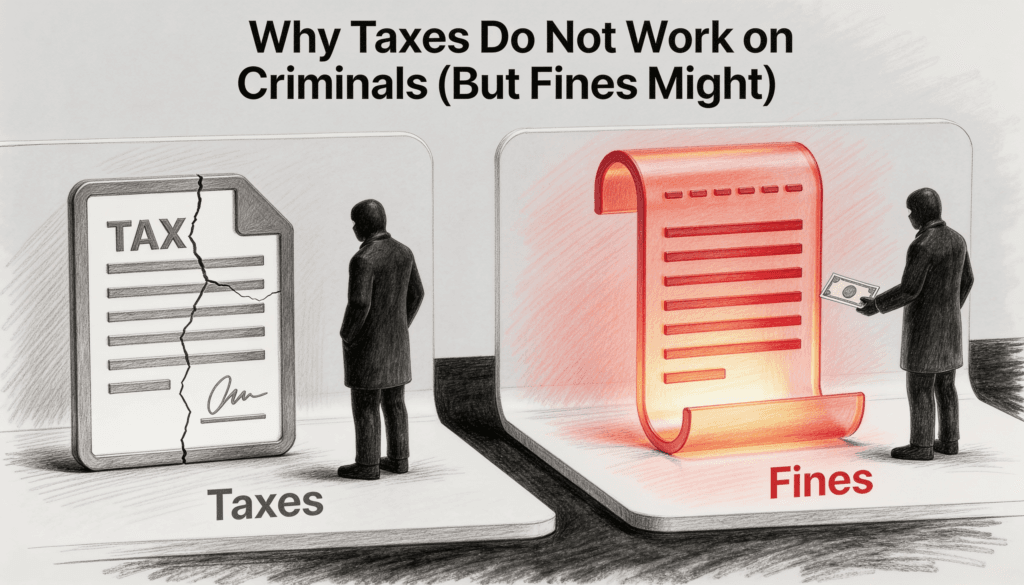
Why Taxes Cannot Touch Crime
Taxes work on a strange premise. They assume the taxed party will, more or less, cooperate. You earn a salary, you report it. You sell a house, you report it. The system runs on visibility. Even tax evasion mostly happens in the gray zones where money is half visible.
Crime is not half visible. Crime is invisible by design.
A drug dealer is not going to file a Schedule C for “controlled substances distributed.” A car thief is not going to declare capital gains on a stolen Honda. The entire infrastructure of taxation, with its forms and audits and W-2s, depends on a paper trail that criminals spend their entire careers erasing.
So if you cannot tax a behavior, what can you do about it? You can outlaw it. And once you outlaw it, you have to decide how to punish the people who do it anyway. This is where Becker’s framework gets interesting.
The Criminal as Accountant
Becker’s model treats every potential criminal as a small, slightly unhinged accountant. Before committing a crime, this internal accountant looks at three numbers.
The first is the probability of getting caught. The second is the severity of the punishment if caught. The third is the expected gain from the crime itself. If the gain is bigger than the probability of being caught multiplied by the punishment, the crime happens. If it is smaller, it does not.
This sounds cold. It is supposed to. Becker was not saying criminals are rational in some deep philosophical sense. He was saying they respond to incentives, just like everyone else who has ever decided whether to speed on an empty highway or take the office stapler home.
The implication is uncomfortable. If criminals are responding to incentives, then the question is not “how do we stop bad people from being bad” but “how do we set the price of bad behavior correctly.”
Prison Is Expensive (For Everyone)
Here is where most people, including most lawmakers, get it wrong.
The instinct, when crime goes up, is to demand harsher prison sentences. Lock them up longer. Make them suffer more. This feels good. It satisfies something deep in the human nervous system.
But Becker noticed something inconvenient. Prison is expensive. It costs the state thirty thousands of dollars per inmate per year. It costs the prisoner his earning years, his family connections, and often his future employability. It costs society a person who, when released, is statistically more likely to commit another crime than he was before he went in.
In economic terms, prison is a punishment that destroys value on both sides. The state pays to inflict pain. The prisoner absorbs the pain and produces nothing. Everyone loses, and the only thing generated is the abstract feeling that justice has been served.
Fines, Becker pointed out, are different.
The Quiet Genius of the Fine
A fine is a transfer. The criminal pays, the state receives. The pain to the offender becomes a benefit to the public. No prison guard needs to be hired. No cell needs to be built. No one’s life is destroyed in a way that costs taxpayers another thirty thousand a year.
If a crime causes, say, ten thousand dollars in damage, and the probability of getting caught is one in five, then the fine should be fifty thousand dollars. The math works out. The expected punishment matches the expected harm. The criminal, if he is the rational accountant Becker describes, will not commit the crime.
This logic is so clean it almost feels suspicious. And in fact, it has a problem. A big one.
The Rich Man’s Loophole
Fines work beautifully on people who can pay them. They do not work at all on people who cannot.
A fifty thousand dollar fine deters a middle class accountant. It does not deter a homeless man. It does not deter a billionaire either, because to a billionaire, fifty thousand dollars is the cost of a long lunch. The fine has different prices for different people, even though the dollar amount is identical.
This is why some countries have experimented. The idea is to scale the fine to the offender’s income. A speeding ticket might cost a teacher two days of pay and a tech executive two days of his much larger pay. The pain of the punishment becomes proportional, not the dollar value. Finland has done this for decades. There is a famous case where a Nokia executive was fined over one hundred thousand euros for speeding. He could afford it. The point was that he felt it.
This solves part of the problem but not all of it. Some people genuinely cannot pay any fine. For them, the system has to fall back on something else. Community service, probation, in serious cases prison. But the principle stands. Where fines can work, they should be the first tool, not the last.
Why This Matters Beyond Crime
Becker’s insight goes far beyond burglars and shoplifters.
Think about parking tickets. Think about pollution penalties. Think about the FCC fining a broadcaster for an obscenity, or the SEC fining a hedge fund for fraud, or a court ordering damages in a civil case. All of these are applications of the same idea. You cannot tax the behavior because the behavior is not legitimate. So you price it through punishment instead.
When pollution penalties are too low, companies pollute. They calculate the fine, compare it to the cost of cleaning up their factory, and choose the fine. This is not because executives are evil. It is because the price of polluting is wrong. Raise the price, and the pollution stops. Lower the price, or stop enforcing it, and the pollution returns.
This is the same logic, just dressed in a suit.
The Counterintuitive Part
Most people assume that the harshness of punishment is what deters crime. Becker showed something different. The probability of being caught matters more than the severity of the punishment.
A guaranteed twenty dollar fine deters more crime than a one in a thousand chance of a ten thousand dollar fine, even though the math is identical. Humans, it turns out, are not perfect accountants. We discount low probability events. We tell ourselves we will not be the unlucky one. We think we will get away with it.
This is why visible policing tends to work better than draconian sentences. A cop on every corner does more than a death penalty applied once a decade. The certainty of being caught is the lever. Severity is just the backup.
It also suggests that countries pouring money into longer sentences while neglecting their police forces are making a bad trade. They are paying for the wrong half of the equation.
The Moral Discomfort
There is something about Becker’s framework that bothers people. It strips crime of its drama. It turns the murderer and the tax cheat into two points on the same graph. It implies that society’s job is not to express moral outrage but to set prices correctly.
Critics say this is dehumanizing. That it ignores the role of poverty, mental illness, addiction, and trauma. That it treats people as calculators when they are actually messy biological creatures with childhoods and grudges and bad days.
These critiques are fair. Becker’s model is a model, not a complete theory of human behavior. It does not explain crimes of passion. It does not explain why some people commit crimes that obviously will not pay. It does not explain why deterrence sometimes fails entirely.
But a model does not have to explain everything to be useful. It just has to explain something better than the alternative. And the alternative, for most of human history, has been “punish them harder and hope it works.” That alternative has not produced great results.
So Why Not Tax Criminals?
Because they will not file. Because the activity is invisible. Because the entire structure of taxation depends on a kind of cooperation that crime, by its nature, refuses.
But you can still set the price. You just have to do it through enforcement instead of paperwork. Through fines instead of returns. Through the certainty of being caught instead of the fantasy of being audited.
It is not a tax. But the math, in the end, is the same. Behavior responds to price. Price the behavior wrong, and you get more of it. Price it right, and you get less.
Gary Becker spent his life trying to convince people of this simple thing. That the world is full of incentives, and the only question is whether we are setting them on purpose or by accident.
The criminal, it turns out, is just a person who priced something differently than the law expected. The law’s job is not to be shocked.
It is to do the math better next time.