Table of Contents
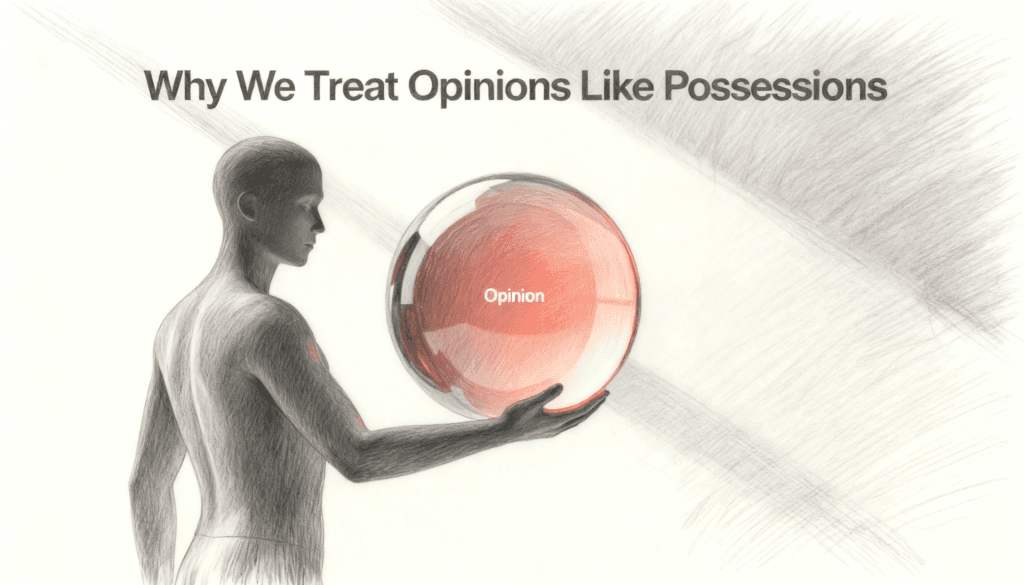
You have never held an opinion in your hand. You have never locked one in a safe, insured it against theft, or watched it appreciate in value on a shelf. And yet, if someone tries to take one from you, something inside your chest tightens in exactly the same way it would if they reached for your wallet.
This is not a coincidence. It is a pattern so deeply wired into human behavior that behavioral economist Dan Ariely has spent a significant portion of his career trying to explain it. His work, most notably in Predictably Irrational, reveals something both fascinating and slightly embarrassing about the human mind: we treat our beliefs with the same irrational protectiveness we reserve for things we own. And just like with physical possessions, we overvalue them simply because they are ours.
Welcome to the strange economics of the mind, where ideas have price tags and changing your position feels like a loss.
The Endowment Effect, But for Your Brain
Ariely is perhaps best known for popularizing the endowment effect, the well documented tendency for people to demand more money to give up something they own than they would pay to acquire it in the first place. In one of his classic experiments, students who were given coffee mugs valued them at roughly twice the price that other students were willing to pay for the same mug. Nothing changed about the mug. The only thing that changed was ownership.
Now take that same mechanism and apply it to an idea.
The moment you form an opinion, you become its owner. And the moment you own it, a quiet psychological inflation begins. The opinion does not get smarter or more evidence based just because it now belongs to you. But it starts to feel more valuable. More correct. More worthy of defense. You did not run a peer reviewed study. You did not consult a panel of experts. You just thought something, and now it is yours, and now it matters more than it did thirty seconds ago.
This is not a character flaw. It is architecture. The brain is not designed to evaluate ideas with the neutrality of a courtroom judge. It is designed to form quick assessments and then protect them, because in evolutionary terms, hesitation could be fatal. The problem is that we no longer live on the savanna. We live in a world of complex policy debates, career decisions, and internet comment sections. And the software has not been updated.
Why Letting Go Feels Like Losing
Ariely’s research intersects powerfully with another concept from behavioral economics: loss aversion, the principle that losses feel roughly twice as painful as equivalent gains feel pleasurable. Losing twenty dollars hurts more than finding twenty dollars feels good. This asymmetry is one of the most replicated findings in the field, and it applies with surprising force to the world of ideas.
When someone challenges your opinion, the brain does not process that as an opportunity to learn. It processes it as a potential loss. You are about to lose something you own. And so the defenses go up. You start looking for evidence that supports your position, not because you are dishonest, but because your brain is running a threat response. This is confirmation bias operating under the protection of loss aversion, and it is a remarkably effective combination for keeping you exactly where you already are.
Think about the last time someone presented you with a genuinely compelling argument against something you believed. Did you feel curious? Maybe. But more likely, you felt a small surge of resistance first. A tightening. A reflexive search for a counterpoint. That resistance was not intellectual. It was emotional. It was the feeling of someone trying to take your mug.
The IKEA Effect of Belief
There is another dimension to this that Ariely explored with particular insight: the IKEA effect. This is the finding that people assign disproportionately high value to things they had a hand in creating. Build a wobbly bookshelf from a flat pack box, and suddenly it is the finest piece of furniture in the house. Not because it is. Because you built it.
Opinions work the same way. The more effort you put into constructing a belief, the more resistant you become to dismantling it. If you spent three hours reading about a topic, debated it with friends, posted about it online, and refined your position through multiple conversations, that opinion is no longer just a thought. It is a project. It is your wobbly bookshelf. And you will defend it against anyone who points out that it leans to the left.
This is why people who are deeply invested in a position are often the hardest to persuade, even when the evidence shifts dramatically. It is not that they cannot see the new data. It is that accepting it means writing off their investment. Psychologically, they would have to admit that the hours and energy they spent were, to some degree, wasted. And the brain would rather bend the interpretation of new facts than absorb that kind of loss.
Here is the counterintuitive part. The more intelligent and articulate a person is, the more effective they tend to be at constructing sophisticated justifications for beliefs they arrived at emotionally. Intelligence does not protect you from this bias. In many cases, it provides better tools for reinforcing it.
Identity: When Opinions Become Body Parts
If the endowment effect explains why we value our opinions, and loss aversion explains why we resist letting them go, identity explains why the whole process can feel so violent.
At some point, an opinion stops being something you have and starts being something you are. This is the moment it becomes truly dangerous to challenge, because now you are not just threatening a person’s idea. You are threatening their self concept.
Ariely’s work touches on this, but it also connects to a broader body of research in social psychology, particularly the work on identity protective cognition. When a belief becomes fused with identity, any attack on the belief is experienced as an attack on the self. This is why political and religious debates so often generate more heat than light. The participants are not really arguing about policy or theology. They are defending who they are.
You can see this play out with remarkable clarity on social media. People do not just share opinions. They perform them. They pin them to their profiles, argue for them publicly, and build communities around them. Each of these actions drives the opinion deeper into the identity structure. And with every layer of social reinforcement, the cost of changing that opinion goes up. It is no longer just about being wrong. It is about being wrong in front of everyone who watched you be so confidently right.
The Marketplace of Ideas Is Not a Market
There is a popular metaphor in public discourse: the marketplace of ideas. The assumption is that good ideas will naturally rise to the top through open competition, the way quality products win in a free market. It is a lovely metaphor. It is also deeply misleading.
A real market works, at least in theory, because consumers evaluate products based on utility and price. But in the marketplace of ideas, every participant is walking around overvaluing their own inventory. Everyone thinks their mug is worth twice what it is. Everyone experiences a challenge as a loss. And everyone has spent enough time assembling their beliefs that throwing them out feels like tossing a bookshelf they built with their own hands.
Ariely’s work suggests that this marketplace is not efficient at all. It is riddled with the same biases and distortions that plague actual economic markets. The difference is that in economic markets, there are external checks. Prices eventually correct. Companies go bankrupt. Reality intrudes. In the marketplace of ideas, you can hold onto a bankrupt opinion for decades and never face a margin call.
The Sunk Cost of Being Right
This connects to one of the most stubborn cognitive traps in human decision making: sunk cost fallacy. In economics, a sunk cost is money already spent that cannot be recovered. Rational decision making says you should ignore it and evaluate future choices based on future outcomes only. But humans are terrible at this. We keep watching bad movies because we already paid for the ticket. We stay in failing projects because we already invested six months. And we cling to outdated opinions because we already spent years defending them.
The longer you have held a belief, the more it has cost you in time, social capital, and emotional investment. Letting it go means accepting that all of that was spent on something that turned out to be wrong. For many people, that is simply too expensive. So they keep holding. They keep defending. They keep doubling down. Not because the evidence supports it, but because the psychological ledger demands it.
This is where things get genuinely tragic. Because the very mechanism that makes humans loyal, committed, and persistent in the face of adversity is the same mechanism that makes us stubborn, irrational, and resistant to growth. The wiring that once kept our ancestors alive by committing fully to a survival strategy now keeps us committed to arguments about tax policy that we formed when we were twenty two.
What Ariely Suggests We Do About It
To his credit, Ariely does not just diagnose the problem. He nudges toward solutions, though he is realistic about how difficult they are to implement.
One of his key insights is the power of what he calls a “cooling off” period. Just as some consumer protection laws allow you to cancel a purchase within a set window, Ariely suggests that we need psychological cooling off periods for our beliefs. Before you commit fully to a position, especially on something complex, give yourself time. Let the initial emotional attachment fade. Then reevaluate.
He also advocates for what might be called structured self skepticism. This is not about doubting everything you believe. It is about building habits that counteract the endowment effect. Ask yourself: if I did not already hold this opinion, would I adopt it today based on the evidence? This question is deceptively simple and remarkably powerful, because it forces you to separate the value of the idea from the fact of ownership.
Another practical suggestion from Ariely’s broader work is to reduce the identity stakes. If you can learn to hold opinions as tools rather than trophies, as instruments for navigating the world rather than decorations for your personality, the cost of updating them drops dramatically. A tool that does not work gets replaced. A trophy that gets taken away triggers grief.
The Uncomfortable Mirror
There is something deeply uncomfortable about all of this, and that is precisely why it matters.
Most people reading this will nod along and think about other people. They will think about that relative who will not change their mind, that coworker who digs in during meetings, that stranger on the internet who doubles down in the face of obvious evidence. The hardest part of Ariely’s work is not understanding the bias. It is accepting that it applies to you.
You are not the exception. The endowment effect does not skip people who are aware of it. Loss aversion does not take a day off because you read a book about behavioral economics. The IKEA effect does not care how many degrees you have. These are features of human cognition, not bugs specific to other people.
And this might be the most valuable thing Ariely teaches us. Not that we are irrational. That has been established thoroughly. But that our irrationality is predictable. It follows patterns. And if it follows patterns, it can be anticipated, studied, and in some cases, gently corrected.
You will not stop treating your opinions like possessions. That would require a brain transplant. But you can start noticing when you do it. You can catch that flicker of defensiveness when someone questions your position and ask yourself whether you are protecting an idea because it is right, or simply because it is yours.
That question will not always change your mind. But it will, occasionally, create just enough space for something better to get through. And in a world where everyone is clutching their mugs with both hands, even a slightly loosened grip is a kind of progress.