Table of Contents
Imagine Voltaire waking up in 2026. After the initial shock of indoor plumbing and oat milk lattes, someone hands him a smartphone. He scrolls through a feed where a stranger is screaming about lizard people, a celebrity is selling skincare made from snail residue, and a teenager is being publicly shamed for a tweet she wrote when she was twelve. He would probably ask for the guillotine back, not as a political statement, but as a personal request.
The man who once wrote that he disapproved of what you say but would defend to the death your right to say it might struggle today. Not because he was wrong, but because the conditions he assumed have quietly evaporated. The Enlightenment thinkers believed in reason, civil debate, the free exchange of ideas, and the slow polishing of truth through public discussion. Social media promised to deliver all of this at scale. Instead, it delivered something stranger. A global town square where everyone shouts, nobody listens, and the loudest voice wins a brand deal.
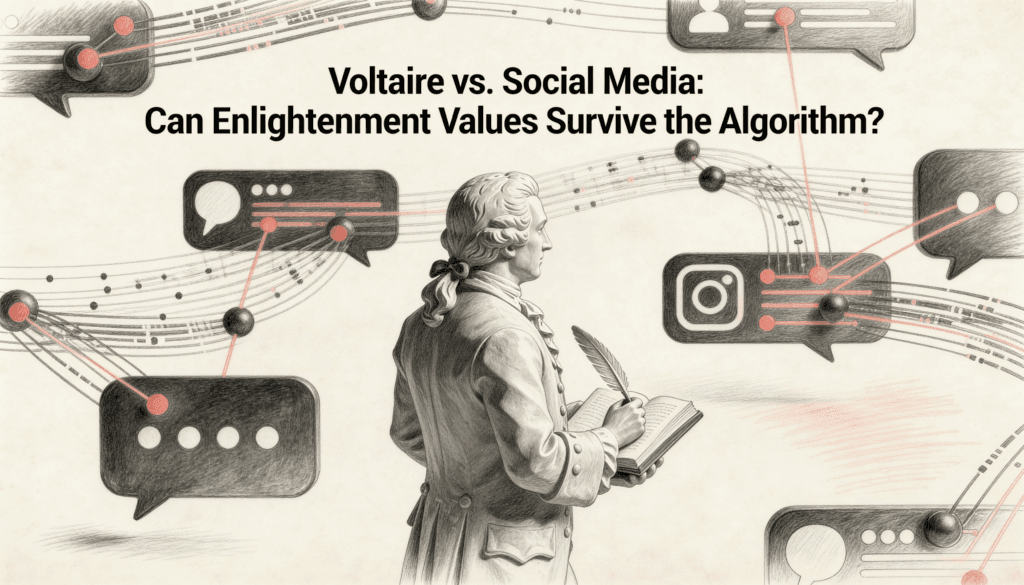
So the question is not whether Voltaire would have a TikTok account. The question is whether the values he and his contemporaries built can actually survive in a world where the algorithm, not the argument, decides what gets heard.
The Original Promise of Public Reason
To understand what is at stake, it helps to remember what the Enlightenment was actually trying to do. In the 17th and 18th centuries, a group of thinkers across Europe started arguing for something genuinely radical. They suggested that ordinary people, given access to information and the freedom to discuss it, could govern themselves. Truth was not something handed down by kings or priests. It was something we built together, slowly, by reasoning in public.
This is why coffeehouses mattered so much. They were not just places to drink overpriced beverages and complain about work. They were the social infrastructure of an entire intellectual revolution. Newspapers, pamphlets, salons, and letters created a network where ideas could travel, get tested, and either survive or die based on their merit.
The key word there is merit. The Enlightenment assumed that in a free marketplace of ideas, the better arguments would eventually win. It was an optimistic view of human nature. Maybe too optimistic. But it shaped the modern world, including the constitutions of most democracies, the principles of academic research, and the idea that journalism should serve the public rather than the powerful.
Now consider what social media was supposed to be. The early evangelists used almost identical language. A global village. A democratization of voice. The end of gatekeepers. The wisdom of crowds. If you squinted, it looked like the Enlightenment dream finally going digital. Every person a publisher. Every citizen a participant. The marketplace of ideas, but with better graphics.
What could possibly go wrong?
The Algorithm Did Not Read the Memo
Here is the part that would have made Voltaire put down his quill and reach for a strong drink. The marketplace of ideas, as designed by social media platforms, was never actually a marketplace of ideas. It was a marketplace of attention. And those are not the same thing at all.
In Voltaire’s imagined public square, ideas competed based on whether they were true, useful, or beautiful. In the algorithmic public square, ideas compete based on whether they make you stop scrolling. These two criteria overlap occasionally, by accident, but they are fundamentally different games. Truth is patient. Attention is not.
The algorithm does not know what is true. It does not care. It only knows what keeps you engaged. And the things that keep you engaged, as researchers have found over and over again, tend to be the things that make you angry, anxious, or outraged. Calm, nuanced, well sourced explanations of complex topics do not perform well. They do not drive comments. They do not get shared with the caption “this is everything.” They sit there, accurate and ignored, while a video of a man yelling about how eating bugs are a globalist plot racks up million views.
This is not a bug in the system. It is the system working exactly as designed. The platforms make money when you stay. You stay when you are emotionally activated. Therefore, emotionally activating content gets boosted. The algorithm is not evil. It is simply doing its job with a kind of mechanical honesty that humans find disturbing.
The Enlightenment thinkers assumed that reason would win in a free exchange of ideas because they assumed the exchange would be roughly fair. They did not anticipate a system that would actively reward unreason because unreason happens to be more profitable.
The Death of the Slow Argument
One of the quieter losses in all of this is something the Enlightenment really valued: the slow argument. The long essay. The careful book. The pamphlet that took weeks to write and months to circulate. These forms of communication had a built in cooling effect. By the time your opponent responded, you had time to actually think about what they said.
Social media collapsed this entire structure. Now the response comes in seconds. The argument has to fit in a few hundred characters. Nuance is a liability because it gives your enemies something to misquote. Subtlety is invisible because the algorithm cannot tell the difference between subtle and boring. So everyone learns to speak in the only register that survives: short, sharp, and ideally a little bit mean.
You can still write a careful essay. You can publish it. But it will probably reach about fourteen people, three of whom are your relatives. Meanwhile, someone who took your argument, stripped it of context, and turned it into a sneering screenshot will reach four hundred thousand. This is not because the screenshot is better. It is because the screenshot is faster, angrier, and easier to react to without thinking.
Voltaire was a master of the short, sharp barb. He would have probably thrived in some ways. But he also wrote enormous works of history, philosophy, and fiction. He understood that wit was a tool for opening minds, not just for closing them. The modern version of Voltaire would be tempted to stay in the barb mode forever, because that is what gets rewarded, and the longer works would never get written.
Free Speech in an Age of Infinite Speech
The Enlightenment defense of free speech was built for a world of scarcity. Ideas were expensive to produce and distribute. Printing presses cost money. Newspapers had editors. Publishing a book required someone to believe it was worth publishing. In that world, the argument for free speech was about removing barriers so that more voices could be heard.
We now live in the opposite world. Every voice can be heard. Every idea, no matter how strange or harmful or simply wrong, can be broadcast to millions. The bottleneck is no longer production. It is attention. And in a world of infinite speech, the question is not who is allowed to speak. It is who gets listened to, and why.
This creates a problem the Enlightenment thinkers never had to solve. If a lie can travel around the world before the truth puts on its boots, and if the algorithm actively prefers the lie because the lie is more engaging, then “more speech” is not necessarily a solution to bad speech. It might be the delivery mechanism for it.
This does not mean the answer is censorship. The cure of letting governments or corporations decide what is true tends to be worse than the disease. But it does mean the simple Enlightenment formula needs an upgrade. The marketplace of ideas only works if there is actually a market. Right now, what we have is more like a casino, where the house always wins, and the house has decided that outrage pays better than truth.
The Strange Survival of Reason
And yet, here is the counterintuitive part. Reason is not actually dead. In some ways, it is doing better than ever. We have more access to information than any humans in history. Anyone with a phone can read scientific papers, watch university lectures, learn a language, study philosophy, or follow a working historian explaining their research in real time. The Enlightenment dream of universal access to knowledge has, in many ways, been delivered.
It is just that this dream is sharing space with a nightmare. The same phone that lets you read Spinoza also lets you fall into a conspiracy theory about how Spinoza was secretly a lizard. Both possibilities exist on the same screen. Which one you end up in depends on what you search for, who you follow, and what the algorithm decides you want next.
This is actually closer to the Enlightenment than we sometimes admit. The Enlightenment was not a guarantee that everyone would become rational. It was an argument that people should have the freedom and the tools to try. Some did. Many did not. The 18th century was also full of nonsense, mysticism, mobs, and people who believed extremely strange things very loudly. The difference now is that all of this happens faster and at greater volume.
The values are not dead. They are just no longer the default. They have to be chosen, deliberately, against the grain of a system that does not particularly want you to choose them.
What Voltaire Might Actually Do
Suppose Voltaire really did wake up tomorrow. After the initial despair, what would he do? Probably not what most of us imagine. He would not write long essays defending the marketplace of ideas. He would not lecture people about civility. He would, I suspect, do exactly what he did in his own time. He would find the cracks in the system and use them.
Voltaire understood that ideas spread through whatever channels are available, in whatever forms those channels allow. He wrote plays when plays were the medium. He wrote letters when letters were the medium. He wrote vicious satire when satire was the only way to slip past the censors. He used humor, mockery, fiction, and outright trolling, all in service of trying to push the world a little bit toward reason.
The modern equivalent might be unrecognizable. Maybe it looks like a podcaster who actually does the reading. Maybe it looks like a creator who turns down brand deals to keep their work honest. Maybe it looks like a thread that takes the time to explain something properly, even knowing it will not go viral. Maybe it looks like a community that decides, collectively, that they care more about being right than being loud.
The algorithm is not going to save us. It was not built to. Whether the values of reason, civil disagreement, and honest inquiry survive is genuinely up to whoever still cares about them. That used to be a much larger group. It can be again. But it will not happen by accident, and the platforms will not help.
Voltaire would probably find this depressing. Then he would write something funny about it, publish it under a fake name, and get back to work.