Table of Contents
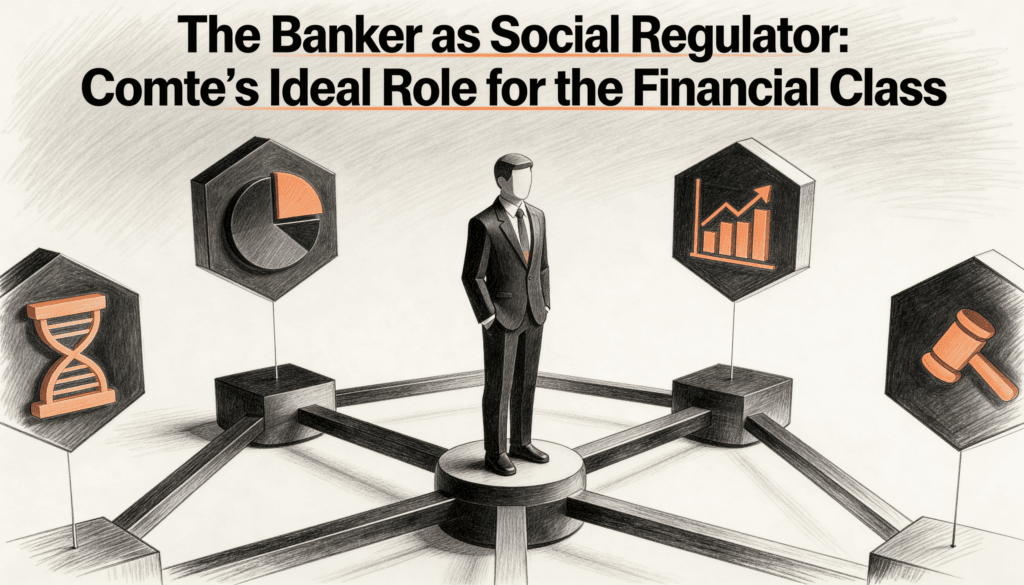
Auguste Comte spent much of his life trying to figure out how a society that had just thrown out kings, priests, and the old certainties could possibly hold itself together. He was watching France stagger through the aftermath of revolution, industrial upheaval, and the slow death of the medieval order. Something had to fill the vacuum. Most thinkers of his time looked to politicians, philosophers, or the new captains of industry. Comte looked somewhere stranger. He looked at the banker.
This was not a casual choice. For Comte, the banker was not merely a man who lent money at interest. He was, or rather could become, the spiritual successor to the feudal lord and the bridge between the old world of property and the new world of production. The financial class, in his vision, was meant to be a kind of secular clergy of capital, charged with the moral weight of directing resources toward the public good. If that sounds odd to modern ears, it should. We have spent the last century watching bankers do roughly the opposite.
But the strangeness of the idea is exactly why it deserves a fresh look. Comte was not naive. He understood that money attracts the greedy. He just thought the solution was to dignify the role rather than to demonize it.
The Problem Comte Was Trying to Solve
To understand why Comte put bankers on a pedestal, you need to understand the wreckage he was standing in. The French Revolution had cleared away the old aristocracy, but it had not replaced the social glue that aristocracy provided. Comte believed every healthy society needed two things working in harmony. It needed a temporal power, meaning the people who actually got things done in the material world. And it needed a spiritual power, meaning the people who set the moral tone and adjudicated values.
In medieval Europe, this was tidy. The nobles ran the estates and fought the wars. The Church told everyone what was right and wrong and reminded the nobles that they would eventually have to answer for their behavior. Comte thought this was a reasonable model, even if the specific institutions had become rotten by his lifetime.
The question was who would play these roles in an industrial society. The answer for the temporal power was obvious. The new captains of industry, the factory owners, the engineers, the men who built railways and steel mills. They were the new lords. But who would be their bankers, in the deep sense? Who would be the highest expression of practical leadership, the people at the very top of the worldly hierarchy?
Comte’s answer was the financiers. And the reason is more interesting than you might expect.
Why Bankers Sit at the Top
In Comte’s scheme of industrial society, there was a hierarchy of practical work. At the base, you had the workers who handled raw materials and physical labor. Above them, the manufacturers who turned materials into goods. Above them, the merchants who moved those goods across distances. And at the very top, the bankers, who dealt not in any specific thing but in the abstract relationships between all things.
The logic here is worth slowing down on. A worker thinks about his task. A factory owner thinks about his factory. A merchant thinks about his trade routes and his customers. But a banker, if he is any good at his job, has to think about everything at once. He has to consider which industries are rising, which are falling, which regions are productive, which are draining capital, which inventions matter and which are fads. He sits at a vantage point that forces him to take a wide view.
Comte saw this wide view as fundamentally a public function dressed up in private clothing. The banker who decides which entrepreneur gets capital is, whether he admits it or not, deciding what kind of society will exist tomorrow. He is choosing winners and losers across the entire economy. He is shaping the very texture of daily life for millions of people he will never meet.
If that is what bankers actually do, Comte reasoned, then we should stop pretending they are just merchants of money. We should treat them as social regulators and hold them to standards appropriate to that role.
The Moral Weight of Capital
Here is where Comte gets uncomfortable for modern sensibilities. He believed that property, including capital, was not really private in any deep sense. He thought of wealth as something held in trust. The owner of a fortune was, in effect, a custodian for society. He had the legal right to control it, yes, but he had a moral obligation to deploy it for the common good.
This is not socialism in the modern sense. Comte was not arguing for state ownership or wealth redistribution by force. He thought private control of capital was more efficient than public control, and he had no patience for utopian schemes that ignored human nature. What he wanted was something more demanding. He wanted owners to internalize the duty of stewardship voluntarily, the way a medieval bishop was expected to internalize his pastoral duty.
The banker, in this picture, was the apex of stewardship. Because he controlled not just his own capital but the flows of capital across the entire economy, his obligation was the heaviest. He was supposed to be a kind of statesman, only more disciplined, because he dealt with hard numbers rather than soft rhetoric.
You can see the appeal of this vision even if you find it impossibly optimistic. It tries to solve the central problem of capitalism, which is that the people with the most power over collective resources are usually accountable only to themselves and their shareholders. Comte’s answer was not to take their power away. It was to surround them with a culture of obligation so thick that they would feel ashamed to misuse it.
The Spiritual Counterweight
Now here is the part of Comte’s thinking that often gets forgotten. He did not trust bankers to regulate themselves. He was not that naive. He believed the temporal power, including the bankers at its peak, had to be checked by a separate spiritual power.
This spiritual power was the part of his system that has aged the worst, because he tried to invent an actual religion to perform it, complete with rituals, calendars, and a Positivist clergy. The details are easy to mock, and people have mocked them for nearly two centuries. But the underlying idea is not absurd. Comte was saying that material power needs moral oversight from somewhere outside itself. Bankers cannot be both the players and the referees.
In his ideal society, this spiritual class would have no political authority and no money. Its only power would come from public opinion, education, and the force of moral judgment. It would praise bankers who served the common good and shame those who did not. It would set the standards of conduct that the financial class was expected to live up to. It would, in short, act as the conscience of capital.
Whether such a class could ever actually exist is a separate question. The point is that Comte did not just hand the keys to the bankers and wish them luck. He paired financial power with a permanent critic perched on its shoulder.
Why Modern Readers Find This Hard to Swallow
The obvious objection to Comte’s view of the banker is that real bankers do not behave like priests of capital. They behave like people trying to maximize returns within legal and reputational limits. The history of the last hundred years is littered with financial scandals, bubbles, crashes, and the occasional bailout. The idea that this class is a natural candidate for moral leadership feels, depending on your mood, either funny or insulting.
But Comte was not describing how bankers actually behaved in 1840. He was describing what their role would require if they took it seriously. He was making a normative claim, not a descriptive one. The fact that bankers often fail to live up to the role does not refute the idea that the role exists. A bad priest does not prove there is no such thing as priesthood. A bad doctor does not prove medicine is fake.
There is also something worth noticing in the modern critique of finance, which is that the critique itself often borrows Comte’s framework without realizing it. When commentators complain that bankers caused a crisis, they are implicitly saying that bankers had a responsibility beyond their own profits and failed to honor it. That is a Comtean argument. The only difference is that Comte said it openly and in advance, while the modern version tends to show up after the damage is done.
What to Take Away
You do not have to buy Comte’s whole system to find something useful in his vision of the banker. The system itself is dated, eccentric, and in places a little ridiculous. But the core idea, that the people who control the flow of capital are doing a public job whether they admit it or not, has lost none of its force.
If anything, the idea matters more now than it did in his lifetime. Capital is more concentrated, more mobile, and more abstract than it was in 1840. The decisions made in a handful of financial centers ripple outward to shape what gets built, where people work, and which futures are funded and which are starved. The banker as social regulator is not a quaint old idea. It is a fairly accurate description of what some bankers already are, minus the moral framework that would make the role tolerable.
Comte’s contribution was to insist that this kind of power needs more than skill to wield well. It needs character, training, and a culture that takes the obligation seriously. He may have been wrong about the specifics. He may have been hopelessly optimistic about human motivation. But he asked the right question, which is how to make the most powerful actors in an economy worthy of the influence they already have.
The question has not gone away. It just gets ignored more politely now.