Table of Contents
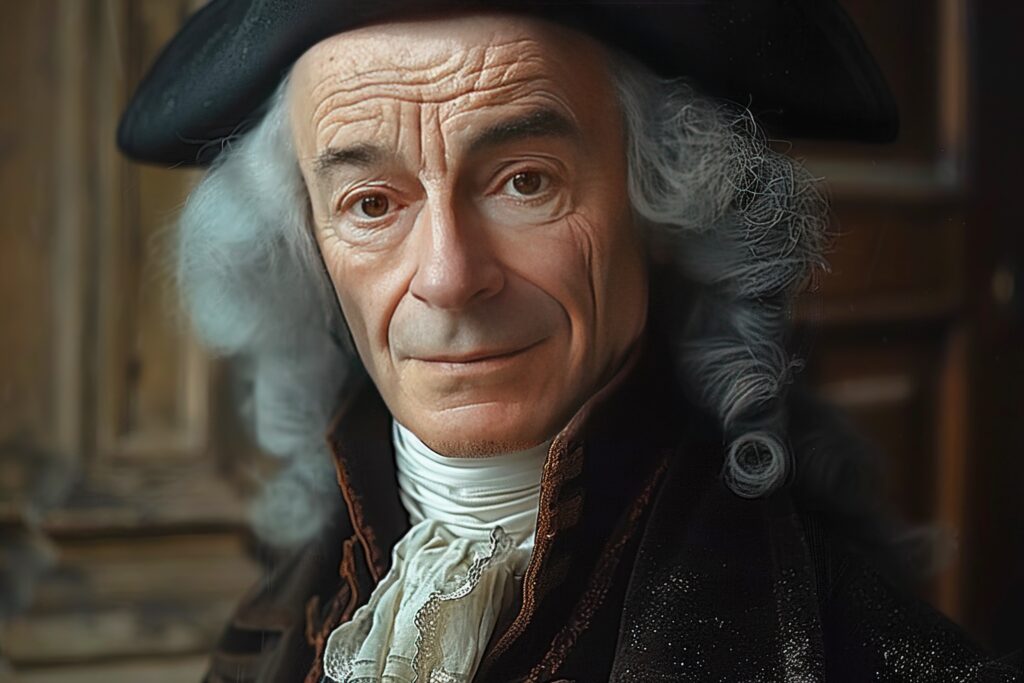
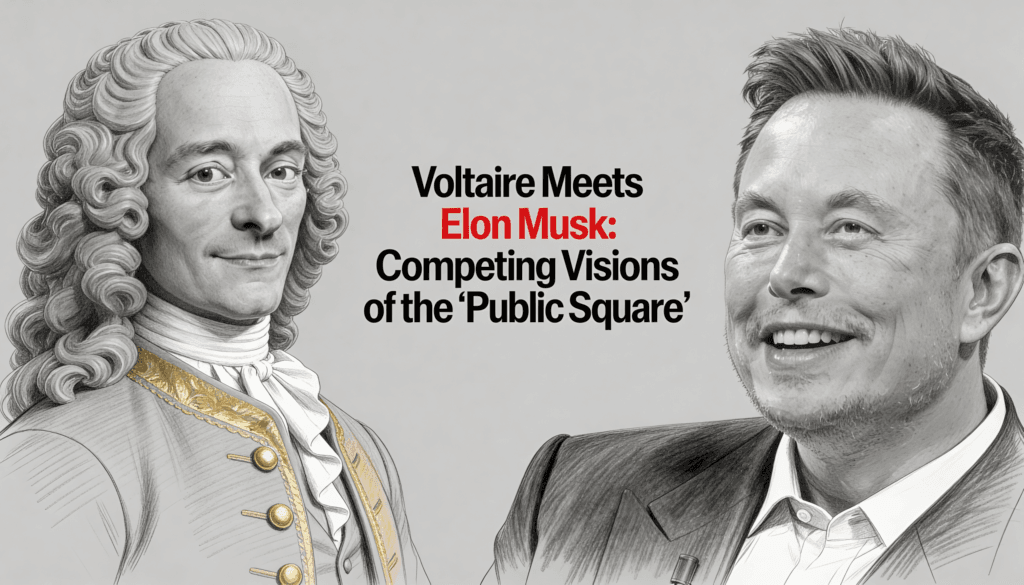
Imagine for a moment a strange dinner party. On one side of the table sits Voltaire, the French philosopher who spent much of the eighteenth century being exiled, jailed, or publicly burned in effigy for writing things that powerful people did not want to hear. On the other side sits Elon Musk, the richest man alive, who bought a social media platform partly because he felt his jokes were not getting enough reach.
They both claim to defend something called “free speech.” They both invoke the idea of a “public square” where ideas can clash openly. And yet, if you put them in the same room, they would probably spend the evening misunderstanding each other entirely.
This is not a small misunderstanding. It is the central confusion of our age. We have inherited a word from one century and tried to bolt it onto the machinery of another, and the result is a constant low hum of cultural argument that never seems to resolve. To understand why, it helps to look at what each man actually meant, or means, by the square.
The Square That Voltaire Knew
When Voltaire defended the right to speak, he was defending it against something very specific: the state, the church, and the polite consensus that protected both. The danger to speech in his world came from above. A king could throw you in the Bastille. A bishop could have your book burned. A mob, often nudged by either of the two, could ruin your life.
The public square Voltaire imagined was not a place. It was an aspiration. It was the salon, the printed pamphlet, the letter passed from one reader to another, the café where men argued over coffee that was still considered slightly suspicious. The square was small, slow, and dangerous. To speak in it required courage because the cost of speaking was high and the audience was narrow.
What Voltaire wanted was not noise. He wanted reason to have a fighting chance against authority. His famous line, which he probably did not actually write but which captures him well enough, is that he would defend to the death your right to say what he disagreed with. Notice what is buried in that sentence. It assumes there is a “you” worth defending, a “thing” worth saying, and a shared world in which the saying matters. It assumes scarcity of voice and weight of consequence.
The Square That Musk Bought
Now consider the modern version. When Musk talks about the public square, he means something almost the opposite in structure, even when he uses the same vocabulary. The threat, in his telling, does not come from the king or the bishop. It comes from moderators, algorithms, and what he sometimes calls the “woke mind virus.” The danger is no longer that you will be silenced by the state. It is that you will be silenced by a private company with a content policy.
This is not a trivial shift. It is a complete inversion of where power lives. In Voltaire’s world, the platform was the printing press, and the printing press was the brave little workshop being raided by soldiers. In Musk’s world, the platform is the workshop, the soldiers, the town, and the country, all rolled into one.
There is something genuinely interesting here, and it is worth being fair to it. The big social platforms really did become something like utilities. When a handful of companies control how most of humanity talks to each other, their moderation choices stop being private business decisions and start to feel like governance. You can dislike Musk and still admit that this is a real problem.
But the version of the square he has built, or claims to have built, is not really Voltaire’s at all. It is something newer and stranger. It is a square where the loudest voice wins, where attention is the only currency, and where the owner of the square can amplify or mute anyone he likes with a flick of the wrist. The exile is no longer the brave dissident. The exile is the person whose post got buried by the algorithm because they did not pay for a blue check.
The Old Trick and the New Trick
There is a useful way to see the difference. In Voltaire’s century, the trick used by power was to make some speech impossible. Books were banned. Authors were exiled. The state’s tool was the gag.
In our century, the trick is almost the reverse. Speech is not made impossible. It is made worthless. You can say whatever you want, but so can ten million other people, all at once, in the same feed. The signal drowns in the noise. The state, if it wants to suppress an idea, no longer needs to ban it. It just needs to flood the zone with so many other ideas that yours becomes statistically invisible.
This is the part that I think both sides of the current debate keep missing. Free speech in 2026 is not threatened mainly by censorship. It is threatened by abundance. There is too much speech, not too little. And in that ocean, the things that float to the top are rarely the things Voltaire was defending. They are the things designed to provoke, to outrage, to be shared by people who did not finish reading them.
A philosopher in the Voltaire mold would have to reckon with this. It is not enough to demand the right to speak when the real question is whether anyone can still hear.
The Funny Thing About Owners
There is a quiet irony at the center of all this. Voltaire’s enemies were powerful men who claimed to act on behalf of God, the crown, or the natural order. Today’s defenders of the square are often powerful men who claim to act on behalf of free expression. The robes are different. The position is similar.
When a single individual owns the place where global conversation happens, the structure starts to look less like a square and more like a private garden with a sign at the gate that reads, “Everyone welcome, terms subject to change.” This is not a moral failing of any particular owner. It is just what private ownership of public space means. If you bought the only park in town, your moods on a given Tuesday would shape what people are allowed to picnic about.
Voltaire would have recognized the shape of this immediately. He spent his life writing about the absurdity of private power dressing up as public good. He would not have been impressed by a billionaire who calls himself a free speech absolutist and then suspends accounts that mock him. He would have written a small, savage essay about it, and then gone back to his garden.
What People Actually Mean by “Public Square”
Part of the problem is that the phrase itself is a metaphor we have stopped examining. A real public square, the kind that existed in Athens or Rome or medieval Florence, had certain features that the digital version does not. You had to be physically present. You could see who you were talking to. Your audience was finite. The cost of being a jerk was social, immediate, and embodied. If you screamed nonsense, real people would look at you and walk away, and you would feel it.
The digital square has none of these features. You can be anywhere. You can be anonymous. Your audience is theoretically infinite. The cost of being a jerk is, for most people, zero. And the design of the place actively rewards the behavior that a real square would punish.
So when someone says we need to defend the public square, the first question worth asking is, which one? The one Voltaire imagined, where reasoned dissent struggles against authority? The one Musk runs, where attention is a market and the owner sets the rules? Or the one we actually have, which is something neither of them quite designed and neither of them seems able to fix?
A Small Defense of Both
I want to be careful here, because it would be easy to write Musk off entirely and treat Voltaire as a saint, and neither would be quite honest.
Voltaire was a snob. He admired tolerance in principle and was capable of being remarkably intolerant in practice, especially about people he considered beneath him. His public square was not open to everyone. It was open to gentlemen who had read the right books.
Musk, for all his contradictions, has put his finger on something real. The old gatekeepers of public discourse, the newspapers and television networks, were not neutral referees. They had their own biases, their own blind spots, and they did not enjoy being challenged. The complaint that legacy institutions had grown too comfortable was not invented by Musk, and it did not become false because he started shouting it.
The honest position is probably that both visions of the square are incomplete. Voltaire’s is too narrow for a world of eight billion voices. Musk’s is too chaotic for any kind of serious conversation to survive. Somewhere between them is the square we actually need, and so far nobody has figured out how to build it.
What This Means for the Rest of Us
The reason this matters is not academic. It shapes how you spend your day. If you treat the feed in your phone as a public square in Voltaire’s sense, you will keep being disappointed. You will expect reasoned dissent and find dunks. You will expect courage and find performance. You will expect ideas to win on their merits and find that the algorithm has other priorities.
If you treat it as Musk’s square, you may feel briefly liberated by the noise and then exhausted by it. Total freedom of speech in a system designed to reward outrage is not freedom at all. It is a slot machine that pays out in adrenaline.
The useful thing to do, I think, is to stop calling it a square. It is not one. It is a market, a stage, a casino, and occasionally a brawl. Sometimes it is all four in the same hour. Treating it as something nobler than it is just makes you a worse participant.
The actual public square, the one Voltaire would recognize, still exists. It lives in long conversations with people you trust, in books that take more than ninety seconds to read, in arguments that you have face to face with someone who can see your expression. It is smaller than it used to be, but it is not gone.
It just does not have a logo.