Table of Contents
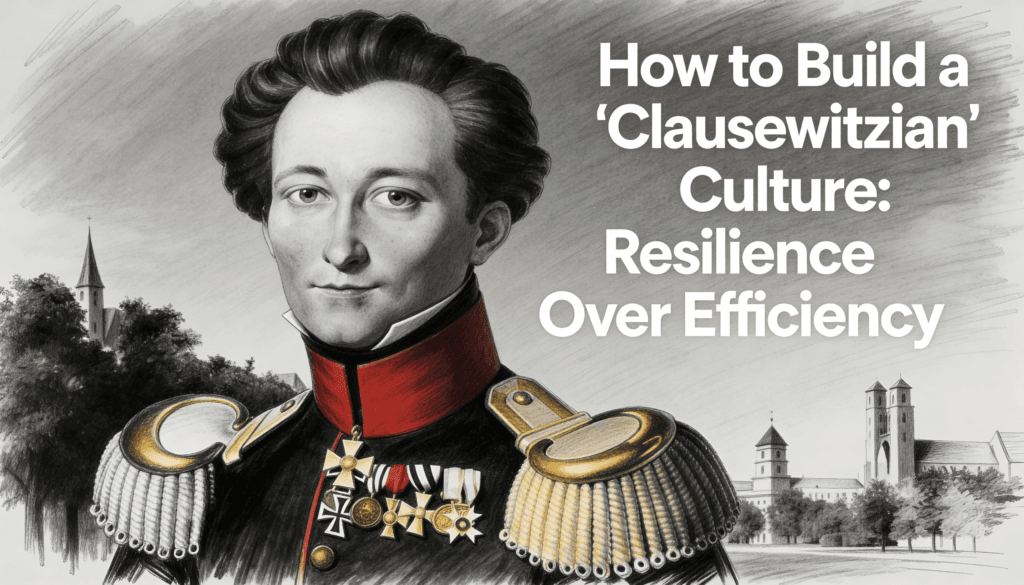
Many organizations want to build themselves into Swiss watches. Beautiful, precise, and completely useless the moment a single gear breaks. Carl von Clausewitz, the Prussian military theorist who spent his life studying why armies collapse, would have looked at the modern corporate org chart and laughed himself into a coughing fit. Not because it is poorly designed, but because it is designed for a world that does not exist.
Clausewitz wrote On War in the early nineteenth century, but his core insight has nothing to do with cannons or cavalry. He noticed that every plan, no matter how brilliant, meets something he called friction. Friction is the gap between the map and the territory. It is the supplier who goes bankrupt the week you launch. It is the star employee who quits during the merger. It is the global pandemic that arrives precisely when your three year strategy assumed three years of normalcy. Friction is not a bug in your strategy. It is the operating environment.
And here is where most companies get it wrong. They respond to friction by trying to eliminate it. They add more processes, more dashboards, more contingency plans, more layers of approval. They optimize. They streamline. They become, in a word, efficient. And efficiency, as Clausewitz would tell you over a glass of brandy, is the polite name for fragility.
The Cult of Efficiency Is a Death Cult
There is a quiet religion that has taken over modern management, and its high priest is the efficiency consultant. The doctrine is simple. Waste is bad. Slack is waste. Therefore, eliminate slack. Every employee should be at ninety five percent capacity. Every supply chain should be lean. Every dollar should be working. Every minute should be billable.
This sounds reasonable until you remember what slack actually does. Slack is what lets a system absorb a shock without breaking. Slack is the extra inventory that saves you when the container ship gets stuck sideways in a canal. Slack is the engineer who has thirty percent unscheduled time and uses it to notice the bug that would have brought down production. Slack is the relationship your sales lead has with a client that does not appear on any KPI but quietly keeps the account renewing year after year.
When you optimize all of that away, you do not get a better company. You get a company that works beautifully under perfect conditions and collapses the moment conditions become imperfect. Which, if you have been paying attention to the last several years, is most of the time.
Clausewitz watched Napoleon, arguably the most efficient military commander in history, march into Russia with a perfectly optimized army and lose almost all of it to weather, distance, and the simple fact that horses need food. The lesson was not that Napoleon was a bad planner. The lesson was that planning, past a certain point, becomes an enemy when perfect environment changes.
What a Clausewitzian Culture Actually Looks Like
So what is the alternative? Not chaos. Not the pretend disorder of a startup that has not figured out its expense policy. Something more deliberate.
A Clausewitzian culture is built around the assumption that things will go wrong. Not might. Will. The plan is a starting point, not a destination. The org chart is a suggestion. The strategy document is a working hypothesis. Everyone, from the CEO to the new hire, operates with the understanding that today’s brilliant decision will look stupid by next five years, and that is fine.
This requires a few specific habits, and none of them are comfortable.
The first habit is what military theorists call commander’s intent. Instead of telling people exactly what to do, you tell them what you are trying to achieve and why. Then you let them figure out how. This sounds obvious. It is not how most companies work. Most companies hand down detailed instructions and then act surprised when the people executing those instructions cannot adapt when reality shifts.
If your team needs a meeting to decide whether to deviate from the playbook, your playbook is the problem. The point of training people deeply in your goals is so they can throw out the playbook when the playbook is wrong. A great chef does not call the head office when the fish supplier sends salmon instead of cod. A great salesperson does not need approval to offer a discount that saves a relationship. A great engineer does not need a committee to roll back a deployment that is breaking things.
The second habit is redundancy. Yes, the dirty word. The thing every efficiency consultant has been trying to eliminate for forty years. Redundancy means more than one person knows how to do the critical thing. It means more than one supplier can deliver the critical part. It means more than one channel reaches your customers. It means, frankly, that some money will be spent on capacity you do not currently need.
This will look wasteful on a spreadsheet. It will look brilliant the next time the critical person quits, the critical supplier defaults, or the critical channel changes its algorithm. The savings from running lean are visible every quarter. The cost of running lean is invisible until the day it breaks you.
The Counterintuitive Part: Resilient Cultures Move Faster
An efficient culture optimizes for the predicted scenario. When reality matches the prediction, it executes beautifully. When reality does not match, the entire system has to stop, reconvene, reanalyze, and replan. Decisions get bumped up the chain. Meetings multiply. The smart people who could have handled it locally are sidelined while the chain of command catches up.
A resilient culture, on the other hand, assumes the prediction will be wrong. It builds the assumption of error into its operating rhythm. When reality diverges, the people on the ground are already authorized to adapt. They do not need permission. The system bends instead of breaks, and the company moves through the disruption while the efficient competitors are still scheduling the all hands.
You can see this in companies that survived 2020 versus the ones that did not.
How to Actually Build This
Theory is cheap. Here is what changing the culture actually requires, and why most leaders will not do it.
Start with how you talk about mistakes. In an efficient culture, mistakes are failures of execution. Someone did not follow the process. Someone did not hit the number. The response is punishment, blame, and tightened control. The lesson everyone learns is to hide problems and avoid initiative.
In a Clausewitzian culture, mistakes are data. Some are honest experiments that did not work. Some are real failures that need to be addressed. The difference matters, and you have to be willing to tell them apart out loud. If you treat all mistakes the same, your people will optimize for not getting caught, which is the opposite of what you want.
This does not mean tolerating incompetence. It means distinguishing between someone who tried something reasonable that did not work and someone who repeatedly does the same dumb thing. One deserves a conversation about what was learned. The other deserves a different conversation entirely.
Next, look at your meeting structure. Most companies meet too much because they trust too little. Every meeting is, at some level, a control mechanism. A status update is someone checking that you are doing what you said you would do. An approval meeting is someone confirming you are not going to do something stupid. A planning meeting is everyone agreeing on what they say they will execute.
A resilient culture cuts most of these. Not because meetings are bad, but because the underlying lack of trust is bad. If you trained your people well and gave them clear intent, you do not need to check on them constantly. If you have to check on them constantly, the problem is upstream of the meeting.
Then there is the question of how you hire. Efficient cultures hire for narrow expertise. The candidate who has done this exact job at this exact scale at three previous companies. Resilient cultures hire for judgment. The candidate who has handled unfamiliar situations, made decisions with incomplete information, and learned from the results. The first kind of person executes the playbook. The second kind of person knows when to ignore it.
Both are valuable. But if your entire team is the first kind, you are one disruption away from collective paralysis.
Why Most Companies Will Never Do This
I want to be honest. Most companies that read this will nod, agree with every point, and then change nothing. The reason is structural.
Building a Clausewitzian culture requires accepting visible costs in exchange for invisible benefits. The slack capacity, the redundant suppliers, the unscheduled engineering time, the salaries of judgment heavy senior people, all of this shows up on next quarter’s financials. The cost of not having these things shows up only on the day disaster strikes, which might be never, which might be next year.
Public companies in particular have a hard time with this. The market punishes visible inefficiency every quarter. It only punishes hidden fragility once, and usually by then the executives responsible have moved on with their bonuses intact. The incentive structure is wrong.
Private companies, founder led companies, and family businesses tend to do this better. They have skin in the game over longer time horizons. They have seen what happens when the optimization goes too far. They remember 2008 or 2020 not as a case study but as the year that cost them.
If you are leading an organization and you want to build for resilience, you will have to make peace with looking suboptimal on paper. You will have to defend hiring people you do not strictly need yet. You will have to explain why you are paying for capacity you are not using. You will have to resist the constant pressure to squeeze the last drop of efficiency out of a system that is already too tight.
This is not a popular position. It is, however, the difference between companies that survive and companies that become case studies in MBA programs about what went wrong.
The Real Lesson From Clausewitz
The deepest insight in On War is not about strategy at all. Clausewitz was the rare military thinker who understood that war is not a chess game. It is a contest between two minds, each trying to disrupt the other, conducted under conditions of fog, exhaustion, and constant surprise. The winner is rarely the one with the better plan. It is the one whose system can keep functioning when the plan falls apart.
Business is not war. The metaphor only goes so far, and pretending otherwise leads to a lot of bad leadership books. But the underlying point holds. Your competitive environment is also a contest of minds operating under uncertainty. Your plan will also meet friction. The question is not whether you will be surprised. The question is what your organization does in the first thirty seconds after the surprise arrives.
If the answer is “schedule a meeting,” you have an efficient culture. If the answer is “the people closest to the problem are already solving it,” you have a Clausewitzian one.