Table of Contents
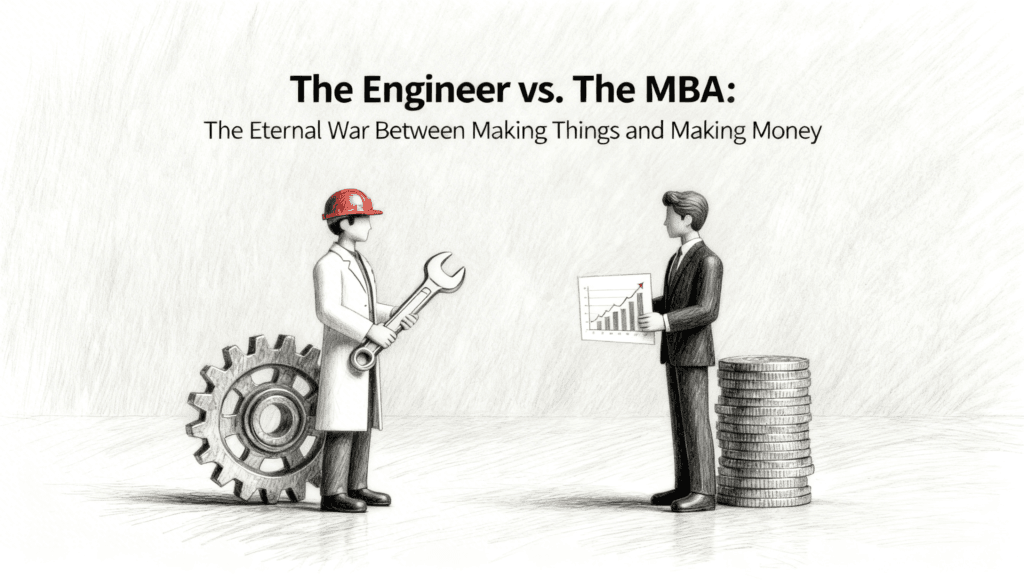
Over a century ago, a strange, socially awkward economist from rural town noticed something that most people still refuse to see. Thorstein Veblen, a man who could not hold a university job to save his life, looked at the American economy and saw two civilizations living under one roof. On one side stood the engineers, the makers, the people who wanted to build things that worked. On the other side stood the businessmen, the financiers, the people who wanted to make money whether things worked or not.
Veblen did not think these two groups were simply different. He thought they were fundamentally at war. And he thought the wrong side was winning.
What makes his observation so uncomfortable, even now, is that he was not talking about corruption or greed in the usual sense. He was describing something structural. Something baked into the way modern economies operate. The people who know how to make things are not the people who control things. And the people who control things often succeed precisely by preventing things from being made too well, too cheaply, or too abundantly.
If that sounds like the kind of insight that would get you fired from a business school, well, Veblen was in fact pushed out of several academic institutions. But not for his ideas. For sleeping with faculty wives. The man contained multitudes.
The Instinct of Workmanship
Veblen believed that human beings carry a deep, almost biological drive to do useful work. He called it the instinct of workmanship. It is the satisfaction a carpenter feels when a joint fits perfectly. The pleasure a programmer experiences when code runs clean. The quiet pride of anyone who makes something that functions as it should.
This instinct, Veblen argued, is one of the oldest and most powerful forces in human psychology. Long before anyone invented stock options or quarterly earnings reports, people wanted to make good things. Not because someone was paying them to. Because making good things felt right.
The engineer, in Veblen’s framework, is the modern carrier of this instinct. Engineers think in terms of function, efficiency, and material reality. They ask: does it work? Can it be improved? Is there waste that can be eliminated? Their loyalty is to the process, the product, the physical world of cause and effect.
This might sound like common sense. And it is. Which is exactly why it causes so many problems.
The Business Enterprise
Against the instinct of workmanship, Veblen placed what he called the business enterprise. This is not business in the sense of commerce or trade, which humans have practiced for thousands of years. Veblen meant something more specific. He meant the modern system in which the primary goal of economic activity is not production but profit. And profit, he noticed, does not always require production. Sometimes it requires the opposite.
Here is where Veblen gets genuinely dangerous. He observed that business leaders often make more money by restricting output than by increasing it. A factory that could produce ten thousand units might be more profitable producing six thousand, if scarcity keeps prices high. A patent holder who sits on a technology and licenses it slowly can extract more wealth than one who floods the market with a superior product.
The MBA, in this framework, is not a villain. The MBA is a rational actor operating within a system that rewards financial manipulation at least as generously as it rewards genuine creation. The MBA does not need to understand how the product works. The MBA needs to understand how the market works. And these are not the same thing.
Veblen saw this distinction playing out across the American economy of the early twentieth century. The captains of industry, the Carnegies and Rockefellers, were celebrated as builders. But Veblen argued that their real skill was not building. It was strategic sabotage. They consolidated industries, eliminated competitors, restricted supply, and controlled prices. They were brilliant at it. But what they were brilliant at was not engineering. It was financial warfare.
Sabotage as Business Strategy
Veblen used the word sabotage in a way that surprises most people who encounter it for the first time. He did not mean destruction. He meant the conscious withdrawal of efficiency. The deliberate decision to produce less than you could, to innovate slower than you might, to maintain problems that could be solved, because solving them would not be profitable.
Think about that for a moment. In Veblen’s view, the modern economy does not just fail to reward the instinct of workmanship. It actively punishes it. The engineer who designs a product that lasts forever is a threat to the business model that depends on planned obsolescence. The researcher who discovers a cheap cure is an enemy of the pharmaceutical company that profits from expensive treatments. The software developer who writes code so clean it never needs updating is putting the maintenance team out of work.
This is not a conspiracy theory. It is a structural observation. No one needs to sit in a dark room plotting to suppress good engineering. The incentive structure does the work automatically. When profit is the measure of success, anything that reduces profit is failure, even if it represents a genuine improvement in the quality of human life.
Consider the modern smartphone. The engineering talent that goes into these devices is staggering. The materials science, the miniaturization, the software architecture. And yet these marvels of engineering are designed to become obsolete within two years. Not because the engineering demands it. Because the business model demands it. The engineer wants to build something that lasts. The MBA wants to build something that needs replacing.
Veblen would have found the smartphone a perfect case study. The instinct of workmanship and the logic of business, locked together in one device, pulling in opposite directions.
The Leisure Class Connection
This tension did not exist in a vacuum. Veblen connected it to his most famous idea: the theory of the leisure class. In his 1899 masterwork, he argued that the wealthy do not simply accumulate money. They accumulate status through conspicuous consumption and conspicuous waste. The point of wealth is not comfort. The point of wealth is display.
What does this have to do with engineers and MBAs? Everything.
The engineer produces value. The MBA captures value. But in a society organized around status and display, the person who captures value will always outrank the person who produces it. The investment banker who restructures a company and extracts millions in fees will always be more socially prestigious than the mechanical engineer who designed the product that made the company worth restructuring in the first place.
This is not just unfair. It is, in Veblen’s analysis, economically destructive. When the highest rewards go to value capture rather than value creation, the most talented people migrate toward finance, consulting, and management rather than engineering, science, and production. The economy gets better at extracting wealth from existing structures and worse at building new ones.
If you want evidence that Veblen was onto something, look at where the top graduates of elite universities have gone for the past forty years. Not into laboratories or workshops. Into Goldman Sachs and McKinsey. The instinct of workmanship is alive and well. It is just being applied to financial engineering instead of the regular kind.
The Counter Argument
Now, it would be dishonest to present Veblen’s framework without acknowledging its weaknesses. And there are real ones.
The most obvious objection is that the line between production and finance is not as clean as Veblen suggested. A good MBA does not just manipulate numbers. A good MBA identifies market needs, allocates capital efficiently, manages risk, and coordinates complex organizations. These are genuinely productive activities. An engineer with a brilliant product and no business strategy will fail just as surely as a business with no product.
Steve Jobs, a figure Veblen never could have anticipated, is the classic counterexample. Jobs was not an engineer. He could not write code or design circuits. But his understanding of markets, aesthetics, and human desire produced one of the most innovative companies in history. Was he an engineer or an MBA? He was neither. He was something Veblen’s framework struggles to accommodate: a businessman whose business instinct served the instinct of workmanship rather than opposing it.
There is also the uncomfortable fact that Veblen romanticized engineers. Real engineers are not pure craftsmen laboring selflessly in the service of human progress. They have egos, biases, and blind spots. They can become obsessed with technical elegance at the expense of practicality. They can build magnificent solutions to problems no one has. The stereotype of the engineer who cannot understand why the market rejected a superior product is a stereotype because it happens constantly.
Why This Still Matters
Despite its limitations, Veblen’s framework remains one of the most useful lenses for understanding the modern economy. Not because it is perfectly accurate, but because it identifies a tension that most economic thinking pretends does not exist.
Mainstream economics treats production and profit as essentially the same thing. If a company is profitable, it must be producing value. If a product sells, it must be meeting a genuine need. Veblen rejected this assumption. He insisted that profit and production can diverge, sometimes radically, and that when they do, the consequences are serious.
Look at the pharmaceutical industry, where companies routinely spend more on marketing than on research. Look at the financial sector, which now accounts for a larger share of corporate profits than at any point in American history while producing nothing you can touch, eat, or live in. Look at the tech industry, where the most profitable business models are not the ones that build the best products but the ones that most effectively capture and monetize attention.
Veblen died in 1929, just months before the stock market crash that validated many of his warnings. He did not live to see the Great Depression, the rise of the military industrial complex, the financialization of the American economy, or the emergence of Silicon Valley. But his central insight, that the people who make things and the people who make money from things are engaged in a fundamental conflict, has only become more relevant with time.
The Quiet Revolution That Never Came
Veblen harbored a quiet hope that engineers might eventually take over. He imagined a technocracy, a society governed by technical expertise rather than financial interest. In the 1920s, a movement called the Technical Alliance actually tried to make this happen. It failed, as utopian movements tend to do.
The engineers did not take over. The MBAs did. Business schools proliferated. Management consulting became a prestige profession. The language of finance colonized every domain, from healthcare to education to government. We now evaluate hospitals by their profitability, universities by their return on investment, and governments by their GDP growth. Veblen would have recognized all of this as the triumph of the business enterprise over the instinct of workmanship.
But here is the part Veblen might not have predicted. The instinct of workmanship did not die. It went underground. It reappeared in open source software, where programmers build complex systems and give them away for free. It surfaced in the maker movement, in community workshops, in Wikipedia. It lives in every engineer who stays late to fix a bug that no customer has reported, in every scientist who publishes findings that will never generate a patent, in every craftsperson who refuses to cut corners even when no one would notice.
The war between making things and making money is not over. It was never going to be over. Veblen understood that it is not a problem to be solved but a tension to be managed. And the first step in managing it is seeing it clearly.
Which, given how many people still do not, means Veblen’s strange, awkward, brilliant work is far from finished.