Table of Contents
The Quiet Danger of the AI You Stop Questioning
The most dangerous artificial intelligence in your company is not the one hallucinating wildly or refusing prompts. It is the one your team stopped double checking three months ago. Somewhere between the novelty of a new tool and the comfort of a reliable one, a critical faculty goes to sleep, and that sleep is where real damage happens.
We have been trained by science fiction to fear the rogue AI, the runaway superintelligence, the model that outsmarts its creators. Yet the actual failure mode unfolding across boardrooms, law firms, hospitals, and newsrooms looks nothing like that. It looks like a competent junior analyst whose work nobody reviews anymore because the work has always been fine. Until it is not.
This is the paradox of AI trust: the smarter a system appears, the less friction it generates, and the less friction it generates, the more we surrender the very scrutiny that keeps it honest. The problem is not the machine. The problem is what the machine does to us.
The Machiavellian Insight Nobody Applies to Software
Machiavelli spent much of The Prince obsessed with a question modern executives rarely ask about their tools: who benefits when you trust something completely? His counsel to rulers was blunt. Trust is a resource to be spent carefully, because the moment you extend it fully, you have transferred a portion of your power to whoever, or whatever, receives it.
“The first method for estimating the intelligence of a ruler is to look at the men he has around him.” Machiavelli understood that our judgment is only as sharp as the counselors we choose, and that flattering counselors are the most dangerous of all.
An AI model is, functionally, the most flattering counselor in history. It responds instantly. It never contradicts you rudely. It produces confident, polished prose regardless of whether it is right. It adapts to your tone, mirrors your framing, and gives you what you appear to want. Machiavelli would have recognized the pattern immediately and warned you accordingly.
The overreliance on AI we are witnessing across industries is not a technical failure. It is a governance failure of the exact kind Renaissance political theorists spent centuries mapping. When a counselor tells you what you want to hear and faces no consequence for being wrong, you have not gained an advisor. You have installed a mirror with a vocabulary.
Why Competence Breeds Complacency
There is a specific psychological trap here worth naming. Researchers call it automation bias, and it has been documented in pilots, radiologists, and military operators for decades. The pattern is simple. When a system performs well 95% of the time, humans stop checking it during the other 5%. And the 5% is precisely where the catastrophic errors live.
Consider what happens inside a legal team using an AI research assistant. In week 1, every citation gets verified. In week 4, spot checks replace verification. By week 12, the output flows straight into filings. Then a court sanctions the firm for citing cases that never existed. This is not a hypothetical. It has already happened multiple times in American courts since 2023.
The AI did not become worse. The humans became less vigilant. The tool inherited authority it was never designed to carry.
The Difference Between a Tool and an Oracle
A hammer does not tell you where to drive the nail. A spreadsheet does not decide which quarter matters. Traditional tools extend human capability without displacing human judgment, because they cannot generate the appearance of judgment themselves. Generative AI breaks this pattern in a way we have not fully absorbed.
When a large language model produces a memo, a diagnosis, a legal brief, or a strategic recommendation, it is not merely executing your instruction. It is performing judgment. It structures arguments, weighs considerations, and delivers conclusions in the register of an expert. The output looks like the product of thinking, and our brains, wired to respond to fluent language as evidence of intelligence, treat it accordingly.
This is the heart of ai blind trust danger. We are not just using tools. We are outsourcing cognition to systems that mimic the surface features of cognition without the underlying accountability. A human expert can be questioned, cross examined, held liable. A model produces the same confidence with none of the exposure.
The Fluency Trap
Fluency is the con. Humans equate articulate speech with competence. This bias predates AI by millennia. Aristotle warned in the Rhetoric that a persuasive speaker with a false premise is more dangerous than an incompetent one with a true premise, because persuasion carries the audience past the moment where they should have checked the foundation.
Aristotle wrote that rhetoric is the faculty of observing in any given case the available means of persuasion. He did not mean this as a compliment. He meant it as a warning about what happens to societies that reward eloquence over accuracy.
Modern language models are, by design, optimized for fluency. They are trained to produce text that a human reader will accept. Accuracy is a secondary property that emerges only when the training data and the query happen to align well. This is not a flaw to be patched. It is the architecture. And it means the outputs will always sound more reliable than they are.
Where Trust Fails Most Expensively
Not every domain punishes AI trust equally. Some sectors will absorb the friction of occasional errors. Others will see catastrophic outcomes the first time vigilance drops. Understanding the difference is the beginning of any serious framework for using these tools well.
High Stakes, Low Verification Cost
Consider medical diagnostics. AI imaging tools can flag anomalies faster than human radiologists in many contexts. The stakes are enormous. But verification is relatively cheap, because a second human read of the scan is standard practice. Here, trust can be extended incrementally, with the human loop preserved as a governor.
High Stakes, High Verification Cost
Now consider strategic business advice generated by AI. A model can produce a 40 page market entry analysis in 3 minutes. To verify it, an executive would need to reproduce most of the underlying research, defeating the point of using the tool. So verification collapses, and the recommendations get treated as sound because they read as sound. This is where overreliance on AI quietly destroys enterprise value.
Low Stakes, Cumulative Effect
The most underestimated category. Marketing copy, internal memos, meeting summaries, first draft emails. Each individual output matters little. But over 18 months, a company that runs on AI generated communication develops a homogenized voice, loses institutional memory, and hollows out the writing skills of its junior staff. The damage compounds invisibly.
A Framework for Calibrated Skepticism
The answer is not to reject these tools. That is the reaction of someone who has not thought carefully about competitive dynamics. Firms that refuse AI will lose to firms that use it well. The answer is to build a discipline around it that assumes the tool is a talented liar until proven otherwise on any specific question.
Here is a working framework you can implement this quarter.
1. Separate Generation from Verification
The person who prompts the AI should never be the sole person who validates its output on consequential work. This is basic separation of duties, the same principle that governs accounting controls. When the generator and the validator are the same human, cognitive investment in the output biases the check.
2. Track Failure Rates, Not Just Wins
Most teams that adopt AI count the hours saved. Almost none count the errors caught downstream. If you cannot answer the question “how often did this tool produce something wrong that we caught, and how often might we have missed something,” you are flying blind. Build a simple log. Review it monthly.
3. Preserve the Skill Underneath
Any function you fully delegate to AI will atrophy in your team. If junior lawyers stop drafting because the model drafts, they will not become senior lawyers capable of judging the model’s drafts. This is the hidden succession crisis of the next decade. The organizations that will win in 2030 are the ones that used AI to accelerate learning rather than replace it.
4. Adversarial Prompting as Standard Practice
For any important output, run the same question through the model 3 times with different framings. Ask it to argue the opposite. Ask what a critic would say. The fluency of a single response is a trap. The variance across multiple responses is information.
5. Name the Domain of Trust Explicitly
Trust is not a global setting. You can trust an AI to summarize a document accurately while distrusting its judgment about what the document means. You can trust it to generate options while reserving all selection to humans. Executives who say “I trust the AI” or “I do not trust the AI” are asking the wrong question. The right question is: for which specific task, with what specific verification, at what specific stakes.
The Machiavellian Court, Rebuilt in Silicon
Return to Machiavelli for a moment, because the parallel deepens the more you sit with it. A Renaissance prince surrounded himself with advisors whose incentives he had to manage constantly. Flatterers were dangerous. Honest counselors were rare. The prince who could not tell the difference lost his state.
Your relationship with AI is structurally identical, with one crucial difference. The Renaissance prince at least knew his advisors had interests. He could reason about their motives. A large language model has no motives, which sounds reassuring until you realize it also has no stake in being right. It will not warn you when it is guessing. It will not hesitate when it should. It performs certainty because that is what the training rewards.
The wise prince, Machiavelli argued, must be a great feigner and dissembler, and must know how to see through the same in others. Substitute “model” for “others” and the advice reads as if it were written for 2025.
The executives, doctors, lawyers, and analysts who thrive over the next decade will be the ones who treat AI outputs the way a shrewd Renaissance ruler treated the counsel of ambitious courtiers. Useful, often insightful, occasionally brilliant, and never accepted without the assumption that verification is your job, not theirs.
What Blind Trust Actually Costs
Let us make the costs concrete, because abstract warnings rarely change behavior. Consider what happens across a 24 month horizon when an organization drifts into ai blind trust danger.
- Erosion of expertise. Junior staff stop developing the pattern recognition that comes from doing the work manually. When the AI is unavailable or wrong, no one notices.
- Homogenized thinking. Everyone in the industry uses the same 2 or 3 models with the same training data. Strategic differentiation collapses into whoever prompts most creatively.
- Legal and reputational exposure. Fabricated citations, invented statistics, incorrect medical guidance. Each incident is individually rare. Aggregated across an industry, they become inevitable.
- Loss of institutional memory. Knowledge that used to live in senior practitioners migrates into prompts and workflows nobody documents. When people leave, so does the ability to use the tools well.
- Strategic blindness. Models trained on public data cannot see what your competitors are about to do, because they cannot see what has not been written yet. Companies that rely on AI for foresight are, by construction, always looking backward.
None of these show up on a quarterly report. All of them determine which firms are still standing in 2032.
The Contrarian Position Worth Taking
Here is the position I would defend. The AI safety conversation is fixated on the wrong risk. Alignment researchers worry about hypothetical superintelligences with misaligned goals. Meanwhile, ordinary language models are already producing measurable harm at scale, not because they are dangerous in themselves, but because humans have granted them authority they were not built to hold.
The next 5 years will not be defined by whether AI becomes conscious or breaks containment. They will be defined by whether ordinary organizations develop the discipline to use fluent, confident, frequently wrong systems without losing their own capacity to judge. This is a governance problem, a cultural problem, and above all a problem of intellectual humility, both about the machine and about ourselves.
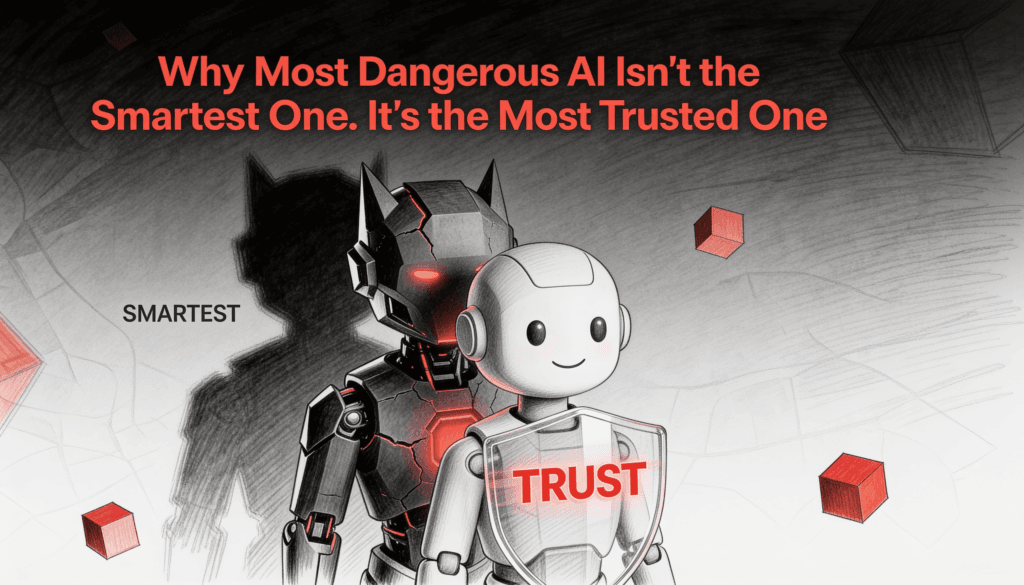
The smartest AI in the room is not the threat. The threat is the AI that has quietly become the room’s most trusted voice, precisely because nobody has questioned it lately. That is the counselor Machiavelli warned about, wearing new clothes.
The Practical Discipline Ahead
If there is one habit worth cultivating as these systems spread through every function of modern life, it is the habit of asking, before accepting any AI output, a single blunt question. What would I need to see to know this is wrong? If you cannot answer, you are not using the tool. The tool is using you.
Trust is not the enemy. Uncalibrated trust is. The organizations, professions, and individuals who master this distinction will treat AI as what it actually is: a powerful, unreliable, articulate assistant whose value depends entirely on the judgment of the human who deploys it. The ones who do not will discover, probably too late, that the most dangerous system in their operation was never the one they feared. It was the one they forgot to doubt.
Machiavelli would have understood immediately. The rest of us are still catching up.