Table of Contents
There is a quiet phrase that has crept into boardrooms, war rooms, family dinners, and personal journals. It sounds wise. It sounds responsible. It sounds like the kind of thing a grown adult should say with a furrowed brow and a slow nod.
Safety first.
Two words that feel like a moral upgrade over whatever you were thinking before. Two words that make cowardice sound like prudence and indecision sound like wisdom. Two words that, if Carl von Clausewitz could hear them whispered in a modern strategy meeting, would probably make him put down his pipe and ask whether we have all lost our minds.
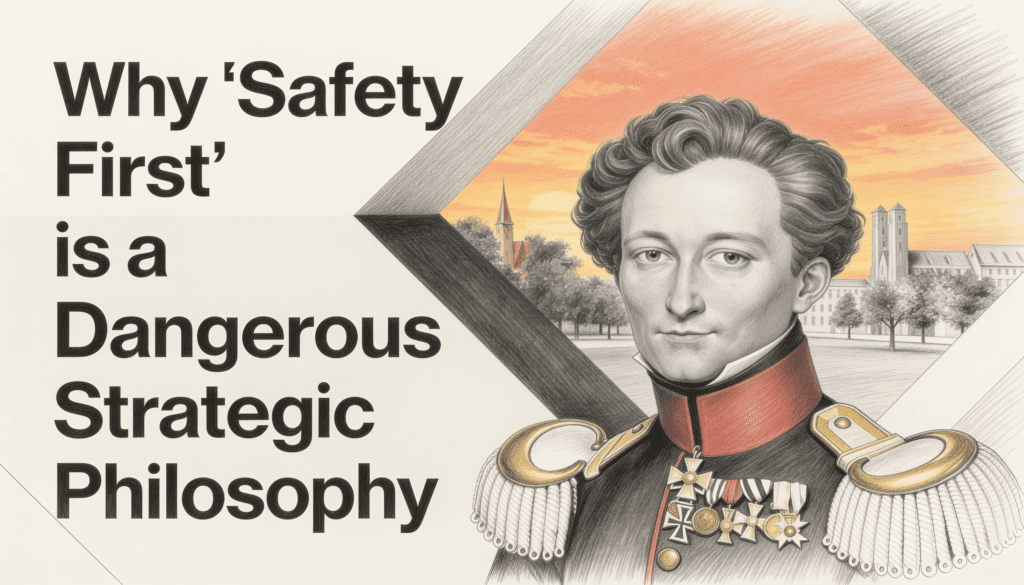
Clausewitz, the Prussian general who wrote On War in the early nineteenth century, did not write a manual for cautious people. He wrote a meditation on the nature of conflict, decision, and the strange gravitational pull that fear exerts on the human mind under pressure. And buried inside his thinking is a quiet warning that almost no one talks about today. The pursuit of safety, when elevated to a guiding principle, is not the opposite of recklessness. It is its twin.
Let us walk through why.
The Comfortable Lie of Defensive Posture
Clausewitz made a famous observation that the defensive form of war is, in pure theory, the stronger form. You hold the ground. You force the other side to come to you. You let them exhaust themselves on your prepared positions while you sit behind your walls eating soup.
People who skim Clausewitz love this part. They quote it at meetings. They use it to justify hiring freezes, product delays, and a general posture of waiting to see what happens.
But they stop reading too soon.
Because Clausewitz immediately adds something most of his casual fans ignore. The defense, he said, has a stronger form but a negative purpose. You cannot win a war by defending. You can only avoid losing for a while.
Eventually, if you want anything to change, you have to move. You have to attack. You have to accept the weaker form of war because it is the only form that produces results.
This is the part where “safety first” starts to look less like wisdom and more like a beautifully decorated trap.
A company that adopts safety first as its strategic philosophy is essentially saying it has chosen the negative purpose forever. It will defend its market share. It will protect its current revenue. It will preserve what it has. And while it does all of this defending and protecting and preserving, someone else, someone less worried about safety, is building the thing that will eventually walk through the front door and take everything.
Fear Wears a Suit and Tie
One of the most underappreciated insights in On War is Clausewitz’s analysis of what he called friction. War, he said, is the realm of physical exertion, of uncertainty, and of chance. Plans look beautiful on paper and then disintegrate the moment they meet reality. Soldiers get tired. Messages get lost. Maps turn out to be wrong. The simplest things become difficult.
What does friction have to do with the safety first philosophy?
Everything. Because the person who adopts safety first as a worldview is, in effect, trying to legislate friction out of existence. They are saying: I will only act when the path is clear, when the risks are known, when the outcomes are predictable. They are demanding a battlefield that does not exist.
This is where the irony becomes almost painful. By refusing to act until conditions are safe, the safety first thinker guarantees that they will only act after the moment has passed. Safety, in this sense, is a kind of permanent lateness. It is showing up to every important decision once the room has already emptied out.
Clausewitz understood that the great commanders were not the ones who eliminated uncertainty. They were the ones who acted decisively inside of it. He used a term that translates roughly as “the coup d’oeil,” the inward eye, the ability to look at a chaotic situation and see, almost instantly, what needed to be done. That is not the gift of a cautious mind. That is the gift of a mind that has made peace with the fact that no decision will ever be safe.
The Paradox of Risk Avoidance
Avoiding risk is, itself, a risk.
When you choose not to launch the product, you are choosing the risk that someone else launches it first. When you choose not to have the difficult conversation, you are choosing the risk that the relationship slowly suffocates. When you choose not to invest, you are choosing the risk that inflation quietly hollows out your savings.
There is no risk free position. There is only a choice of which risks you are willing to face.
The safety first philosophy disguises this fact. It pretends there is a neutral position called “not doing anything” where no consequences accrue. But Clausewitz would have recognized this immediately for what it is. It is the strategic equivalent of an army that refuses to march because the weather might turn bad. The weather will turn bad whether you march or not. The only question is whether you will be somewhere useful when it does.
The leaders who survive in difficult environments tend to understand this. They do not pretend that bold action is safe. They simply notice that inaction is not safe either, and at least bold action gives them a chance to shape what happens next.
When Caution Becomes a Story We Tell Ourselves
There is a deeper problem with safety first that Clausewitz, with his unusually clear eye for the human condition, would have spotted in a second.
It is a philosophy that flatters us.
When you decline an opportunity because it seems too risky, you get to feel responsible. Mature. Sober. You get to walk away feeling like the wise grown up in a room full of dreamers. The story you tell yourself is one of self control and good judgment.
But strip away the flattering self image and look at what actually happened. You were afraid. The fear made a decision and dressed it up as a strategy. You felt threatened by uncertainty, so you retreated, and then you constructed a noble explanation for the retreat afterward.
Clausewitz wrote at length about moral forces in war, by which he meant something closer to what we would call psychological factors. He understood that courage and fear are not just emotions but active forces that shape outcomes. A commander who is governed by fear, even a well disguised, intellectually justified fear, will make a particular kind of decision again and again. They will hold back when they should advance. They will preserve when they should commit. They will save resources for a tomorrow that, by virtue of their hesitation, never arrives.
Safety first is fear with a vocabulary.
The Strategic Use of Boldness
Now, none of this is an argument for recklessness. Clausewitz was not a fan of generals who threw their troops into meat grinders for the thrill of seeing dust rise. He distinguished sharply between boldness and foolhardiness.
The difference is worth understanding.
Boldness is the willingness to act decisively when the situation calls for it, accepting that you cannot know all the variables but trusting your judgment and your preparation. Foolhardiness is acting decisively when you have not bothered to prepare, when you have not thought through the consequences, and when your motivation is mostly your own ego.
The safety first crowd tends to collapse these into one category. To them, anyone who acts under uncertainty is reckless. Anyone who commits to a course of action without complete information is irresponsible. This conflation is convenient, because it lets them dismiss bold thinkers without engaging with their arguments.
But Clausewitz would point out that boldness, properly understood, is not the absence of caution. It is the integration of caution into action. The bold commander has thought carefully about what could go wrong. They have prepared for it. And then, having done the work, they move. They do not endlessly defer the moment of commitment in the hope that some future configuration of facts will make the decision easy.
The decision will never be easy. That is what makes it a decision.
What Happens in Organizations That Worship Safety
Look at almost any large organization that has lost its way, and you will find a culture where safety first has quietly become the operating principle.
The symptoms are recognizable. Meetings get longer. Decisions require more sign offs. People stop suggesting ambitious things because the cost of being wrong outweighs the reward of being right. New initiatives die in committee, not because anyone votes against them, but because no one is willing to attach their name as the sponsor.
What looks like prudent management is actually slow motion suicide. The organization is so focused on not losing that it forgets how to win. And while it perfects its defensive posture, its competitors, who have made peace with risk, are eating its lunch one bite at a time.