Table of Contents
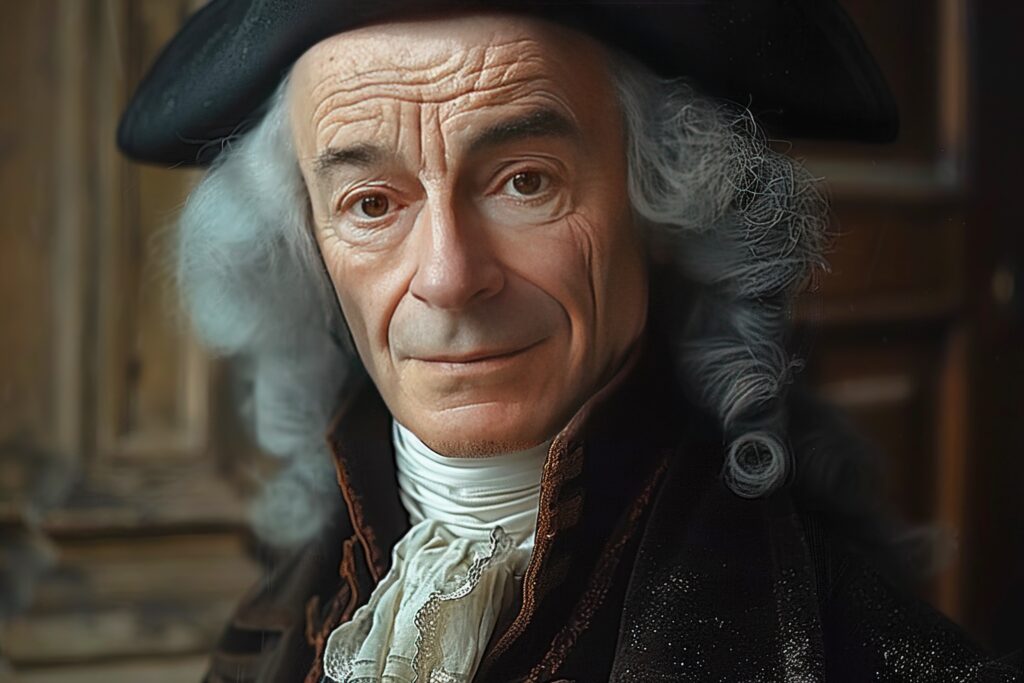
In 1748, a French aristocrat published a book that would quietly reshape how Europeans thought about why some nations grew rich while others stayed poor. His name was Charles-Louis de Secondat, Baron de Montesquieu, and his book, The Spirit of the Laws, attempted something audacious. He wanted to explain human civilization itself. Not through divine providence, not through racial mythology, but through something far more mundane. The weather.
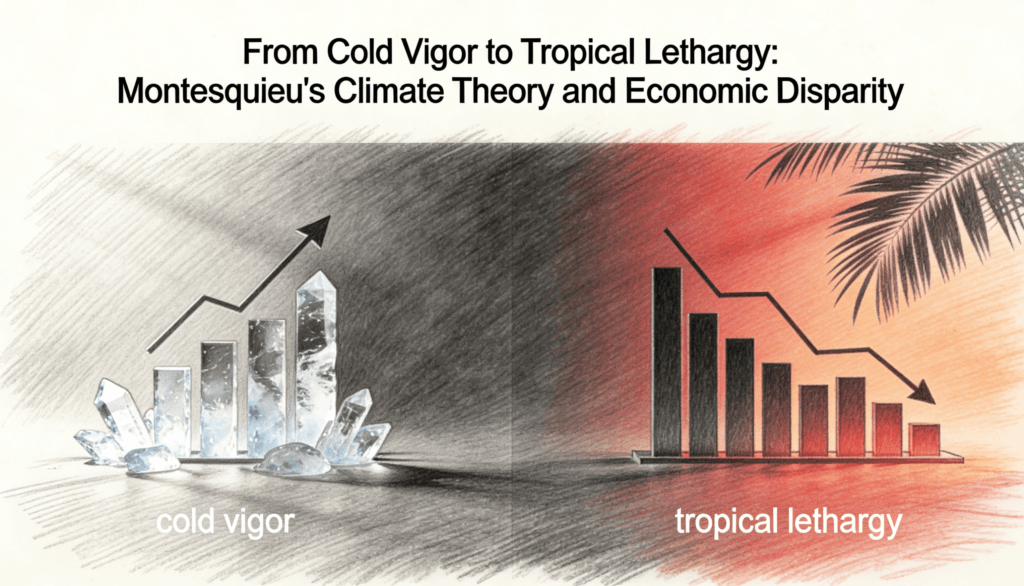
Yes, the weather. Montesquieu believed that the temperature of the air you breathed shaped everything about you. Your appetite for work, your tolerance for tyranny, your capacity for invention, even the strength of your love affairs. Cold climates, he argued, produced vigorous, industrious, freedom loving people. Hot climates produced lazy, sensual, easily dominated ones. And somewhere in the middle, conveniently, sat the temperate zones of Europe.
You can probably guess where this is going.
The Theory in Brief
Montesquieu was not pulling these ideas from thin air. He was building on a tradition that stretched back to Hippocrates and Aristotle, both of whom had speculated that geography shaped character. But Montesquieu gave the theory a systematic spine. He performed experiments on sheep tongues, observing how they contracted in cold and expanded in heat. From this, he extrapolated to human bodies. Cold air, he claimed, tightened the body fibers, making people more energetic, courageous, and confident. Hot air relaxed them, leaving inhabitants of warm regions languid, timid, and inclined toward submission.
From these physiological claims, he built an entire political theory. Northern peoples, with their tightened fibers and sharp minds, naturally gravitated toward liberty. They had the energy to resist tyrants and the discipline to govern themselves. Southern peoples, melted into compliance by the heat, accepted despotism because they lacked the vigor to fight it. The economic implications followed neatly. Industrious cold climate workers built prosperous societies. Languid tropical populations remained poor because, well, they could not be bothered to do otherwise.
It was a tidy theory. It was also, conveniently, a flattering one if you happened to be writing from Bordeaux.
Why the Theory Caught Fire
You might wonder why anyone took this seriously. The answer is that it offered something irresistible to 18th century European readers. It provided a secular explanation for European dominance at exactly the moment Europeans were beginning to dominate the globe. Before Montesquieu, claims of European superiority had to lean on religious arguments or vague appeals to civilization. After Montesquieu, you could point to a thermometer.
This was the Enlightenment, after all. Reason was in fashion. Theories that explained the world through observable, measurable forces felt scientific. Climate seemed observable. Temperature seemed measurable. The fact that the resulting theory just happened to put northwestern Europe on top was treated as a happy coincidence rather than a suspicious one.
The theory also flattered something deeper than national pride. It made wealth feel deserved. If you were a successful Dutch merchant or an English landowner, climate theory told you that your prosperity was the natural result of being born in the right latitude. Your industriousness was not a fluke. It was meteorology. And if Bengal or the Caribbean produced poverty alongside great natural abundance, that was not a puzzle requiring uncomfortable answers about colonial extraction. It was just the weather doing what weather does.
The Logic, Examined Up Close
Let us actually walk through Montesquieu’s reasoning, because the cracks become visible quickly.
He argued that hot climates make people lazy because heat weakens energy. Fine. But this would predict that the hottest parts of the year in any given country would also be the least productive. Anyone who has visited a French vineyard during the August harvest, or watched Italian farmers bringing in olives under a brutal sun, knows the reality is more complicated. People in hot places do not stop working. They adapt. They wake before dawn, rest during the worst heat, and continue into the evening. The siesta is not a confession of laziness. It is an efficient schedule.
He also argued that cold climates produce political liberty. This is a strange claim if you actually look at history. Russia, one of the coldest inhabited regions on earth, produced some of the most absolute autocracies the world has ever seen. The Mongols, whose homeland features brutal winters, built history’s largest contiguous empire through conquest, not through town hall meetings. Meanwhile, plenty of warm climate societies developed sophisticated participatory institutions long before northern Europe got around to it. Classical Athens was not freezing. Neither was the Roman Republic.
Montesquieu’s response to these inconvenient examples was essentially to handwave. He acknowledged exceptions but treated them as anomalies. The theory was true in general, he insisted, even when the specifics refused to cooperate.
The Counterintuitive Reversal
Here is something worth sitting with. If you actually look at the broad sweep of human civilization, the pattern Montesquieu described is not just incomplete. For most of recorded history, it was inverted.
For roughly five thousand years, the wealthiest and most technologically advanced societies on earth were concentrated in warm regions. Mesopotamia, Egypt, the Indus Valley, China, Persia, Mesoamerica, the great African empires of Mali and Songhai. These civilizations built cities, developed writing, conducted astronomy, and accumulated wealth while northern Europeans were still living in wooden huts and trading furs. As late as the 15th century, a visitor from London arriving in Cairo or Beijing would have felt like a country bumpkin stumbling into a metropolis.
The reversal Montesquieu took as eternal was actually recent. Northern Europe surged ahead only in the few centuries before he wrote, and the causes had little to do with body fibers tightening in cold air. They had to do with specific technologies, institutional arrangements, the windfall of New World silver, the dispossession of indigenous peoples across two continents, the slave trade, and the particular dynamics of the Industrial Revolution. Climate was, at best, a minor character in this story.
But Montesquieu lived inside the early stages of this shift and mistook a temporary economic gap for a permanent natural law. It is a bit like someone in 1995 declaring that suburban office parks would eternally dominate commerce because that is what the world looked like out their window.
Why the Theory Refuses to Die
You might think that two centuries of historical evidence and economic research would have buried climate theory by now. You would be wrong. It keeps coming back, often dressed up in new clothes.
Modern versions trade Montesquieu’s talk of body fibers for discussions of tropical disease burden, agricultural productivity, or the supposed difficulty of state building near the equator. Some of these arguments have genuine merit. Malaria does impose real economic costs. Certain tropical soils do present farming challenges. But the underlying impulse, the desire to explain global inequality through geography rather than through the messier history of conquest, colonization, and policy choices, remains suspiciously similar to what Montesquieu was selling in 1748.
The persistence of the theory tells us something about human reasoning. We prefer explanations that feel natural and inevitable. If poverty in tropical countries is caused by climate, then nobody is responsible for it. It just is. If, on the other hand, it is caused by centuries of extraction, drawn borders, debt arrangements, and trade rules, then someone has to think about who benefited and who lost. The first story is more comfortable. The second is more accurate.
The Strange Honesty of the Theory
In one peculiar way, Montesquieu was being more honest than many modern thinkers. He at least named his variable clearly. The climate determines wealth, he said. You could test that claim. You could examine it. You could, as economists eventually did, run the numbers and find that climate explains a surprisingly small portion of variation in national income, especially when you control for institutional history.
Compare this to vaguer modern arguments about culture, work ethic, or national character. These claims often function as updated versions of climate theory without the falsifiability. If a country is poor, it must have bad cultural values. If it grows rich, the values were good all along. The reasoning is circular, but because culture cannot be measured like temperature, the circle is harder to spot.
Montesquieu got several things right, and some of them have aged surprisingly well.
He understood that human institutions are not free floating constructs. They sit inside physical environments and respond to them. Societies in drought prone regions develop different water laws than societies blessed with abundant rainfall. Mountain communities organize differently than coastal trading hubs. The point that environment shapes social organization is not wrong. The point that climate alone determines wealth and freedom is.
He also championed the idea that you cannot understand a country by looking only at its constitution or its kings. You need to understand the soil it grew in, both literally and figuratively. This was a significant intellectual move. It opened the door for sociology, anthropology, and modern comparative politics. Even when his specific conclusions were wrong, his method of asking why societies differ from each other was a step forward.
And there is something to be said for his attention to scale. He understood that policies which work in a small republic might fail in a large empire. He grasped that what suits one culture may strangle another. These insights remain relevant, even if his reasons for them were tangled up in unreliable theories about climate.
What This Costs Us
The lingering ghost of climate theory still shapes how wealthy countries discuss poor ones. Listen to casual conversations about why some nations are rich and others are not. You will hear echoes of Montesquieu, even from people who have never read him. Phrases about countries that “just cannot get their act together,” or about regions where people “do not have the same drive,” carry his fingerprints. The thermometer has been replaced by stereotype, but the underlying move is the same. Locate the cause of inequality inside the poor country itself, rather than in the relationships between countries.
This matters because diagnosis shapes treatment. If poverty is climate, the cure is, at best, air conditioning. If poverty is culture, the cure is moral lectures. If poverty is the predictable result of centuries of specific historical arrangements, then the conversation has to become much more uncomfortable, and much more honest, about what those arrangements were and how they continue.
A Final Thought
Montesquieu is worth reading not because he was right, but because he shows us what intelligent, well meaning, broadly curious people can convince themselves of when they want a particular answer badly enough. He was not a fool. He was one of the sharpest minds of his century. But he wrote inside an intellectual climate that rewarded explanations placing his civilization at the natural top of the human ladder, and he produced exactly such an explanation.