Table of Contents
John Locke wrote his Two Treatises of Government in 1689, a time when the idea of a nation receiving millions of newcomers in a single decade would have struck him as somewhere between unthinkable and absurd. England in his day had a population of about five million people. The notion of a state absorbing that many strangers in a generation, while keeping its laws, customs, and political character intact, simply did not enter his mental universe. And yet, three centuries later, his framework for understanding when a government has effectively ceased to exist may be more relevant than ever.
The question is uncomfortable, but it deserves a serious look. Locke argued that governments can dissolve in two ways. The first is from the outside, through conquest. The second, and far more interesting one, is from the inside.
A government dissolves, Locke wrote, when those entrusted with power betray the trust placed in them, when the legislative body is altered without consent, or when the executive abandons its duty to enforce the laws. The people, in such cases, are released from their obligation to obey. The contract is broken not because someone tore up the paper, but because one side stopped honoring it.
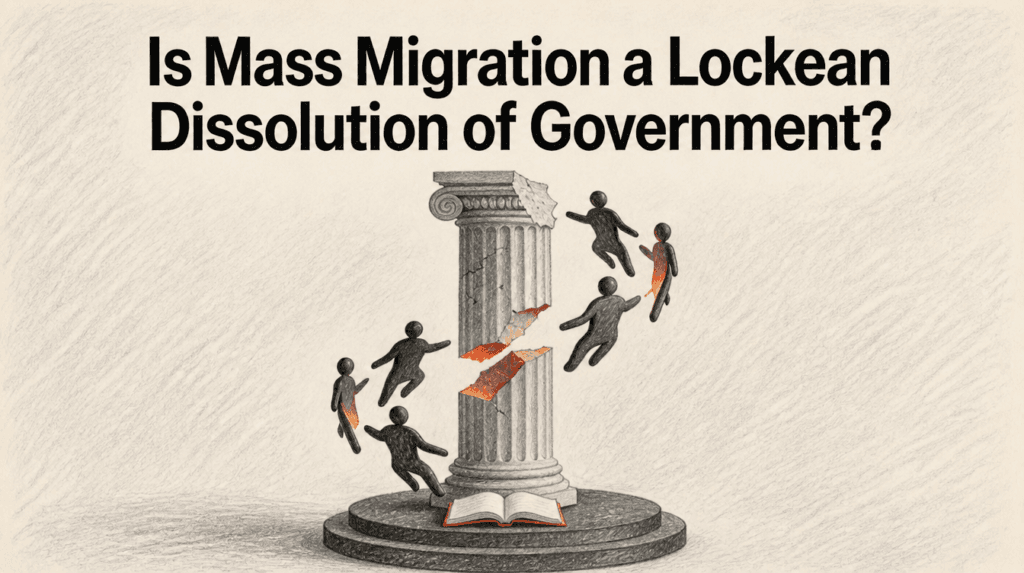
So here is the provocative question. If a government allows, encourages, or fails to prevent the entry of millions of people who were never part of the original political compact, has it altered the legislative body without the consent of the governed? Has it changed the very composition of the the people who are supposed to be the source of all political authority? And if so, what does Locke have to say about that?
The Quiet Revolution Nobody Voted For
Let us be honest about one thing. In most Western democracies, mass migration was never put on a ballot in any meaningful way. Voters were not asked whether they wanted their countries to receive ten, twenty, or thirty percent foreign born populations within a generation. The policies that produced these outcomes were assembled piece by piece, often through administrative decisions, court rulings, treaty obligations, and quiet legislative tweaks. By the time anyone noticed the cumulative effect, the demographic facts on the ground had already shifted.
This is not a complaint about any particular group of migrants. The people who come are, in most cases, doing exactly what any rational person would do. They are seeking better lives, fleeing danger, joining family, or chasing opportunity. The question is not about them. It is about the political class that decided, without ever quite saying so out loud, that the composition of the citizenry was a matter for technocrats rather than citizens.
Locke would have found this remarkable. For him, the legislative power was sacred precisely because it represented the will of the people. The whole point of consent was that no one could be bound by laws they had no say in making. If the body that makes the laws can be quietly replaced, or even gradually diluted, by people who had no part in the original agreement, then in what sense is the government still legitimate? It is a bit like discovering that the company you work for has been sold three times without anyone telling you, and now reports to a board you have never heard of.
The Twist
Here is where things get interesting, and where the simple version of this argument starts to break down. Locke himself was not a nativist. He was, in fact, remarkably open to the idea of people moving between political communities. In his view, any adult who lived under a government and enjoyed its protections gave a kind of tacit consent to be bound by its laws. The act of walking the king’s roads, he said, was enough to count as agreement, at least for the duration of one’s stay.
So Locke gives us a paradox. On one hand, he was deeply concerned about the integrity of the social contract and the legitimacy of the legislative body. On the other, he was relaxed about the movement of individuals across borders, treating residence itself as a kind of soft membership. The question is what happens when these two principles collide. What happens when the soft membership of millions starts to reshape the hard membership of the original political community?
The honest answer is that Locke did not work this out, because he did not have to. The scale was different, the technology was different, and the very idea of a welfare state that distributes resources collected from citizens did not exist. He was thinking about a world where a French Huguenot might settle in London, learn English, and quietly become an Englishman in everything but accent. He was not thinking about a world where entire neighborhoods could be transformed within a decade, where parallel legal customs might emerge, or where the question of who counts as a member of the political community could become genuinely contested.
The Trust Problem
The most powerful part of Locke’s argument about dissolution is not really about laws or borders. It is about trust. Government, in his view, is a trust relationship. The people trust the rulers to act for the common good. When the rulers act against the common good, or in ways that suggest the people they serve are not really the people they claim to serve, the trust collapses. And when the trust collapses, so does the legitimacy of the whole arrangement.
This is where the migration question gets really sharp. The issue is not whether immigration is good or bad in some abstract sense. The issue is whether citizens feel that their elected representatives are actually representing them, or whether they are pursuing some other agenda, perhaps an economic one, perhaps an ideological one, perhaps simply the institutional inertia of agencies that have grown used to operating without much oversight.
Polls in many Western countries consistently show that majorities, sometimes large majorities, want lower levels of immigration than they actually get. This has been true across decades and across changes in government. Either the public is wrong about its own preferences, which seems unlikely, or there is a persistent gap between what voters want and what governments deliver. Locke would have called this a betrayal of trust. He probably would have used stronger language than that, actually. He was not known for his diplomatic phrasing when it came to rulers who ignored the wishes of the people.
The Counterargument
A fair minded reader might object at this point. Surely governments can change their populations through legitimate means? Surely the children of immigrants become citizens, and their grandchildren become indistinguishable from anyone else? Surely the political community is always evolving, always absorbing newcomers, always renewing itself?
All of this is true, and it is worth taking seriously. The United States absorbed enormous waves of immigration in the late nineteenth and early twentieth centuries, and emerged stronger for it. Britain absorbed Huguenots, Jews, and many others over the centuries, often to its great benefit. Cultures are not static, and political communities are not museums. The fear that any change is dissolution is a fear that does not survive contact with history.
But there is a difference between absorption and replacement, between integration and transformation. The historical examples that worked best involved migration at rates that allowed cultural transmission to happen in both directions. The newcomers learned the language, the customs, the political traditions. The hosts adjusted, but the core institutions held. When the rate of change outpaces the rate of integration, something different happens. You do not get a richer version of the original society. You get a society that has to negotiate its basic identity from scratch, often without the tools or the trust to do so peacefully.
The question of whether current migration levels exceed this threshold is empirical, not theoretical. Reasonable people can disagree about the answer. But the question itself is legitimate, and pretending otherwise is part of what creates the trust problem in the first place.
Where Locke Leaves Us
If we take Locke seriously, we end up in a more nuanced place than either side of the migration debate would prefer. The simple nativist reading, that any significant migration is a dissolution of government, does not work. Locke himself would have rejected it. People have always moved, and political communities have always changed. The pretense that any nation has ever been a sealed ethnic unit is just bad history.
But the simple cosmopolitan reading, that borders are arbitrary and the composition of the citizenry is none of the citizens’ business, does not work either. Locke would have found this view bizarre. For him, the whole point of political society was that it belonged to its members, who had the right to decide who joined them and on what terms. To deny this is to deny the very idea of self government.
The honest Lockean position is something like this. Governments have a duty to manage migration in a way that preserves the trust of the governed. They have a duty to be transparent about what they are doing and why. They have a duty to ask the people, not just consult the experts.
When they fail to do these things, they do not necessarily dissolve the government, but they do erode its legitimacy. And eroded legitimacy, over time, can lead to outcomes that nobody, on any side of the debate, actually wants.
The Practical Upshot
So is mass migration a Lockean dissolution of government? The answer, frustrating as it may be, is that it depends. It depends on whether the migration happens with the consent of the governed or against their wishes. It depends on whether institutions can absorb and integrate, or whether they are simply overwhelmed. It depends on whether trust is maintained or broken.
What is clear is that the question deserves to be asked. For too long, the migration debate has been conducted as if there were only two positions, both of them caricatures. Either you are a heartless xenophobe, or you are a starry eyed utopian. The truth is that most people are neither, and most people have legitimate questions that have not been adequately answered.
Locke gave us a way of thinking about when governments lose their legitimacy. He told us it happens when those in power stop serving the people who put them there, when they alter the foundations of political life without consent, when they break the trust that holds everything together. Whether that is happening in any particular country today is a judgment each citizen has to make. But the framework is there, sitting in a book written more than three hundred years ago, waiting for anyone willing to read it carefully.
It turns out that the dead philosophers sometimes have the most uncomfortable things to say about the living. That is part of why we keep reading them. And it is part of why the questions they asked, awkward as they often are, still refuse to go away.