Table of Contents
Every few decades, an economic idea arrives dressed in new clothes and convinces us it has never been seen before. We greet it like a stranger at the door, marvel at its novelty, and forget that we invited its grandfather to dinner ninety years ago. Universal Basic Income is having its moment now. Politicians flirt with it. Tech billionaires fund pilot programs for it. Op-ed writers either praise it as salvation or warn that it will collapse civilization. What almost nobody says out loud is that UBI is not really a new idea at all. It is Keynesianism with a software update.
To see why, we have to go back to a man who liked to write letters to presidents and once predicted his grandchildren would work fifteen hour weeks.
The Original Plumber of Demand
John Maynard Keynes did not invent the idea that economies could get stuck. He just explained it better than anyone else. Before him, the dominant view was something like this: if people lose their jobs, wages will fall, businesses will hire them again at the cheaper rate, and everything balances out. The market, given enough time, fixes itself. Keynes looked at the Great Depression, where this self correction had been promised for years and never arrived, and said something close to:
nice theory, shame about the breadlines.
His insight was almost embarrassingly simple. An economy is not a machine that hums along on its own. It runs on demand. When people stop spending, businesses stop selling. When businesses stop selling, they stop hiring. When they stop hiring, more people stop spending. The whole thing spirals down into a hole that no amount of patient waiting will climb out of. Somebody has to put money into people’s hands so they can buy things again. If the private sector will not do it, the government must.
This was treated as heresy at the time. The idea that you could spend your way out of a downturn felt like prescribing more wine for a hangover. But it worked. Or at least it appeared to work well enough that for the next forty years, governments built highways, mailed checks, ran deficits, and called it responsible economics. Keynes had given them permission, and they took it.
The mechanism mattered more than the morality. Keynesianism was never about being generous. It was about keeping the engine running. Money in pockets meant goods off shelves meant workers on payrolls meant more money in pockets. The flow was the point.
Enter the Robots, Stage Left
Fast forward to now. We are not in a depression, at least not officially. Unemployment numbers look fine in most rich countries. The stock market does whatever it does. And yet there is a persistent feeling that something has gone sideways in how money moves through ordinary lives. Wages have not kept pace with productivity for decades. Some categories of work have been hollowed out by automation, outsourcing, or the quiet violence of an algorithm replacing a human at a call center. The jobs that remain often pay less, offer less stability, and demand more emotional performance than the ones they replaced.
This is the soil UBI grew in. The pitch is straightforward. Give every adult a regular check, no questions asked, no forms to fill out, no caseworker to satisfy. Enough to cover basics. Maybe a thousand dollars a month. Maybe more. Let people decide what to do with it. The thinking goes that this would solve poverty, ease the trauma of job loss, free people to start businesses or care for family members, and prepare us for a future where artificial intelligence eats more and more of the work humans used to do.
Notice what is happening here. We have a situation where ordinary people do not have enough money to keep the economy circulating the way it used to. The proposed fix is to put money into their hands directly. If this sounds familiar, it should. We have stumbled, by a different road, into the same diagnosis Keynes made in 1936.
The Same Engine, Different Fuel
The classic Keynesian move was to spend government money on big projects. Build a dam. Pave a road. Hire teachers. The logic was that the workers would take their wages and spend them in town, which would help the diner owner pay her rent, which would help the landlord buy a new truck, which would help the truck dealership hire another salesperson. Economists called this the multiplier effect. Money is shy. It does not like sitting still. Once you push it into the system, it tends to keep moving.
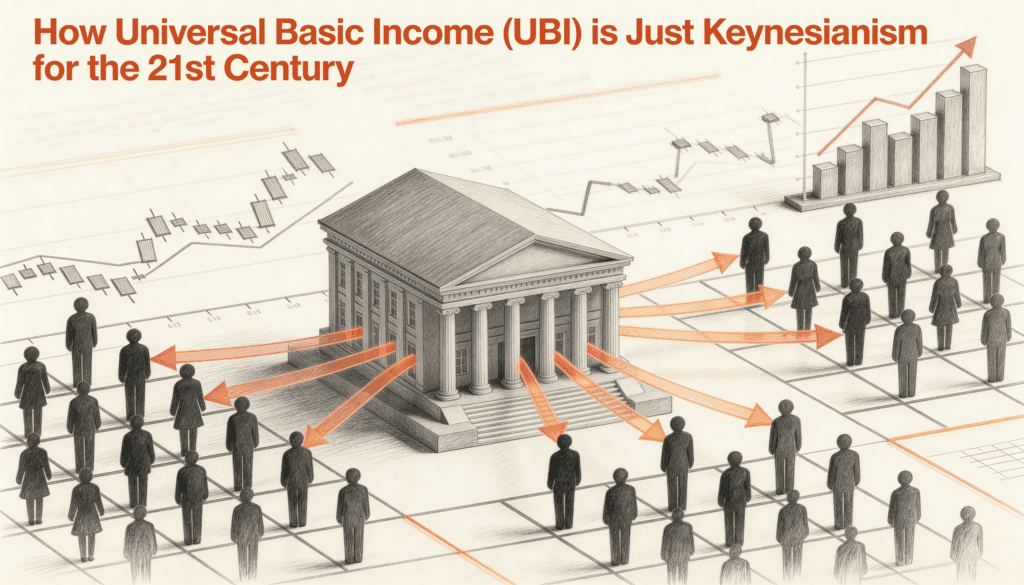
UBI does almost exactly the same thing, but skips a step. Instead of paying people to dig and then fill in ditches, you just hand them the cash directly. The expectation is that they will spend most of it on rent, food, transportation, clothing for their kids, the small repairs that always need doing. That spending props up businesses, which keep workers employed, who in turn spend their wages. The engine runs. The multiplier multiplies.
The difference between mid century public works and a monthly direct deposit is the same kind of difference as between a horse drawn plow and a tractor. Different mechanism. Same field. Same harvest.
You could argue, and some economists do, that this makes UBI more efficient than traditional stimulus. The government does not need to identify worthy projects, hire contractors, oversee construction, or cut ribbons. It just sends money. The market decides where it goes. That should warm the heart of any free market enthusiast, though most of them recoil from the idea instinctively, because the word universal triggers something in the political nervous system that the word infrastructure does not.
The Sales Pitch Has Changed
Here is where it gets interesting. Keynesianism in its original form was sold as a tool for managing the business cycle. You spent in the bad times. You pulled back in the good times. It was supposed to be temporary, technical, and frankly a little boring. The politicians who liked it most were the ones who could promise full employment and steady growth.
UBI gets pitched in completely different language. It is framed as freedom. As dignity. As the natural answer to a world where work itself is becoming optional. Its advocates talk about creativity, about caregiving, about the right to exist without justifying your existence to an employer. None of this sounds like Keynes. Keynes was an Edwardian gentleman who wore three piece suits and spoke about aggregate demand in a tone that suggested he found most people slightly tiring.
But strip away the romance. The economy is not producing enough purchasing power on its own. The state must intervene to put money in circulation. Whether you call it a stimulus check, a basic income, a citizens dividend, or a freedom payment, you are still doing the same thing. You are using public money to maintain private consumption.
The Counterargument Worth Taking Seriously
The most honest objection to UBI is not the one you usually hear. People will say it will cause inflation, that it will discourage work, that nobody will want to be a janitor anymore. These are real concerns but they have answers, and the answers depend on details like how much, how funded, and how phased in.
The deeper objection is that putting money into the economy without producing anything new is a bandage on a wound that will not stop bleeding. Keynesianism in the 1930s came with a side of actual construction. Dams got built. Bridges got built. Power lines got strung. The country had more infrastructure after the spending than before. UBI just maintains consumption. It does not necessarily create the productive base that supports that consumption over time.
This is a real puzzle. If the underlying problem is that automation is taking jobs faster than new jobs appear, then handing out cash keeps people fed but does not solve the structural shift. You end up with a population that consumes without producing, paid for by a shrinking number of workers and corporations who do produce, and that arrangement gets politically unstable fast.
The right wing tells the workers they are subsidizing the lazy. The left wing tells the workers the corporations are not paying their fair share. The recipients of the income feel patronized either way.
Keynes himself had an answer to something like this, though he did not live to see the problem in its current form. He thought that as societies got richer, people would work less and devote more time to leisure, art, family, and what he called the art of life itself. He was wrong about the timeline. He was probably wrong about human nature too. People who lose their work often do not bloom into renaissance figures.
They get depressed, they drink more, they fall out of community.
This is the part UBI advocates need to take more seriously. It is not enough to give people money. The Keynesian project, in its better moments, gave people something to do with their days that felt meaningful. A teacher had students. A road builder had a road. The check was a side effect of the contribution. UBI, by design, separates the two. Whether that is liberation or a slow form of cultural rot is a question we are about to find out, whether we want to or not.
The Wheel Turns Again
What strikes me most about the UBI conversation is how unaware it often is of its own ancestry. Pilots are launched in places like Stockton and Helsinki with the air of a grand experiment, as though we have never tried putting money in people’s hands before. We have. We did it in the 1930s, we did it again during the pandemic, and most countries have been doing it in piecemeal form for generations through pensions, welfare, food assistance, and tax credits. UBI just proposes to do it more cleanly, more universally, and more honestly.
The novelty is not the cash. The novelty is admitting that the cash is the point.
Keynes would, I suspect, find the whole thing slightly amusing. He spent his career arguing that the government had a role in keeping demand alive. He was attacked as a socialist for saying so. Now, a century later, his core insight has been rediscovered by people who would not be caught dead reading the General Theory, and is being pitched as the future of liberty itself. The vocabulary changed. The wardrobe changed. The argument did not.
There is something almost comforting about this, in a strange way. The big economic questions do not really change. How do you keep people fed when the machines take the jobs? How do you maintain demand when wages stagnate? How do you balance the productive capacity of an economy with the purchasing power of its citizens? Every generation answers these questions in its own language, with its own metaphors, and convinces itself it has finally figured out something the previous generation missed.
We have not. We are just using different words to describe the same engine, fueled by the same instinct, aimed at the same problem. UBI is Keynesianism with a smartphone. Whether that turns out to be a good thing or a bad thing depends less on the idea itself than on what we choose to build alongside it.
Cash without purpose is just cash. Cash with a project behind it is something more.