Table of Contents
There is a particular kind of person you meet at parties, usually somewhere between their second drink and their third existential crisis, who will tell you with great solemnity that they are “on a journey to find themselves.” They have quit their job. They have bought a one way ticket to somewhere with mountains. They have downloaded a meditation app and started using the word “energy” as a noun, a verb, and occasionally a personality trait.
You nod politely. You wish them well. And then, if you are honest with yourself, you wonder if they will ever actually arrive anywhere.
Because here is the uncomfortable truth that nobody at the party wants to hear: there is no self to find. There never was. The whole idea is built on a metaphor so flimsy it would not survive a stiff breeze, let alone the weight of a human life.
You are not a buried treasure. You are not a hidden manuscript waiting in some Tibetan monastery. You are not, despite what the wellness industry has spent billions convincing you, a beautiful authentic essence trapped beneath the corporate sludge of modern living. You are something far more interesting and far more demanding. You are a project under construction.
And the person who understood this best was a tiny, neurotic German philosopher who never traveled more than ten miles from his hometown and yet somehow figured out more about the human condition than most of us will in a lifetime of yoga retreats.
His name was Immanuel Kant.
The Man Who Walked the Same Street Every Day
Kant lived in Königsberg in the eighteenth century. He woke at five. He took a walk at exactly the same time every afternoon, so reliably that his neighbors set their clocks by him. He never married. He never traveled. He died in the same town he was born in.
If you handed Kant a brochure for an Ayahuasca retreat in Peru and told him it was the path to self discovery, he would have looked at you the way a math teacher looks at someone who insists two plus two might equal five if you really feel it in your heart.
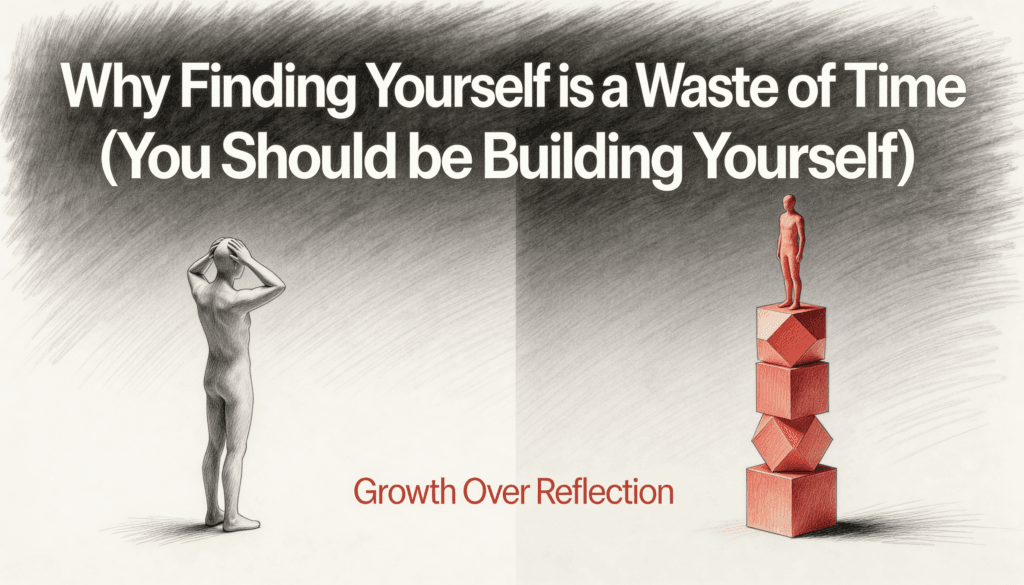
For Kant, the self was not something you discovered. It was something you constructed through reason, discipline, and the daily exercise of moral choice. You were not born with a true self lying in wait. You became a self by what you did, what you committed to, and what you refused to compromise on. The self was a verb, not a noun.
This is a much harder pill to swallow than the find yourself narrative. Because finding implies the work is done somewhere out there, waiting for you to stumble across it. Building implies you have to pick up the hammer.
The Comforting Lie of Authenticity
Modern culture loves the word authentic. We use it for everything. Authentic cuisine. Authentic relationships. Authentic personal brand, which is perhaps the most spectacular oxymoron our generation has produced.
The implicit promise of authenticity is that somewhere underneath all your conditioning, all your social roles, all your obligations, there is a real you waiting to be released. Strip away the noise and you will find the signal. Quiet the world and you will hear your true voice.
It is a beautiful idea. It is also almost certainly false.
What you find when you strip away your habits, your commitments, your relationships, and your responsibilities is not your true self. What you find is a slightly hungry mammal with anxiety and good intentions. The “real you” that emerges from three weeks of silent retreat is not more authentic than the version of you who shows up to work on Tuesday. It is just a version with fewer obligations and worse table manners.
Kant would have spotted this trick immediately. He understood that the self is not a thing you uncover. It is a coherent identity you forge through consistent action over time. Your character is not what you feel when you are alone on a mountain. Your character is what you do when nobody is watching, when it is inconvenient, when there is nothing in it for you.
The mountain does not give you a self. The years of choosing to keep your word do.
The Tyranny of Feelings
One of the more curious side effects of the find yourself ideology is that it has made us hostage to our own feelings. If the goal is to discover who you really are, and your feelings are the compass, then any time your feelings shift you are obligated to follow them. You quit the job because it does not feel right. You leave the relationship because something feels off. You abandon the project because you have lost the passion.
This is treated as wisdom. Kant would have called it slavery.
For Kant, the highest expression of being human was not to be ruled by your impulses but to govern them. Freedom did not mean doing whatever you felt like in the moment. Freedom meant having the discipline to act according to principles you had reasoned your way into and committed to. A person who does whatever they feel is not free. They are simply a leaf in the wind of their own neurochemistry.
This is not a popular message. It is much more flattering to be told your feelings are sacred and your impulses are wisdom. But anyone who has lived long enough knows the truth. The version of you that wanted to text your ex at two in the morning was not your authentic self. It was a tired, lonely version of you that needed a glass of water and a good sleep.
Building yourself means learning to tell the difference. It means developing the muscle to act on your deeper commitments even when your surface feelings disagree. The find yourself crowd will tell you this is repression. Kant would have told you it is the beginning of becoming a person.
What Building Yourself Actually Looks Like
So what does it look like, this building of a self? It is much less glamorous than the alternative, which is part of why it does not sell as many books.
Building yourself looks like making promises and keeping them. It looks like choosing a craft and giving it ten years before you decide you are no good at it. It looks like staying in difficult conversations when every part of you wants to leave the room. It looks like having opinions you can defend rather than vibes you can perform.
It looks like reading hard books. It looks like writing badly until you write less badly. It looks like saying no to things that flatter your ego and yes to things that develop your character. It looks like the slow, almost invisible accumulation of small acts of integrity that over decades produce something other people start calling wisdom.
There is nothing exotic about it. No one will photograph you doing it. There is no perfect outfit for it and no Instagram filter that captures it well. The person who is genuinely building themselves often looks, from the outside, suspiciously like someone with a routine.
Like, for instance, a small German philosopher walking the same street at the same time every day.
The Paradox of Becoming Someone
Here is the strange thing. The people who actually become someone interesting, the ones whose lives have weight and shape and meaning, are almost never the ones who set out to find themselves. They are the ones who set out to do something. To build something. To master something. To serve someone. To answer a question that seemed to them worth answering.
The self emerges as a byproduct of the work. It is not the destination. It is the residue.
The painter does not find herself by searching for her authentic style. She finds her style by painting thousands of paintings, most of them bad, until something coherent emerges from the practice. The writer does not discover his voice by introspection. He discovers it by writing a million words and noticing which ones still sound like his after a year. The good parent does not become themselves by attending workshops on conscious parenting. They become themselves by showing up, again and again, to the unglamorous reality of raising another human.
Kant understood this in his own way. He believed that the dignity of a human being came from being a rational, self legislating agent. In plain English, that means a person who decides what they stand for and then actually stands there. Not someone who waits for the universe to whisper their purpose into their ear. Someone who picks up the chisel and starts carving.
The Real Reason We Prefer Finding
If building yourself is so much more effective, you might ask, why has the find yourself industry become such an unstoppable cultural force?
The answer is uncomfortably simple. Finding is passive. Building is active. Finding can be accomplished in a single dramatic gesture, like quitting a job or moving to a new country or going on a retreat. Building requires showing up tomorrow, and the day after, and the year after that, when nobody is watching and nothing feels meaningful.
Finding gives you a story to tell at dinner parties. Building gives you a slow transformation that is almost impossible to describe, because it happens in increments so small that no individual moment seems significant.
We prefer finding because we are tired. We are tired of the slow grind of becoming, and we want to believe there is a shortcut. We want to believe that somewhere out there, in the right combination of geography and ritual and substance, the work has already been done and we just have to claim it.
But the work has not been done. It cannot be done by anyone other than you, and it cannot be done quickly. There is no version of you waiting in Bali. There is only the version of you who shows up to do the work, or does not.
A Final Word from the Walker of Königsberg
Kant once wrote that two things filled him with awe. The starry heavens above and the moral law within. Notice he did not say the authentic self within. He did not say the inner child or the higher self or any of the other terms that would have made him very rich on the modern speaking circuit.
He said the moral law. The thing you build by repeatedly choosing principle over impulse. The thing you construct out of countless small decisions to act with integrity even when no one would know the difference.
That is what was inside him. Not a self he had found, but a self he had built, brick by brick, over decades of disciplined choice.
You do not have to be Kant. You do not have to walk the same street every day or never leave your hometown or eat lunch at exactly the same hour. But you do have to give up the comforting fantasy that there is a finished you somewhere, waiting to be discovered.
There is not. There is only the raw material of you, and the choices you make tomorrow, and the next day, and the day after that. The self is not found. It is forged.
So put down the brochure. Cancel the retreat. Or do not, if you genuinely want to go. But understand what you are doing. You are not going to find yourself. You are going to take a nice trip. And when you come back, the same person you were when you left will be waiting at the airport, ready to make the same choices that have always been available to you.
The good news is that those choices are enough. They have always been enough. The bad news, if you can call it that, is that no one else can make them for you.
Pick up the hammer. Start building.