Table of Contents
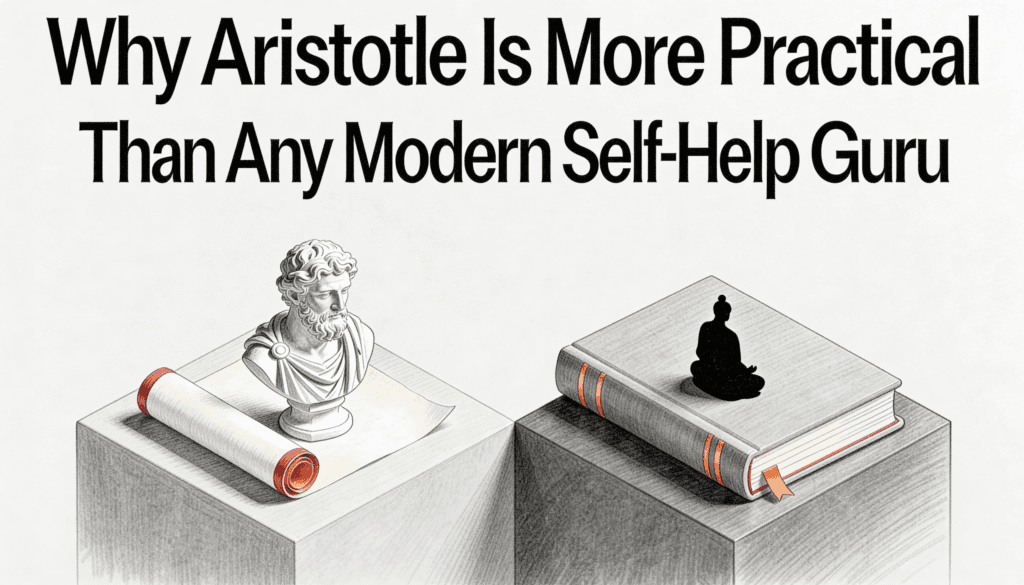
There is a strange ritual happening in bookstores right now. A man in a clean white shirt smiles from a glossy cover, promising you that in seven steps, four agreements, or one tiny habit, your life will transform. The book costs about twenty dollars. It will probably end up on your shelf, half read, next to the other one you bought last year. The author has a podcast. The author has a course. The author, you suspect, may have figured out something you have not.
Meanwhile, a Greek man who has been dead for over two thousand three hundred years sits quietly on a different shelf, ignored, gathering dust, holding answers that are better than anything the guru in the white shirt has ever written.
His name is Aristotle. And the joke, if there is one, is that almost every modern self-help book is just a watered down version of what he already said. Except his version is sharper, more honest, and does not require you to subscribe to a newsletter.
The Strange Thing About Modern Self-Help
Most modern self-help operates on a quiet assumption. The assumption is that you are broken and need fixing. You need to optimize your morning. You need to journal your gratitude. You need to cold plunge, manifest, biohack, and reframe. The promise is always that happiness is somewhere out there, hiding behind a habit you have not yet adopted, waiting for you to unlock it like a level in a video game.
This is a strange way to think about being a person. It treats the human being as a machine with bugs, and the guru as the engineer with the patch.
Aristotle did not see it this way. He saw human beings as something more interesting. He saw them as creatures with a purpose, a nature, and a built in capacity for flourishing. He did not think you needed to be fixed. He thought you needed to be cultivated, like a garden, or trained, like an athlete. The difference matters more than it sounds.
When the guru tells you to wake up at five, take cold showers, and read ten pages a day, he is selling you tactics. When Aristotle tells you to become virtuous through practice, he is selling you a way of being. Tactics expire. Ways of being do not.
The Word He Used That Changes Everything
Aristotle used a word that does not translate well into English. The word is eudaimonia. People often translate it as happiness, but that is misleading. Happiness in our modern sense means a pleasant feeling. It is what you get when you eat a good meal or scroll something funny. It comes, it goes, and then you chase it again.
Eudaimonia is different. It is closer to flourishing. It is the state of a life going well, in the deepest sense, over a long stretch of time. It is not a mood. It is not a vibe. It is what a life looks like when a person is being fully what they are capable of being.
Notice the difference. Modern self-help promises you better moods. Aristotle promises you a better life. One of these is a snack. The other is a meal.
And here is what makes Aristotle practical. He did not just describe flourishing and leave you wondering how to get there. He told you exactly how. You become a flourishing person by becoming a virtuous person. And you become a virtuous person by doing virtuous things, repeatedly, until they become who you are.
Why Habits Are Not New
There is a popular book about tiny habits. There is another popular book about atomic habits. There are dozens of books, talks, and apps about habits. The whole habit industry has convinced people it discovered something important.
Aristotle wrote about this in the fourth century before Christ. He said, and I am paraphrasing because no one wants the literal translation, that we are what we repeatedly do. Excellence, then, is not an act, but a habit.
This sentence gets quoted a lot. People put it on motivational posters. They tend to miss what makes it radical. Aristotle was not saying that habits help you achieve things. He was saying habits are what you actually are. You are not the person who thinks about going to the gym. You are the person who goes, or the person who does not. The thinking does not count. Only the doing counts, and only because the doing, repeated, becomes the doer.
This is a far more honest view of human nature than most modern self-help offers. It does not flatter you with talk of your hidden potential. It tells you that your potential is what you have been doing lately, and if you want to be something else, you have to do something else, for a long time, until the new thing becomes you.
The Middle Path, Without the Mystical Costume
Modern wellness culture loves the idea of balance. There are yoga retreats, balance coaches, balance journals. The word gets used so much it has lost its meaning. Often it is just code for working less and meditating more.
Aristotle had a more useful idea, and he had it first. He called it the doctrine of the mean. He noticed that almost every virtue sits between two failures. Courage is the middle ground between cowardice and recklessness. Generosity is the middle ground between stinginess and being a sucker. Confidence sits between self loathing and arrogance. Even something like ambition has a middle path, between being lazy and being obsessed.
The point is not that the middle is always the safe choice. The point is that virtues are not single values to be maximized. You cannot just be more courageous and call it growth. Past a certain point, courage becomes stupidity. You cannot just be more honest and call it wisdom. Past a certain point, honesty becomes cruelty. The skill of living well is finding the right amount of the right thing, for the right situation, with the right people.
Modern self-help rarely teaches this. It tends to maximize one variable at a time. Be more productive. Be more grateful. Be more authentic. Aristotle would have raised an eyebrow. He would have asked, productive at what, grateful for what, authentic in what way. He understood that wisdom is mostly about proportion, not intensity.
Why Feelings Are Not Enough
There is a current in modern advice that tells you to trust your feelings. Listen to your gut. Follow your heart. Honor your emotions. If something feels right, it is right.
Aristotle would have nodded politely and then disagreed completely.
He did not dismiss feelings. He thought feelings, by themselves, were unreliable. A cowardly person feels fear in the wrong situations. A glutton feels hunger in the wrong amounts. A jealous person feels resentment toward the wrong things. Their feelings are not lying to them. Their feelings are simply trained badly.
The work, then, is not to follow your feelings. The work is to train your feelings, slowly, over years, so that they start pointing in the right direction. So that you start to feel fear about things actually worth fearing. So that you feel pride in what is actually praiseworthy. So that your gut, finally, becomes worth listening to.
This is harder than what the gurus offer. It is also more honest. Anyone who has ever followed their heart into a bad relationship, or trusted their gut into a bad investment, knows that raw feeling is not enough. The feelings need an education. Aristotle, unlike almost anyone else, was willing to say so.
On Friendship, Where He Quietly Demolishes Networking Culture
Modern advice on relationships tends to be transactional. Build your network. Surround yourself with high performers. Cut out toxic people. Your circle determines your ceiling. The language is the language of business deals.
Aristotle wrote long sections on friendship, and he was not impressed by this kind of thinking. He divided friendships into three types. There are friendships of utility, where you are useful to each other. There are friendships of pleasure, where you enjoy each other. And there are friendships of virtue, where you genuinely care about the other person becoming their best self, and they care about the same for you.
The first two are common. They are also fragile. The moment the usefulness fades, or the pleasure runs out, the friendship is gone. The third kind is rare. It takes years to build. It cannot be scaled. You will probably have only a handful of these in your life. But these are the only friendships that survive trouble, and the only ones that actually shape who you become.
The networking guru sells you a Rolodex. Aristotle is telling you that most of those contacts will mean nothing in ten years, and that the friend who tells you the truth when you do not want to hear it is worth more than a thousand connections. He is right. Everyone who has lived long enough knows he is right.
Why He Is Harder to Sell
If Aristotle is so good, why do you not see him on every podcast and bestseller list. The answer is that he is harder to sell. He does not promise results in thirty days. He does not have a five step plan. He cannot be reduced to a slogan that fits on a coffee mug, although people try.
What he offers is a slow, demanding, lifelong project. Become better, in small increments, through deliberate action, in the company of friends who are also trying. Pay attention. Find the middle path. Train your feelings. Develop the practical wisdom to know what each situation calls for. There is no shortcut, and there is no finish line.
This is bad marketing. It is also true. And the older you get, the more you suspect that the things which are true tend to be the things which are bad marketing, while the things which sell well tend to be the things which are slightly false.
What You Can Actually Do
Reading Aristotle directly is not easy. His writing is dense, his examples are ancient, and he assumes you already know things you probably do not. But the core ideas can be put to work without ever opening the Nicomachean Ethics. Here is what they look like in practice.
Pick a virtue you lack. Maybe it is patience. Maybe it is courage. Maybe it is the willingness to tell people the truth. Then do small acts of that virtue, repeatedly, until you start to become someone who has it. Do not wait until you feel ready. The feeling comes after the action, not before.
When you face a decision, ask yourself where the extremes are, and where the middle might be. You will be surprised how often the answer becomes clearer when you frame it this way.
When you are around people, ask which kind of friendship you have with them. Be honest. Spend more time on the rare ones.
When you feel something strongly, do not assume the feeling is wisdom. Ask whether your feelings have been trained well, and by what.
This will not make you happy in the modern, snack sized sense. It might, slowly, make your life flourish in the older, fuller sense. Which is what you were actually looking for, if you think about it. Which is what you were always looking for, even when you bought the book with the man in the white shirt on the cover.
The dust on the old Greek philosopher is not a sign that he is outdated. It is a sign that he has been waiting, patiently, for you to be ready. He is still here. He has always been here. He is, in the end, more practical than any guru, because he is telling you the one thing none of them will. There is no shortcut. There is only the work.
And the work, done well, is the life.