Table of Contents
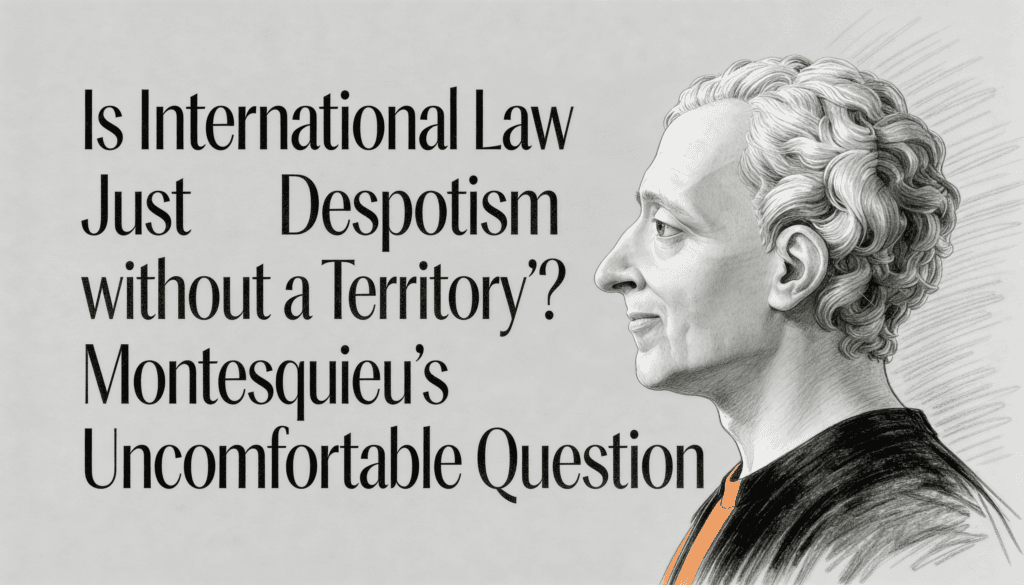
Montesquieu had a gift for the kind of phrase that lingers in your mind long after you have closed the book. Despotism without a territory is one of them. He was not writing about international law when he said it, but the description fits so well that scholars have been borrowing it for centuries. The idea is delicious in its irony. Despotism, after all, is usually defined by its grip on a place. A tyrant rules a country. A king controls a kingdom. What kind of despotism floats above borders, claiming authority over everyone and no one at the same time?
International law is exactly that strange creature. It tells nations what they can and cannot do. It demands compliance from governments that never voted for its rules. It dispatches courts in cities most of its subjects will never visit. And yet, when a powerful state decides to ignore it, international law shrugs and moves on. It is the schoolteacher who lectures about discipline but cannot send anyone to detention. Or so the cynics say.
The question of whether international law is real law, fake law, or something in between has been asked since the discipline was invented. It deserves a fresh look, not because the answer has changed, but because the world around it keeps changing. And the answer, as you might suspect, is more interesting than either side of the debate likes to admit.
The Old Complaint
The classic objection to international law is almost embarrassingly simple. Law, the argument goes, requires a sovereign. Someone has to make the rules, enforce them, and punish those who break them. Inside a country, that someone is the state. It has police, prosecutors, judges, and prisons. It can compel you to pay your taxes and stop you from punching your neighbor.
International law has none of this. There is no global police force. No world prosecutor with a badge and the authority to arrest a sitting president. The International Court of Justice exists, but a country can simply decline its jurisdiction and walk away whistling. The International Criminal Court issues warrants that some countries treat like wedding invitations they have no intention of accepting.
This is where the Montesquieu line bites hardest. International law claims the authority of law without the muscle of law. It writes rules but cannot enforce them. It punishes the weak and lectures the strong. A small African country might find itself before a tribunal for actions far less severe than those committed openly by a great power that has signed nothing and fears no one.
If you stop reading here, you would conclude that international law is theater. Lawyers in expensive suits performing legitimacy for an audience of diplomats. And honestly, sometimes it is.
But Then Why Does It Work?
Here is the part the cynics rarely explain. If international law is just talk, why do states spend so much time and money complying with it? Why do governments hire armies of lawyers to argue treaty interpretations? Why do trade disputes between major economies actually get resolved through the World Trade Organization rather than through tariffs and tantrums?
The strange truth is that international law works most of the time. The mail crosses borders. Planes land where they are supposed to land. Embassies stay unbombed. Fisheries get divided up. Diseases get tracked across continents. None of this happens by accident. It happens because thousands of small agreements quietly do their job while the dramatic failures grab the headlines.
The reason international law gets a bad reputation is that we only notice it when it breaks. Nobody writes news articles about the postal treaties that worked perfectly last Tuesday. We notice when a war crime goes unpunished or when a powerful country flips the table over. We do not notice the millions of cross border transactions that proceed in calm, lawful fashion.
This is the first counter intuitive aspect worth holding on to. The visible failures of international law are statistical outliers. The invisible successes are the rule. Calling international law toothless is a bit like calling gravity unreliable because sometimes airplanes crash.
What Kind of Animal Is International Law?
The trouble with the despotism comparison is that it assumes international law is trying to be a global government. It is not. It never was. The people who built it did not want a world emperor. They wanted something stranger, something without a name in any earlier language. They wanted a system where states would agree to limit themselves because limiting themselves was useful.
Think about it from a state’s point of view. You are a country. You want predictable trade. You want your diplomats to be safe abroad. You want some confidence that other countries will not just invade you. You cannot get any of this alone. You can only get it by agreeing with others to play by certain rules, knowing that you also have to play by them.
International law, then, is less like a despot and more like a club. The members write the rules. The members enforce them, awkwardly, mostly through social pressure and economic consequences. The members can leave, but leaving has costs. It is a system that survives because the alternative, raw chaos, is worse for almost everyone, including the powerful.
This is why even the most lawless of great powers usually bother to dress their violations in legal language. When a country invades another country, it almost always explains itself through the vocabulary of international law. Self defense. Humanitarian intervention. Responsibility to protect. Liberation. The fact that these explanations are often nonsense is beside the point. The fact that they have to be offered at all tells you something. Even the cheaters acknowledge the game.
The Real Despotism Problem
Now, having defended international law, it would be dishonest not to admit that Montesquieu still cuts somewhere true. International law does have a despotism problem. It is just not the one the cynics usually describe.
The real problem is not that international law is too weak. It is that international law is selective. The rules apply to everyone in theory, but in practice they apply unevenly. Smaller and poorer countries face accountability more often than larger and richer ones. Certain kinds of violations get prosecuted. Other kinds get ignored. The institutions that make and apply international law were largely built in the middle of the twentieth century by a small group of powerful states, most of them in the West, and the architecture still reflects those origins.
This creates a peculiar form of authority. International law speaks in the name of universal humanity but often acts in the interest of particular powers. It tells a Sudanese general he is a war criminal while declining to investigate the conduct of others whose actions are more lethal but less politically convenient. The selectivity is not absolute. There are moments of genuine impartial application. But it exists, and pretending otherwise insults the intelligence of every law student who has ever read a casebook.
So perhaps Montesquieu was half right. International law is not despotism without a territory because it is not powerful enough to be despotic. But it can be unjust without a territory. It can apply standards inconsistently. It can claim universal jurisdiction while serving partial interests. The criticism, when properly aimed, is not that international law is fake. It is that international law sometimes pretends to be more impartial than it actually is.
The Quiet Power of Norms
Here is something that might surprise you. The most powerful parts of international law are the parts that have no enforcement mechanism at all. Diplomatic immunity. The prohibition on torture. The taboo against using chemical weapons. These rules are kept not by courts but by something much older and stranger: shared norms.
When a state violates one of these norms, it loses something that money cannot easily buy. It loses standing. Other states stop trusting it. Citizens of other countries protest it. Companies hesitate to invest in it. The cost is diffuse and slow, but real. The despot may not be sent to jail, but the despot finds it harder to borrow money, harder to attend international meetings, harder to be treated as a normal participant in global life.
Norms are messy. They are not always consistent. They can be manipulated by propaganda. But they are stubbornly persistent. Two centuries ago, slavery was legal in many places. Now it is illegal everywhere on earth, though it still happens in shadow forms. Two centuries ago, attacking a neighbor was considered a normal tool of statecraft. Now it is considered an aberration that demands justification. These shifts did not happen because a world court forced them. They happened because international law, in its strange and patient way, changed what counted as acceptable behavior.
This is the form of authority Montesquieu would have found hardest to categorize. It is not despotism because it is not concentrated in one ruler. It is not democracy because it is not elected by anyone. It is not even law in the traditional sense because much of it cannot be enforced. It is something else. A kind of slow moving moral architecture that constrains states through reputation, expectation, and habit.
So What Is the Verdict?
Was Montesquieu right? Partly. The phrase captures something genuine about how international law can feel from below. The rules come from somewhere far away. They claim authority over you. They are sometimes applied unevenly. They cannot be voted out. From a certain angle, yes, that has the texture of despotism.
But the comparison breaks down when you look at how international law actually functions. It is not a single ruler. It is a vast and untidy network of agreements, courts, customs, and expectations that states maintain because they need to. It survives the violations because the system is bigger than any one rule. It bends under pressure from great powers but does not break.
The honest answer is that international law is neither the noble guardian its defenders describe nor the empty fraud its critics dismiss. It is a human invention with human flaws, doing a difficult job under impossible conditions.
Montesquieu was a careful thinker who knew that institutions should be judged by what they actually do, not by what their critics fear. If he were alive today, looking at the patient, imperfect, occasionally heroic work of international law, he might have softened. He might have noticed that the territory of this strange despotism is not a country, but something subtler and more durable. The territory is the slow consensus of nations on what civilized behavior looks like. And the despot, if there is one, is something close to our better collective judgment, whispering rules to those who would rather not hear them.
That whisper, faint as it sometimes is, has kept more peace than any throne.