Table of Contents
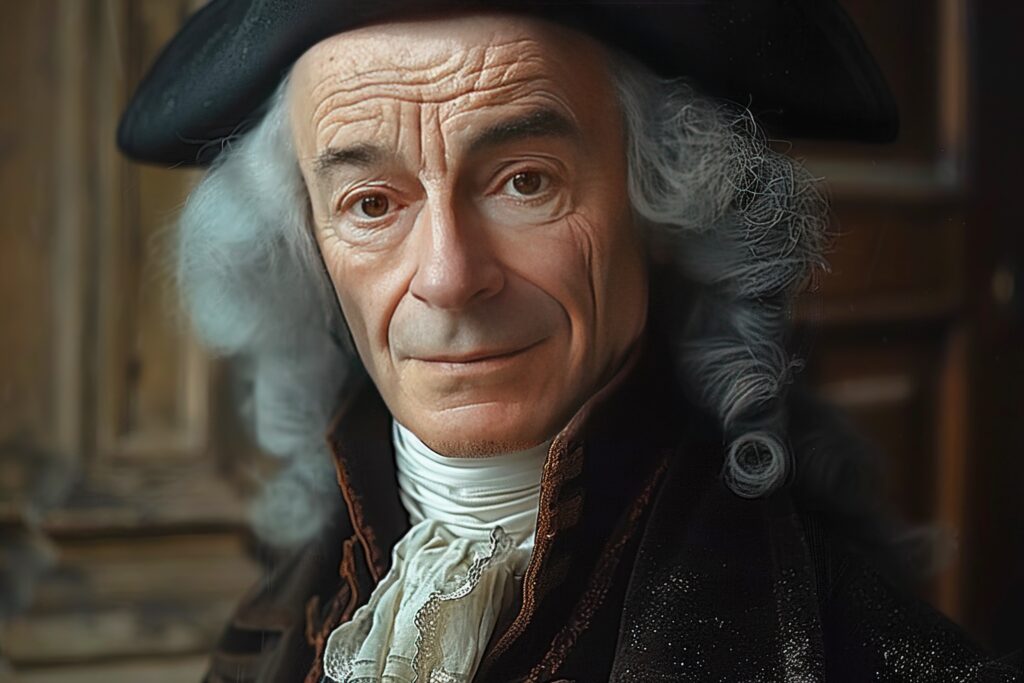
There is a famous line attributed to Voltaire that goes something like this: “I disapprove of what you say, but I will defend to the death your right to say it.” The quote is everywhere. It is printed on mugs, sprayed on protest signs, quoted by politicians, and dropped into Twitter threads by people who have never read a page of Voltaire in their lives.
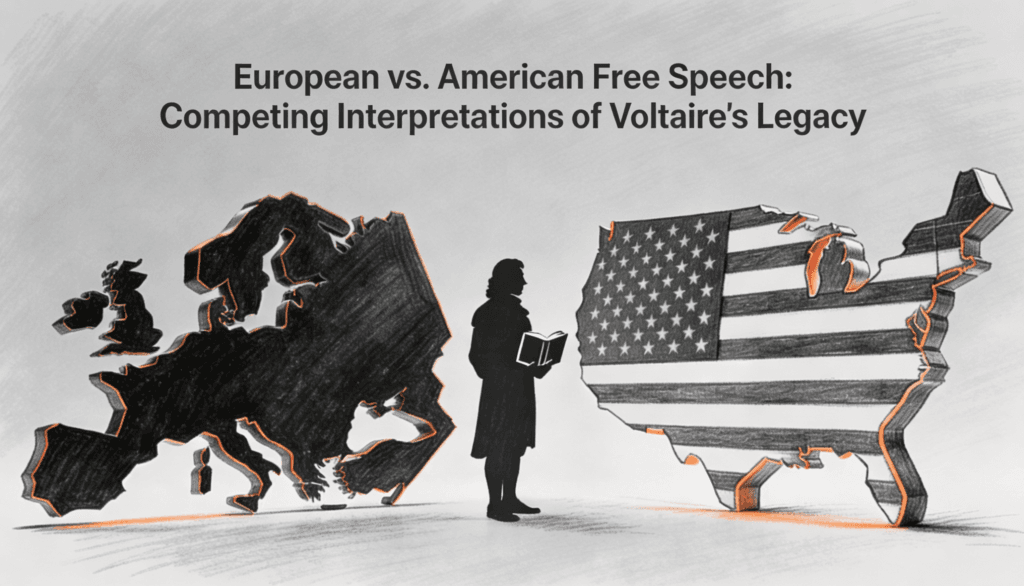
Here is the small irony. Voltaire never actually wrote that sentence. It was coined in 1906 by an English biographer named Evelyn Beatrice Hall, who was summarizing what she believed his attitude to be. So the most famous defense of free speech in modern history is technically a paraphrase invented two centuries after his death. That seems oddly fitting, because the way Europeans and Americans have interpreted his legacy diverges so sharply that you sometimes wonder if they are reading the same author at all.
Both sides claim Voltaire as their intellectual ancestor. Both believe they are protecting his vision. And yet if you handed a French magistrate and a Texas judge the same controversial pamphlet, you might get two completely opposite rulings. One would call it protected expression. The other would call it a crime. Welcome to the strange afterlife of an eighteenth century satirist who spent more time in exile than at home.
Two Continents, One Philosopher, Two Very Different Interpretations
The American interpretation of free speech is, at its core, almost absolutist. The First Amendment protects expression with very few exceptions. You can burn the flag. You can deny the Holocaust. You can stand on a street corner and shout that the government is a fraud, that religion is poison, or that your neighbor is a fool, and the state cannot touch you. The exceptions are narrow and specific. Direct incitement to imminent violence. True threats. Defamation that can be proven false and harmful. Beyond those tight categories, the law steps back.
The European interpretation is something else entirely. Across France, Germany, Austria, Belgium, and much of the continent, certain kinds of speech are not just frowned upon. They are illegal. Holocaust denial can land you in prison. Hate speech laws criminalize expression that incites hatred against protected groups. Insulting public officials, blasphemy in some jurisdictions, and even certain forms of political satire can trigger legal consequences. The European Court of Human Rights has repeatedly upheld these restrictions as compatible with freedom of expression, arguing that liberty has limits when it threatens dignity, public order, or democracy itself.
So which side is keeping faith with Voltaire? The answer is more complicated than either camp likes to admit.
What Voltaire Actually Believed
Voltaire was not a free speech absolutist in the modern American sense. He spent most of his career fighting religious dogma, royal censorship, and clerical hypocrisy. He defended the family of Jean Calas, a Protestant wrongly executed by Catholic authorities, and turned the case into a generational scandal. He railed against the Catholic Church with such venom that his books were burned, banned, and smuggled across borders. He understood censorship intimately because he lived under it.
But Voltaire also held views that would make a modern free speech advocate uncomfortable. He wrote things about Jewish people that today read as openly antisemitic. He sometimes called for the suppression of what he considered superstition. He believed reason should triumph over fanaticism, and he was not always picky about how that triumph was achieved. He was a man of his time, and his time was complicated.
What he did believe, consistently and passionately, was that the state had no business deciding which ideas were acceptable to discuss. He hated the alliance of throne and altar. He hated being told what he could not write. He thought intellectual freedom was the foundation of a civilized society. And he believed that truth, if allowed to compete openly, would eventually win out over lies.
This is where the two modern traditions split.
The American Reading: Trust the Marketplace of Ideas
Americans, broadly speaking, took the Voltairean torch and ran with it in one direction. The argument goes like this. If the state can decide what speech is too dangerous to permit, then the state becomes the arbiter of truth. And history suggests that states are not very good at this job. Governments have banned everything from scientific theories to religious texts to political dissent, often catastrophically.
Better, the American tradition argues, to let everyone speak. The good ideas will rise. The bad ideas will be exposed, ridiculed, and dismantled in public. Sunlight, as the saying goes, is the best disinfectant. This is sometimes called the marketplace of ideas, a metaphor that suggests truth wins the same way good products do, through competition and consumer choice.
There is something genuinely Voltairean about this. He did believe in open debate. He did believe in ridicule as a weapon. He would have appreciated the American instinct to mock authority, to publish what powerful people do not want published, to refuse to bend the knee to official narratives.
The downside is also real. The marketplace of ideas sometimes behaves less like a clean exchange and more like a noisy bazaar where the loudest vendor wins, regardless of what he is selling. Conspiracy theories spread faster than corrections. Lies travel further than truth. The American model assumes citizens have the time, education, and patience to sort through it all, which is a generous assumption.
The European Reading: Some Truths Must Be Protected by Law
The European tradition reads Voltaire differently. Yes, he hated censorship. But he also lived through the horrors that unchecked rhetoric could produce. And Europeans, more than Americans, lived through the consequences of the twentieth century. Two world wars. The Holocaust. Decades of fascist and communist propaganda that proved, beyond reasonable dispute, that words could lay the groundwork for atrocities.
After 1945, much of Europe concluded that some ideas were too dangerous to leave to the marketplace. The continent had watched what happened when ordinary people were marinated in hateful speech for years. It had seen newspapers normalize the unthinkable until the unthinkable became policy. The lesson, for many European jurists and lawmakers, was that liberty without limits could devour itself.
So the European model places restrictions where the American model does not. Germany criminalizes Holocaust denial because Germany knows, in a way no other country quite does, what happens when those lies are allowed to spread. France restricts certain forms of hate speech because France has watched what happens when minorities are publicly dehumanized. These are not arbitrary rules. They are scars.
There is also something Voltairean about this approach, even if Americans struggle to see it. Voltaire believed in protecting human dignity. He defended persecuted minorities. He thought reason should triumph over prejudice. A European might argue that hate speech laws are not the enemy of his project. They are an extension of it, adapted to a continent that learned the hard way what happens when prejudice goes unchecked.
The Counterintuitive Bit
Here is where things get interesting, and where most articles on this subject stop short. The American model, for all its absolutism, often produces more chilling effects than it admits. Social pressure, employer policing, and platform bans now restrict speech in ways that would have horrified Voltaire just as much as state censorship. The law may say you cannot be jailed for an opinion, but you can certainly lose your job, your platform, and your reputation. The state is not the only force capable of silencing people, and Americans sometimes pretend it is.
Meanwhile, Europeans, despite all those restrictive laws, often enjoy more robust public debate on certain topics than Americans do. French intellectuals tear into religion, politics, and culture with a ferocity that would make many American commentators clutch their pearls. German talk shows routinely host views that would never make it onto American cable news. The European model criminalizes a narrow band of speech but leaves the rest of the conversation surprisingly open.
So the picture is messier than the simple story suggests. The Americans are not as free as they think, and the Europeans are not as restricted as the headlines imply. Both systems have leaks and contradictions. Both occasionally fail the people they are supposed to protect.
The Quote Voltaire Did Not Write
Return for a moment to that famous fake quote. “I disapprove of what you say, but I will defend to the death your right to say it.” Why has it lasted so long? Why do people keep attributing it to him?
Because it captures something true, even if Voltaire never actually said it. It captures the idea that disagreement is not the same as suppression, that you can find a view repulsive and still believe its expression has value. That principle is genuinely Voltairean, even if the sentence is not.
The Americans took that principle and built a near absolutist legal regime around it. The Europeans took it and built a more conditional regime, one that draws lines where the Americans do not. Both can point to Voltaire and find justification. Both are, in different ways, his heirs.
The disagreement between them is not really about whether free speech matters. Everyone in this argument agrees it matters. The disagreement is about what kind of society best protects it. Is it one where the state never intervenes, trusting citizens to sort the good from the bad? Or is it one where the state holds a few firm lines, accepting that some lies are so corrosive they cannot be left to the marketplace?
There is no clean answer. There is only the long, messy human project of figuring out how to live together without lying to each other or silencing each other. Voltaire spent his life inside that project, getting it right sometimes and wrong often. The fact that two continents still argue about what he meant might be the best evidence that he asked the right questions.
What This Means Today
For all the philosophical weight of this debate, it is not abstract. It plays out every day, in courtrooms, on social media, in newspaper editorials, and in the laws being passed right now across the western world. Should certain online speech be illegal? Should platforms moderate content? Should governments require fact checking? Should denial of certain historical atrocities be punishable? These questions are not new. They are just the latest chapter in a debate that began long before anyone misquoted Voltaire on a coffee mug.
What the American and European traditions both get right, in their own ways, is that the question deserves serious thought. What they sometimes get wrong is the temptation to act as if their answer is the only one that honors the man’s legacy.
Voltaire was a writer. He believed in argument. He believed in publishing. He believed that ideas, even bad ones, were better met with better ideas than with prisons. But he also believed that some truths needed defending and that civilization required certain shared commitments to function.
Both continents inherited that tension. Both are trying, in their own ways, to live with it. Neither has solved it, and neither will. The legacy of Voltaire is not a settled doctrine. It is an argument that refuses to end, which is probably the most Voltairean thing about it.