Table of Contents
There is a quiet scandal at the heart of modern thinking about money. We have somehow arrived at a moment in history where earning a profit is treated as morally suspicious, while losing money is seen as evidence of pure intentions. A nonprofit that burns through donations and produces nothing measurable gets a respectful nod. A business that earns millions by solving a real problem for real people gets interrogated about its motives.
This is, to put it politely, backwards.
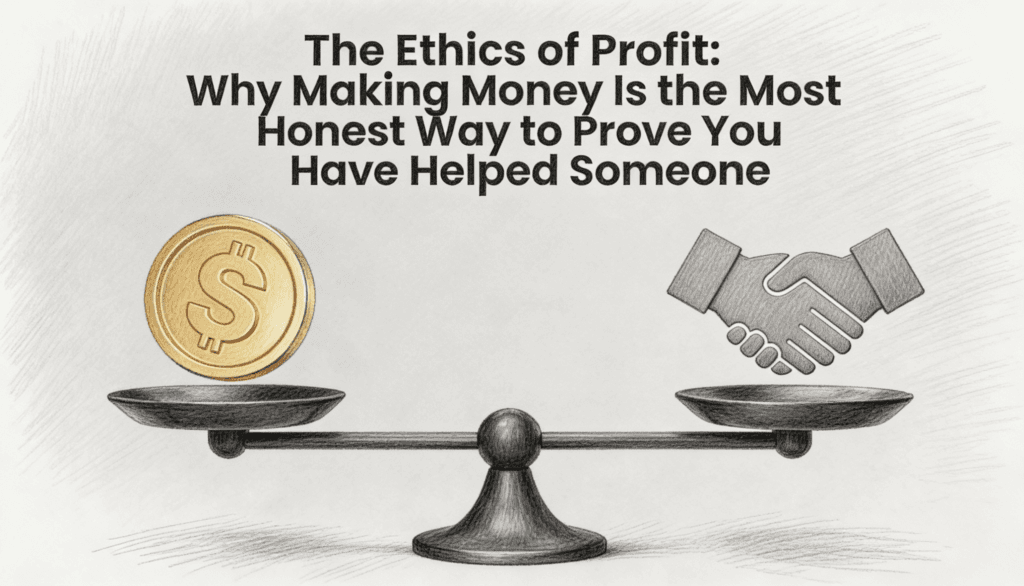
Jean-Baptiste Say, the French economist writing in the early 1800s, understood something that most of us still struggle to accept. He argued that production, not consumption, is the engine of economic life. And embedded in that argument is a radical ethical claim: profit is not a reward for exploitation. It is a receipt. It is proof, verified by the voluntary decisions of other human beings, that you have created something worth more than the resources you used to create it.
That idea deserves a serious examination. Not because profit is always ethical. It is not. But because the blanket suspicion we direct toward money making often protects us from a harder truth: that good intentions, by themselves, prove nothing at all.
The Receipt Nobody Wants to Talk About
Let us start with what profit actually is, stripped of the emotional baggage we have loaded onto the word.
When a business earns a profit, it means that customers voluntarily paid more for a product or service than it cost to produce. Nobody forced them. Nobody held a sword to their throat. They looked at what was on offer, compared it to the price, and decided the exchange was worth it.
This is a remarkable thing when you stop to think about it. In a free transaction, both sides believe they are getting the better deal. The customer values the product more than the money. The seller values the money more than the product. Both walk away feeling richer. Profit is the mathematical residue of that mutual satisfaction.
Say understood this with unusual clarity. His famous “Law of Markets” proposed that supply creates its own demand, meaning that the act of producing something valuable is what gives people the means and the reason to engage in exchange. Production is not the opposite of helping people. It is the mechanism by which helping people actually happens.
Now contrast this with the alternative ways we try to prove we have helped someone. Letters of gratitude. Mission statements. Impact reports filled with bar charts and stock photos of smiling children. These are all fine, but none of them carry the same weight as a simple, falsifiable test: did someone voluntarily hand over their own money for what you made?
That test is brutal in its honesty. And perhaps that is why so many people prefer the bar charts.
The Moral Camouflage of Losing Money
Here is where things get counterintuitive. We tend to trust people more when they are losing money. If someone tells you they run a nonprofit, your guard drops. If someone tells you they run a company with a 40% profit margin, your guard goes up. But think carefully about what each statement actually tells you.
The nonprofit founder has told you nothing about whether anyone has been helped. They have told you only that the organization does not distribute surplus revenue to owners. That is an accounting structure, not a moral achievement. The business owner, by contrast, has told you something concrete: enough people found enough value in what this company does that it consistently generates surplus after covering all its costs.
This is not an argument against nonprofits. Many do extraordinary work. It is an argument against the lazy heuristic that losing money signals virtue and making money signals vice. That heuristic has it exactly backwards. Losing money, in many cases, simply means you have consumed resources without producing equivalent value. It means the world gave you inputs and you returned less than what you took.
Say would have recognized this pattern instantly. In his framework, the entrepreneur is a coordinator, someone who assembles land, labor, and capital into combinations that produce more value than the inputs alone. When that coordination fails, when costs exceed revenues, it is not a noble tragedy. It is a signal that resources have been misallocated. That the wood, the hours, the talent, the electricity would have been better used somewhere else.
Profit says: you used the world’s resources well. Loss says: you did not. We can argue about exceptions. We cannot argue about the general principle.
Why Voluntary Exchange Is the Only Honest Jury
There is a deeper philosophical point lurking here, and it connects to something far outside economics.
In epistemology, the study of how we know what we know, one of the central problems is verification. How do you prove that something is true? How do you prove that a medicine works, that a bridge is safe, that a teacher is effective? The answer, in every domain, involves some form of testing against reality. You do not get to simply declare that your bridge is safe. You have to load weight onto it and see what happens.
Profit is the economic version of loading weight onto the bridge.
When you make a product and put a price on it, you are making a testable claim. You are saying: this thing I have made is worth at least this much to someone. The market then delivers a verdict. If people buy it, your claim holds. If they do not, it collapses. There is no appeals court. There is no committee you can lobby. The verdict comes from the distributed, uncoordinated decisions of thousands or millions of individuals, each acting on their own judgment about their own needs.
This is why profit is more honest than almost any alternative measure of value. It is not self-reported. It is not curated. It cannot be faked by a gifted storyteller with a good slide deck. It emerges from the revealed preferences of real people spending real resources.
Say was writing in the aftermath of the French Revolution, a period saturated with grand declarations about the common good. He had seen, up close, what happens when value is determined by political authority rather than voluntary exchange. The results were not encouraging. Central planners, however well intentioned, lack the information that prices carry. They can declare that bread should cost a certain amount. They cannot declare it into existence when the baker has no flour.
The Uncomfortable Case of Things That Matter but Do Not Sell
Now, a fair reader will raise an objection here, and it is a good one. What about things that genuinely matter but do not generate profit? What about basic research? Public parks? National defense? Art that challenges rather than entertains?
This is a legitimate problem, and pretending it does not exist would be dishonest. Not everything valuable can be captured by market exchange. Economists call these situations market failures, cases where the benefit of something spills over to people who did not pay for it, or where the cost falls on people who were not part of the transaction.
But notice something important about this objection. It does not undermine the principle that profit is evidence of value. It merely says that profit is not the only evidence of value. These are very different claims. Saying that some valuable things do not generate profit is like saying that some healthy people never run marathons. True, but irrelevant to the question of whether finishing a marathon is evidence of fitness.
The existence of public goods does not discredit profit. It simply means that profit is a sufficient indicator of value creation, not a necessary one. When profit is present, you can be reasonably confident that value has been created. When it is absent, you need to look harder, ask more questions, and be more skeptical of anyone who claims to be helping.
Say himself was not a market fundamentalist in the way that term is thrown around today. He recognized the role of government and institutional frameworks. But he insisted, rightly, that the productive entrepreneur deserved moral respect, not moral suspicion. The person who figures out how to make something people want, at a cost they are willing to pay, using fewer resources than the value they create, is doing something genuinely good. Not accidentally good. Not good as a side effect. Good in the most direct and verifiable sense available.
The Strange Guilt of the Productive
There is a psychological dimension to all of this that Say could not have anticipated but would probably have found fascinating.
Modern culture has developed a peculiar relationship with productive success. We admire it in athletes, artists, and scientists, but become suspicious of it in business. A surgeon who saves a thousand lives is a hero. An entrepreneur whose product improves the daily experience of a million people is a person who needs to “give back,” as if they had been taking something in the first place.
This language of giving back reveals an assumption so deep that most people never examine it. The assumption is that profit is extracted from society rather than created within it. That the entrepreneur is a kind of sophisticated parasite who siphons value from the community and then, if they are decent, returns some portion of the loot through philanthropy.
Say would have found this framing absurd. In his model, the entrepreneur does not extract value. The entrepreneur assembles it. They take raw materials that are worth less in their current form and transform them into goods and services that are worth more. The profit is not what they took from the process. It is what they added to it.
The difference matters enormously. If profit is extraction, then the moral response is guilt and redistribution. If profit is creation, then the moral response is respect and encouragement. These two framings lead to very different societies, and we are living through a confused period where both framings coexist, pulling in opposite directions, leaving successful people trapped in a strange cycle of accomplishment and apology.
What Say Would Tell a Room Full of Founders
Imagine, for a moment, that Jean-Baptiste Say could walk into a modern startup pitch competition. He would hear founders talking about disruption, scalability, and total addressable markets. He would hear investors asking about unit economics and burn rates. And somewhere in the background, he would hear the faint cultural murmur that all of this money chasing is somehow less noble than teaching or nursing or community organizing.
He would, I think, gently disagree.
Not because teaching and nursing are unimportant. They are vital. But because the act of building something people want, pricing it fairly, and earning a surplus is itself a form of service. It is service that submits to the hardest test available: the voluntary judgment of the people it claims to serve.
Say would remind the room that every franc, dollar, or bitcoin of profit represents a transaction where both sides felt they gained. That this is not a minor moral achievement. That throughout most of human history, economic life was organized around coercion, tribute, and plunder. The idea that you could become wealthy by making strangers better off, without ever forcing anyone to do anything, would have seemed like utopian fantasy to virtually every civilization that came before.
And yet here we are, living inside that fantasy, and complaining about it.
The Bottom Line on the Bottom Line
Profit is not perfect. It can be distorted by monopoly, fraud, externalities, and information asymmetry. These distortions are real, and addressing them is important work. But the distortions are deviations from the principle, not refutations of it.
The principle remains: in a voluntary exchange, profit is the most honest signal we have that value has been created. It is not the only signal. It is not an infallible signal. But it is a signal that does not depend on self-reporting, does not require a committee to interpret, and cannot be manufactured by good intentions alone.
Jean-Baptiste Say gave us the intellectual framework to understand this over two hundred years ago. The framework has aged remarkably well. What has not aged well is our willingness to take it seriously.
We live in an era that venerates intention and distrusts results. That celebrates the person who tries and fails over the person who succeeds and profits. That treats the balance sheet as a moral document only when it shows red ink.
It is time, perhaps, to read the receipt.