Table of Contents
There is a comforting story being told about artificial intelligence. The story goes like this. AI will help us think more clearly. It will save us time. It will free us from boring work so we can focus on the meaningful parts of life. It will make us smarter, fitter, more productive, more creative. We will become better versions of ourselves because we finally have a tool worthy of our potential.
It is a beautiful story. It is also probably wrong.
The more honest prediction is uglier. AI will not make us better. It will make us more of what we already are. And what we already are, if we are being truthful, is not exactly a species known for self discipline, deep focus, or wise decisions made under pressure. We are creatures of habit, and most of our habits are not great. AI is about to pour gasoline on every single one of them.
The Mirror Problem
There is a basic truth about technology that gets buried under all the marketing. Tools do not transform users. Tools amplify users. A hammer in the hands of a carpenter builds a house. A hammer in the hands of a vandal breaks a window. The hammer does not care. It just multiplies whatever intention picked it up.
AI is the most powerful amplifier we have ever built. Which means the question is not what AI will do to us. The question is what we will do with AI, given who we already are.
And who are we? We are people who pick up our phones one hundred times a day. We are people who cannot sit through a four minute YouTube video without checking another tab. We are people who buy gym memberships in January and stop going by March. We are people who know exactly what we should eat and eat the other thing anyway. We are people who agree to do hard things tomorrow because tomorrow is not real yet.
Now hand this person an assistant that will do anything they ask, instantly, without judgment. What do you think happens next?
The Path of Least Resistance Gets Paved
Most self improvement is not about knowing what to do. It is about doing the thing you already know you should do, when you do not feel like doing it. The gap between knowing and doing is where character lives. It is also where AI is about to install a six lane highway.
Consider writing. People say AI will help them write better. In reality, most people who use AI to write do not become better writers. They become people who used to write and now do not. The muscle that gets used is the one that asks for output. The muscle that gets used to produce that output, the one that actually matters, atrophies.
This is not a moral failing. It is just physics applied to human attention. Water flows downhill. Effort flows toward whatever is easiest. If there is a button that produces something acceptable without struggle, the struggle stops happening. And the struggle was the point.
The irony is delicious. We built a tool to help us think, and the predictable result is that we will think less. We built a tool to help us learn, and we will probably learn less, because learning requires the friction we just engineered away. We built a tool to help us communicate, and our messages will sound increasingly like the same beige soup of polite competence because the model is the same model for everyone.
The Comfort Trap
There is an old joke about a man who loses his keys in a dark alley but searches for them under the streetlight because the light is better there. AI is a very bright streetlight. It is going to attract a lot of searching that has nothing to do with where the keys actually are.
What I mean is this. Hard problems in life rarely have the property of being well defined. Should I leave this relationship? Is my career going somewhere I actually want to go? Am I being a good parent? These questions do not have answers that can be generated. They require sitting with discomfort. They require the slow internal work of figuring out what you actually think and feel, which often takes weeks, not seconds.
AI gives you an answer in seconds. It will give you a thoughtful, balanced, beautifully worded answer to any question you ask, including the questions that should not have answers given to them. And because the answer sounds wise, you might accept it. You might outsource your inner life to a probability distribution.
This is not because AI is malicious. It is because AI is helpful, and helpfulness is exactly the wrong response to certain kinds of questions. Sometimes the helpful thing is to not help. A good therapist knows this. A good friend knows this. A language model does not, because it was trained to produce responses, not to withhold them.
The Productivity Illusion
The productivity argument for AI is the one that sounds most respectable. Use AI to handle the boring stuff so you can focus on what matters. Reasonable, right?
Look at what happened with email. Email was supposed to save us time. We were going to write fewer letters, make fewer phone calls. Time was going to open up. Remember that?
What actually happened is that the cost of sending a message dropped to zero, so the number of messages exploded, and now everyone spends hours a day processing email and the meetings still exist. The time savings were eaten by induced demand, which is what economists call it when you build a bigger road and traffic immediately fills it.
AI will do the same thing to white collar work. The cost of producing a document, a report, a slide deck, a pitch will drop to nearly zero. So the volume will explode. Every meeting will have a pre read. Every pre read will have a summary. Every summary will have a follow up. Everyone will be drowning in content that no one actually reads because everyone knows it was generated and no one wants to be the chump who spent real attention on something that took none to make.
The promise was that AI would handle the busywork. The reality is that AI will manufacture more busywork than any human could produce, and you will be expected to keep up. This is just the same story that has played out with every productivity tool in the last fifty years.
The Personalization Spiral
There is something specific about AI that makes the habit problem worse than previous technologies. AI is personalized. It adapts to you. It learns what you like and gives you more of it.
This sounds good. It is not.
The problem is that most of us are not actually trying to become more like ourselves. We are trying, often without knowing it, to become slightly different. To be a little kinder than our first impulse. A little more patient. A little more curious about things outside our usual interests. Growth is the gentle process of becoming someone you are not quite yet.
A personalized AI works against this by definition. It optimizes for what you already are. It writes in your style, so you never have to encounter a sentence you would not have written. It recommends what fits your taste, so you never stumble across something that would expand it. It agrees with your framing of problems, so you never have to consider that the framing might be the problem.
You become a closed loop with yourself, mediated by a model that has every incentive to keep you happy and zero incentive to challenge you. The result is the same result that social media produced, only worse, because now the feedback loop has moved from your feed into your thoughts.
The Honest Counterpoint
I want to be fair here. Not everyone will use AI badly. Some people will use it brilliantly. The same was true of every previous technology. The printing press created both the scientific revolution and a flood of useless pamphlets. The internet gave us Wikipedia and also gave us the comments section. Television gave us PBS and reality TV. Tools split humanity into the people who use them well and the people who get used by them.
The question is which group is bigger. And historically, the answer is always the same. The group that gets used by the tool is bigger. Much bigger. This is not because most people are foolish. It is because resisting the path of least resistance is exhausting, and most people, most of the time, have other things to be exhausted about.
There will be a small group who use AI to genuinely sharpen their thinking. They will treat it as a sparring partner, not an oracle. They will use it to learn faster, not to skip the learning. They will notice when they are reaching for it out of laziness and put it down. These people will pull ahead. They will be the ones who somehow manage to produce work that still feels like a person made it, because a person did, with AI as a collaborator rather than a replacement.
But this group will be small. It is always small. It is the same group that used to read books while everyone else watched cable.
What This Means For You
If you have read this far, you might be wondering what to do with all this. Here is the part where I am supposed to offer five practical tips for using AI responsibly. I will not, because I do not believe in fixing structural problems with personal hacks. The honest answer is harder and simpler.
Notice when you are about to use AI. Notice what you are using it to avoid. If you are avoiding a task that is genuinely tedious and has no learning value, fine, use it. If you are avoiding the thing where the difficulty was the point, where the discomfort was producing growth, where the struggle was the thing that would have made you better, pause. That is the moment where the future is decided. Not by AI policy. Not by some grand societal choice. By you, alone with a glowing rectangle, choosing whether to do the hard thing or hand it off.
Most people will hand it off. That is fine for them. The interesting question is whether you will be one of them. Because the gap between people who do their own thinking and people who outsource it is about to become the most important gap in modern life. It will determine careers, relationships, the quality of your own mind at sixty.
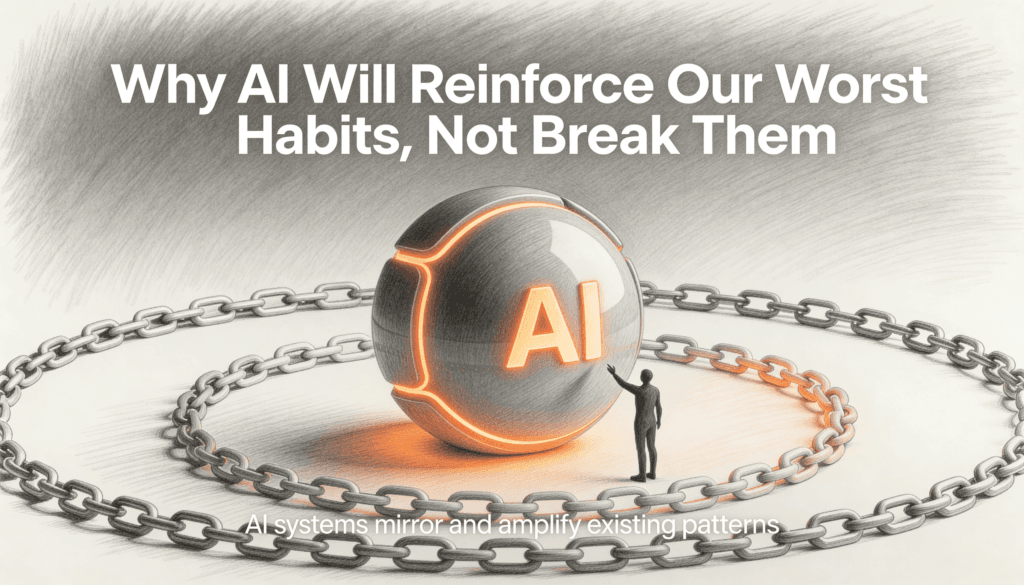
AI is not going to save us. It is not going to ruin us either. It is going to do what mirrors do. It is going to show us, in higher resolution than we have ever seen, exactly who we already were. And then it is going to multiply that, day by day, until we are unmistakably, undeniably, that thing. More so than before.
The good news, if there is any, is that the mirror has not finished forming yet. There is still time to decide what you want it to reflect.