Table of Contents
There is a particular kind of dread that arrives when you watch a machine do your job in three seconds. It is not anger exactly. It is something closer to embarrassment, the way you might feel watching someone fold a fitted sheet correctly for the first time in your life. You realize you have been doing something slowly and badly while believing you were doing it well.
This is the feeling sweeping through offices, studios, law firms, and trading floors right now. The robots are not coming. They arrived. They are sitting in the next cubicle, drinking no coffee, taking no breaks, and producing in an afternoon what used to take a department a week.
The instinct, of course, is to compete. To work faster. To wake up earlier. To answer emails at midnight. To prove, with the sweat of your forehead, that you can keep up.
This instinct is a trap. And to understand why, we need to take a strange detour through the work of an Austrian economist named Israel Kirzner, a man who spent his career thinking about something most people never notice.
The Economist Who Studied What You Did Not See
Kirzner was not famous in the way Keynes or Friedman were famous. He did not write bestsellers or appear on television. He spent decades at New York University quietly making a single argument that, in retrospect, may be the most important idea for surviving the age of intelligent machines.
His argument was this. Most economic theory assumes that people already know what is available to them. The buyer knows the prices. The seller knows the demand. Everyone has the information. The only question is how to optimize given what is known.
Kirzner thought this was nonsense. He pointed out that the real action in any economy was not in the calculation. It was in the noticing. The moment when someone realizes that coffee beans in Brazil are cheap and coffee drinkers in Brooklyn are thirsty, and that nobody else has put those two facts together yet. That moment of awareness, of seeing something that was hiding in plain sight, was the engine of everything.
He called this entrepreneurial alertness. And he believed it could not be reduced to calculation, because calculation requires you to already know what to calculate. Alertness is what tells you there is something worth calculating in the first place.
This sounds abstract until you realize it is the only skill the robots cannot copy.
What Machines Are Actually Good At
Let us be honest about what artificial intelligence can do. It can read every legal case ever written and find the relevant one in two seconds. It can produce a passable marketing email faster than you can find your password. It can analyze a spreadsheet, write a Python script, summarize a meeting, and translate your nonsense into French while you are still pouring your coffee.
What it does is optimize within a defined space. You give it a problem. It searches the space of possible answers. It returns the best one.
This is extraordinary, and it should not be dismissed. But notice the shape of it. The machine needs the space to be defined. It needs the problem to be posed. It needs someone to have already noticed that this is the question worth asking.
That someone, for now, is you.
The robot is a magnificent calculator stranded in a room with no windows. It can do anything inside the room. It cannot tell you that the interesting thing is happening outside.
The Speed Trap
The mistake people are making right now is treating this as a contest of velocity. They are downloading every productivity app. They are learning to prompt faster. They are bragging about how many tasks they completed before lunch.
This is like challenging a forklift to a weightlifting competition. You will lose. The forklift was built for this. It does not get tired. It does not have a back. It does not need a weekend in the Catskills to recover.
If your job is to move heavy boxes from point A to point B, and a forklift shows up, the answer is not to bench press more. The answer is to ask whether the boxes should be moved at all, whether B is the right destination, and whether there is something more valuable to do with your hands than what the forklift is already doing better than you.
Kirzner would have recognized this immediately. The forklift is calculation. The question of where the boxes should go is alertness. The forklift cannot do alertness. It can only do what it is told.
The Awareness Premium
Here is the part nobody is talking about clearly enough. As machines get better at calculation, the value of awareness goes up, not down. This is basic economics. When one input becomes cheap and abundant, the complementary input becomes scarce and valuable.
If anyone can generate a thousand marketing slogans in a minute, the person who knows which slogan actually matters becomes more valuable, not less. If anyone can produce an analysis, the person who knows what to analyze is the one who eats. If anyone can write code, the person who knows what should be built is the entire business.
The machines have not democratized intelligence. They have democratized execution. Which means the bottleneck has moved. It used to sit at the point of getting things done. Now it sits at the point of knowing what to do.
This is good news, in a way that does not feel like good news yet. For most of history, people who saw clearly were held back by their inability to execute. The brilliant friend with a great idea who never finished anything. The thoughtful colleague whose insights got buried under paperwork. The artist who could see the painting but lacked the time to paint it.
Those people are about to be unleashed. The execution layer is no longer the constraint. What you can see is.
What Awareness Actually Looks Like
Now we run into a problem. Awareness sounds great until you try to teach it. It is one of those qualities that everyone wants and nobody can quite explain. Like good taste. Like a sense of humor. Like knowing when to leave a party.
Kirzner himself was a little vague on the mechanics, which is honest of him. You cannot reduce alertness to a checklist, because the moment you do, it becomes calculation, and calculation is what the machines do better than you. But we can say some things.
Awareness is noticing what other people are not noticing. It is the quiet observation that everyone is solving the wrong problem. It is the small detail in a customer complaint that reveals a market nobody else has seen. It is the connection between two unrelated fields that suddenly makes both of them make sense.
It cannot be googled. It cannot be prompted. It comes from the slow accumulation of attention, from spending real time with real things, from caring about something specific enough to notice when it is off.
This is bad news for people who have spent their careers chasing efficiency. It is excellent news for people who have always felt slightly out of step, who notice odd things, who ask questions that make meetings run long. The world is finally catching up to the value of what they do.
The Counterintuitive Part
Here is where it gets strange. To compete on awareness, you have to slow down.
This sounds wrong in an era when everything is accelerating. But think about what awareness actually requires. It requires you to look at things. To sit with them. To wonder about them. To turn them over and notice the side nobody has shown you yet.
You cannot do this at the speed of a robot. You cannot do this while answering emails. You cannot do this while jumping between sixteen browser tabs and four Slack channels. The whole industrial logic of productivity, which says that more output per hour is always better, breaks down completely when the output you need is insight.
Insight has its own clock. It runs on walks, on showers, on conversations that wander off topic, on the strange hours between three and four in the afternoon when nothing seems to be happening but something is rearranging itself in your head. The people who consistently produce good ideas are not the busy ones. They are often the ones who look, from the outside, like they are wasting time.
The machines have given us back the gift of having time to waste. The question is whether we will accept it.
The People Who Will Lose
There is a kind of professional who is going to have a very bad decade. They are good at doing things. They are not particularly good at deciding what to do. They have built their identity around competence at execution. They are fast, accurate, reliable, and entirely replaceable.
This is not their fault. The system rewarded these qualities for fifty years. School taught them. Corporate ladders measured them. The whole machinery of professional life was designed to produce them.
But the machines do these things now. And the people who confused competence with value are about to find out that they were two different things all along.
The way out is not to get more competent. It is to remember what competence was supposed to be in service of. Competence is the cost of admission. Awareness is the game.
The People Who Will Win
The people who will thrive in this new arrangement share a few qualities. They are curious in ways that do not always look profitable. They notice things that other people walk past. They are slightly suspicious of conventional wisdom, not because they are contrarians, but because they have learned that conventional wisdom is often just the last good idea, fossilized.
They spend time outside their field. They have hobbies that seem irrelevant to their work and turn out, mysteriously, to keep informing it. They read things they were not assigned. They talk to people who do not work in their industry. They take their own observations seriously, even the small ones, especially the small ones.
Most of all, they have made peace with looking unproductive sometimes. They understand that thinking is not the same as typing. They have stopped apologizing for the parts of their work that cannot be measured.
This used to be a luxury. It is becoming a necessity.
The Practical Translation
So what do you do tomorrow morning?
You stop trying to beat the machines at what they do well. You stop measuring your worth in tasks completed and emails sent. You start asking different questions. Not how do I do this faster, but is this worth doing. Not how do I keep up, but where is everyone looking that they should not be. Not how do I learn the new tool, but what does the new tool make possible that nobody has tried yet.
You take walks. You read outside your industry. You keep a notebook for the small strange observations that you used to dismiss. You spend an hour a week, at least, doing something that has no obvious return. You treat your attention like the rare and depleting resource it actually is.
You let the machines do what the machines do. And you give yourself permission to do the one thing they cannot, which is to notice.
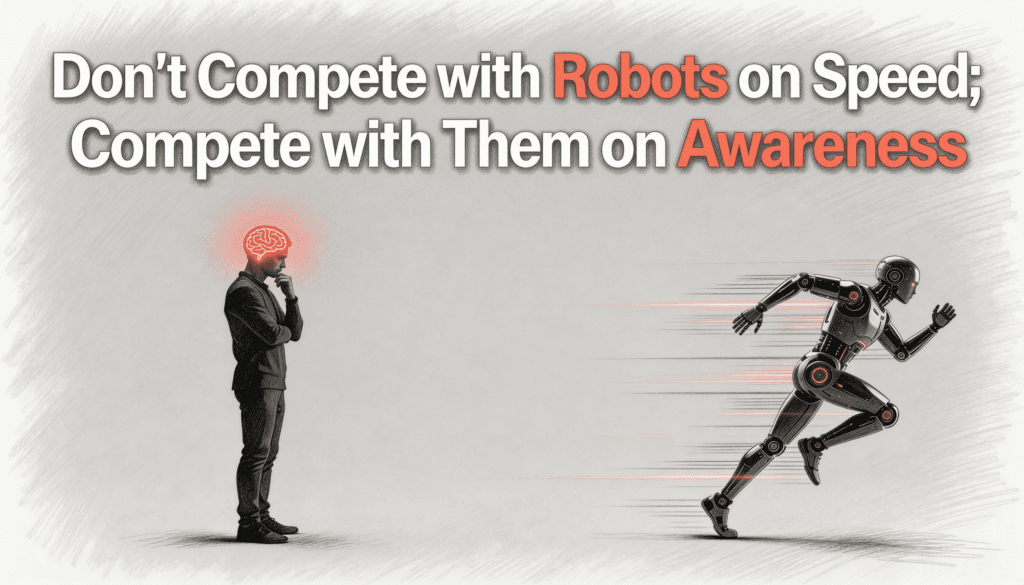
The robots are winning the race for speed. They were always going to. The race for awareness has begun, and you have a head start they cannot close.
Use it.