Table of Contents
There is a strange comedy playing out in modern wellness. People will spend three hundred dollars on a continuous glucose monitor before they will spend three dollars on a bag of lentils. They will research the optimal time to take magnesium glycinate but cannot remember the last time they walked somewhere instead of driving. They will buy a sauna blanket, a red light panel, and a subscription to an app that tracks their heart rate variability, all while sleeping five hours a night and eating dinner out of a paper bag.
The wellness industry has convinced us that health is complicated. It is not. It is just unprofitable to admit otherwise.
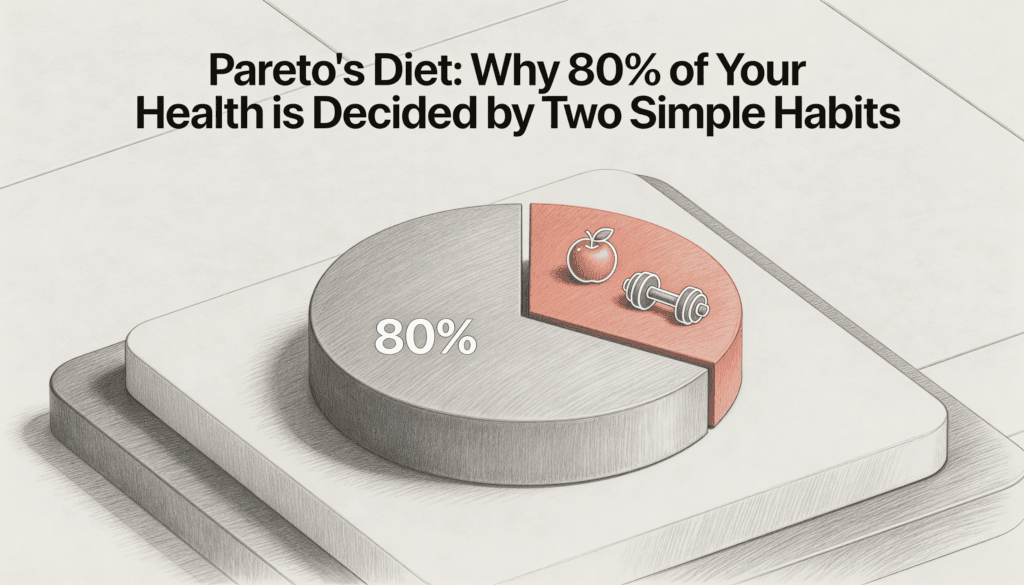
Vilfredo Pareto was an Italian economist who noticed in the late 1800s that roughly 80 percent of the land in Italy was owned by 20 percent of the people. He then noticed the same lopsided pattern in his garden, where 20 percent of his pea pods produced 80 percent of the peas. The principle named after him has since been applied to business, productivity, software engineering, and just about anything else that follows a distribution curve. The idea is simple. A small number of inputs are responsible for the overwhelming majority of outputs. Most of what you do does not matter very much. A few things matter enormously.
Health follows this rule with embarrassing precision. You can spend a decade reading books about cold plunges, fasting protocols, and gut microbiomes. Or you can do two things consistently and capture nearly all of the available benefit. The other 80 percent of effort gets you the remaining 20 percent of results, and frankly, most of it gets you nothing at all except the feeling of having done something.
The two habits are these. Eat well. Move your body every day. That is the entire article. You can stop reading now and you would still get the value. But you will not, because part of you suspects there must be more to it, and that suspicion is exactly what the supplement industry was built on.
Let us talk about the first one.
The Plate Problem
Most people do not have a diet problem. They have an ingredient problem. The food they put in their mouth has been engineered by people whose job is to make it impossible to stop eating. There is a reason you have never accidentally eaten too many apples. There is also a reason you have absolutely demolished an entire bag of chips while watching a show you were not even enjoying.
The trick is not to find the perfect diet. There is no perfect diet. Mediterranean, paleo, vegan, carnivore, intermittent fasting, the blood type diet that someone is still inexplicably promoting. They all work for some people some of the time, and they all share one thing in common when they do work. They get people to eat actual food again. Things that grew, swam, walked, or had a mother. The branding is a distraction. The actual mechanism is just removing the industrial slurry that makes up most of what is sold in the middle aisles of a grocery store.
If you want to be more precise about it, here is the boring truth. Eat protein with every meal, because it keeps you full and preserves muscle as you age. Eat vegetables and fruit, because they contain things your body needs and have not yet figured out how to manufacture in a pill. Eat some carbohydrates, because they are not the devil, despite what your one friend who discovered keto in 2019 keeps insisting at dinner parties. Drink water. Try not to drink your calories. That is essentially it.
The counterintuitive part is that what you do not eat matters more than what you do. You do not need to add kale, chia seeds, and a turmeric latte to a diet of frozen pizza and energy drinks. You need to remove the frozen pizza and energy drinks. The kale is a rounding error. Subtraction beats addition almost every time in nutrition, and yet every wellness influencer is selling you something to add. Funny how that works.
There is also a quiet point worth making about portions. Most people do not need to count calories, but most people also have no idea how much they are actually eating. A handful of almonds is a handful, not a fist full. A serving of pasta is the size of a tennis ball, not a softball. You do not need an app to figure this out. You need to slow down and notice. Eating while scrolling, eating while driving, eating while watching, eating while working. The body has a perfectly functional fullness signal. We have just spent decades drowning it out with stimulus.
The Movement Problem
The second habit is movement, and here is where the irony gets thick. The fitness industry has somehow turned the most natural thing a human body can do into a confusing, expensive, intimidating production. We have stationary bikes that cost more than a used car. We have classes with names that sound like Marvel villains. We have entire YouTube ecosystems dedicated to arguing about whether you should do five sets of three or three sets of five.
None of this is the point. The point is that your body was built to move and it punishes you when you do not. Sit at a desk for ten hours a day and your back will hurt. Take an elevator everywhere and your knees will get worse. Avoid lifting anything heavy for thirty years and you will become the kind of person who cannot open jars. The body adapts to what you ask of it. If you ask nothing, it gives you nothing.
The good news is that the threshold for benefit is shockingly low. Walking, just walking, captures an absurd percentage of what exercise can do for you. A daily walk of thirty to sixty minutes will improve your mood, your sleep, your blood sugar, your cardiovascular health, your cognition, and your odds of being alive in twenty years. That is a ridiculous return on investment for an activity that requires no equipment, no membership, and no special clothes. It is so simple that it feels like it cannot possibly be enough, which is why most people skip it in favor of something more complicated and less effective.
Lift something heavy a few times a week. It does not matter what. Dumbbells, kettlebells, your own body weight, sandbags, the children in your house if you have them and they consent. The mechanism is the same. Muscles that get used grow stronger. Bones that get loaded grow denser. Joints that get moved through their range stay mobile. After the age of thirty, you start losing muscle every year if you do not actively maintain it. By the time most people notice, they are already on the wrong side of the slope. Lifting is not vanity. It is the closest thing we have to a slow-acting insurance policy against frailty.
You do not need a gym. You do not need a trainer. You do not need a program with a name and a logo. You need to do something hard with your muscles a few times a week and walk a lot on the other days. That is the entire prescription.
The Other 80 Percent
Now, you might ask, what about sleep? What about stress? What about hydration, social connection, sunlight, breathing, fasting, supplements, gut health, hormones, and the seventeen other things every podcast wants to sell you a protocol for?
They matter. Of course they matter. But here is the unspoken secret. The two habits we just discussed are upstream of almost all of them. People who eat real food and move their bodies sleep better automatically. They handle stress better because their nervous system is regulated. They feel less anxious because exercise is one of the most effective anti-anxiety interventions ever measured. They are less inflamed, less bloated, less tired, less foggy. The downstream stuff tends to sort itself out when the upstream stuff is handled.
This is why people who try to fix their sleep without fixing their diet and movement usually fail. They are pulling on a string that is tied to two other strings, and they have not noticed yet. You can buy the best mattress on earth and you will still sleep poorly if you ate a burrito at ten and have not exercised since college.
The supplement industry, which is now larger than the global film industry by some estimates, exists almost entirely in this 20 percent zone of marginal returns. Most supplements do almost nothing for most people. The ones that do something only work if your foundation is already solid. Taking vitamin D will not save you if your diet is sugar and your hobby is sitting. It is like trying to improve your car by upgrading the air freshener while the engine is on fire.
Why This is Hard to Accept
There is a reason this article will be less popular than one titled “The 17 Hidden Superfoods Burning Belly Fat While You Sleep.” Simple advice does not sell. Simple advice does not generate clicks, subscriptions, courses, or sponsorship deals. Simple advice is also boring, and humans are wired to believe that anything important must be complicated. If health were really just eating real food and moving every day, what would we talk about? What would we buy?
The wellness industry has a vested interest in convincing you that you are deficient, broken, optimizing, biohacking, and one purchase away from a better version of yourself. The Pareto truth is that you are mostly fine, you already know what to do, and the gap between knowing and doing is not solved by another piece of information. It is solved by repetition. Every day. For years. Until the habits become the kind of thing you do without thinking, the way you brush your teeth.
Speaking of which, that is a useful analogy. Nobody asks what the optimal toothpaste protocol is. Nobody buys a course on advanced flossing. You just do it twice a day, more or less, for your whole life, and your teeth mostly stay in your head. That is the actual model for health. Not a 30 day reset. Not a cleanse. Not a transformation. Just the small, repeated, slightly boring act of doing the basics for decades.
What to Actually Do Tomorrow
If you want a practical takeaway, here it is. Tomorrow, eat three meals built around protein and vegetables, with whatever else you want around the edges. Drink water. Walk for at least thirty minutes. Try to lift something heavy or do something physically hard at some point in the week. Sleep when you are tired. Repeat indefinitely.
Do not buy anything. Do not download anything. Do not start tracking anything beyond a vague mental note of whether you did the things or not. Do not try to be perfect. The point is not to optimize. The point is to keep showing up. Most people who get healthy do not do anything spectacular. They just stop doing the things that were making them sick and start doing the boring things that work.
The 80 percent of your health that is up for grabs is sitting in plain sight. It is in your kitchen and on your feet. You do not need a guru. You do not need a protocol. You need to eat food and take a walk. The rest is decoration, and decoration is fine, but only after the house is built. Most people are arguing about wallpaper while standing on dirt.
Pareto would have approved. He was, after all, a man who noticed that most of the work in his garden was being done by a small number of plants. The same is true of your health. A small number of habits do almost all of the work.
The rest is mostly theater, and the show is expensive.