Table of Contents
You opened the app to check one notification. Forty minutes later, you are watching a stranger in Norway restore an antique clock while another part of your brain composes a witty reply to a comment someone left on your vacation photo from three weeks ago. You did not plan any of this. And yet, here you are, thumb scrolling, mind half engaged, vaguely wondering why.
The easy answer is dopamine. The lazy answer is addiction. The honest answer is older than the internet by about a century, and it comes from a German sociologist who died in 1920 and never owned a smartphone.
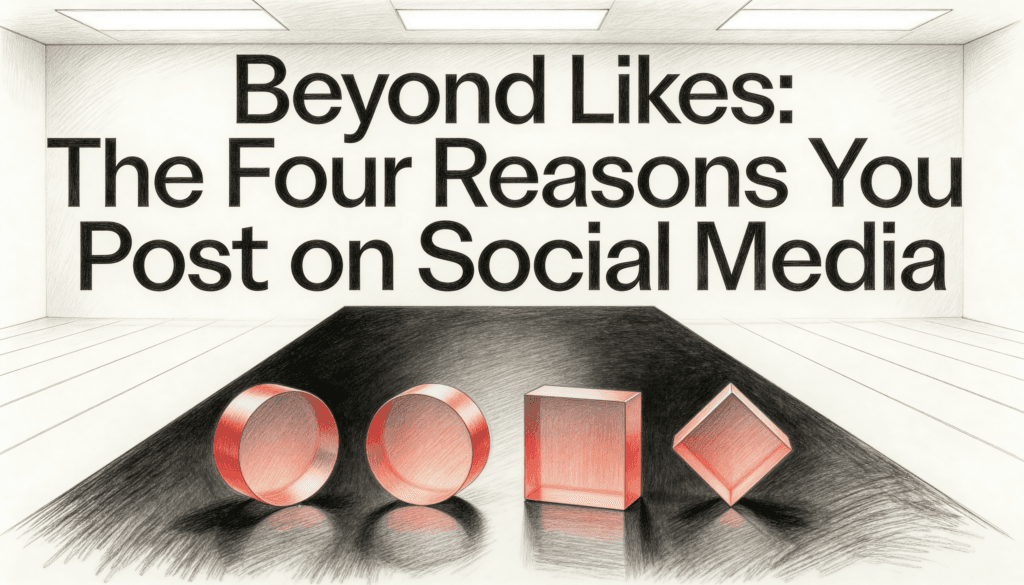
His name was Max Weber, and he spent his life trying to figure out why people do anything at all. Not the surface reasons we give at dinner parties, but the actual machinery underneath. He came up with four categories he called the types of social action, and once you see them, you cannot unsee them. They explain your boss, your mother, your ex, and most usefully, the thing you do roughly 144 times a day: post, like, share, comment, lurk, refresh.
Let us walk through all four, because each one reveals something different about why that little red notification has such an oversized grip on your nervous system.
The First Reason: You Are Trying to Get Something
Weber called this instrumentally rational action. Translation: you are doing X because you want Y, and X is the most efficient way to get Y. You are treating the world like a vending machine and yourself like a customer with exact change.
On social media, this is the most obvious category and arguably the most respectable. The freelance designer posting her portfolio. The job seeker updating his LinkedIn headline. The small business owner running a sale. The author plugging his book launch. The dating app user choosing the photo that makes her look approachable but mysterious. Each of these people knows exactly what they want and is using the platform as a tool to get it.
There is nothing wrong with this. In fact, it is the cleanest, most psychologically healthy way to engage with these platforms, because the feedback loop is honest. Either the client emails you back or he does not. Either the book sells or it gathers digital dust. The success metric lives outside the app.
The trouble starts when people think they are in this category but actually are not. The man who claims he posts gym selfies “for accountability” but cannot articulate what he is being held accountable to. The woman who insists her food photos are “for her food blog” that has had three subscribers for two years. The aspiring influencer who has been “building her brand” for seven years without ever clarifying what the brand is for. They are using the language of instrumental rationality to disguise something else, which is fine, but the self deception costs them. You cannot improve at a game whose rules you refuse to name.
The genuine instrumentalists know they are using the tool. The pretend instrumentalists are being used by it.
The Second Reason: You Believe In Something
Weber called this value rational action. You do something not because it gets you a payoff but because the doing of it expresses what you believe is right, beautiful, true, or important. The reward is in the act itself.
This is the activist sharing infographics about a war happening on the other side of the world. The vegan posting recipes not to win converts but because cooking and sharing plant based food is, for him, an expression of his values. The poetry account run by someone who will never monetize it because monetization would corrupt the point. The grandmother posting Bible verses every Sunday morning. The guy who reviews independent bookstores in cities he visits, with no affiliate links, no sponsorships, just love.
Value rational posting is often the most beautiful kind, and also the most quietly frustrating. The engagement is usually lower. The audience is smaller. The algorithm does not particularly favor sincerity over outrage. People posting from genuine conviction often find themselves outperformed by people doing the exact same thing cynically, which is its own kind of cosmic joke.
But here is the counterintuitive part. Value rational posters tend to be the happiest users of social media, even when they are getting almost no traction. Because the reward was never the likes. The reward was the act of standing for the thing in public. If three people see it, the standing still happened. If thirty thousand see it, the standing was the same standing. Weber would say these people have something most users have lost: an internal scoreboard that the platform cannot touch.
The catch is that pure value rational action is rare. Most of us think we are posting from conviction when we are actually posting from a more tangled place. Which brings us to the third reason, which is where most of us actually live.
The Third Reason: You Are Feeling Something
Weber called this affective action. You did it because you felt something and the feeling demanded an outlet. There was no plan. There was barely a thought. The emotion came up and your thumb moved.
The breakup tweet at 2am. The screenshot of an unhinged email from your boss, posted to the group chat with no commentary needed. The reactionary comment under a politician’s post that you typed in a state of rage and now cannot remember writing. The vague subtweet about someone you are angry at, designed so that only one person will know it is about them. The triumphant gym selfie taken three minutes after a personal record. The grief post. The drunk post. The crying post. The “I am so blessed” post that is really a “please notice me” post wearing a costume.
This is, by volume, where most posting actually happens. And it is the category we are most defensive about, because admitting that your behavior is driven by raw emotion feels like admitting weakness. We would much rather believe we are in category one (strategic) or category two (principled) than confess we are in category three (just feeling things, loudly, in public).
The platforms know this perfectly well. The entire architecture is designed to convert emotion into engagement, because emotion is what makes you post and what makes other people respond. The angry post gets the angry replies. The vulnerable post gets the warm replies. Either way, the machine eats.
This is not necessarily bad. Expressing emotion is human. Doing it in community is ancient. The problem is when the expression becomes the only way you process the feeling, when the post replaces the journal, the friend, the walk, the cry, the conversation. Then the feeling never actually gets metabolized. It just gets broadcast, harvested for reactions, and broadcast again the next time. The emotion becomes content. You become the channel.
The Fourth Reason: You Are Doing What You Always Do
Weber called this traditional action. You did it because you have always done it. There is no thought, no feeling, no plan. It is what your hand does when there is nothing else for it to do.
This is the most invisible category and probably the largest one. The morning scroll before you have opened your eyes. The reflexive double tap on a photo you did not actually look at. The story view that registers no impression in your brain. The “good morning” post your aunt has shared every single day for nine years. The Sunday meme. The Wordle score. The vacation slideshow. The graduation photo dump.
Traditional action is what makes social media feel like furniture. It is not exciting. It is not particularly satisfying. It just is. You do it the way previous generations went to church on Sunday or wrote thank you notes after dinner parties or watched the evening news at six. The habit is the meaning. The habit is also, suspiciously, the thing that keeps the platforms profitable, because companies that depend on engagement metrics adore people who show up out of pure muscle memory.
Here is the uncomfortable part. A lot of what we tell ourselves is in category one or two is actually category four. The “professional networking” that is really just opening LinkedIn out of habit. The “staying informed” that is really just doomscrolling at the same time every night. The “keeping in touch with friends” that is really just liking the same five people’s posts in the same order every time you open the app.
Traditional action is not bad. Rituals are how humans stitch their days together. But a ritual you cannot defend is just a tic. And tics that are profitable to someone else tend to multiply.
The Quiet Mathematics of It
Here is where the four categories get interesting. They are not buckets. They are layers, stacked on top of each other in the same post.
You share an article about climate change. On the surface, it looks like value rational action (you care about the planet). Underneath, there might be some affective action (you are anxious and want to do something with the anxiety). Threaded through that, some instrumental action (you want to be seen as the kind of person who cares about climate change). And holding the whole thing up, the traditional action of opening the app and posting something today, because that is what today is for.
Weber’s point was never that one category is good and another is bad. His point was that knowing which one is actually driving you, in this moment, with this action, is the beginning of being a free person rather than a sleepwalking one. Most of human behavior, he believed, runs on autopilot, justified after the fact with stories we invent to feel coherent.
So the question is not whether to post. Posting is fine. The question is whether you can name, before you tap, which of the four reasons is moving your thumb. If you can, you are awake. If you cannot, the app is using you slightly more than you are using it.
What to Do With This
You do not need to delete your accounts. Weber was not a monk and neither am I. But there is a small practice worth trying.
Next time you reach for the phone, pause for three seconds. Ask yourself which of the four categories you are about to enter. Are you trying to get something specific? Are you expressing something you genuinely believe? Are you feeling a feeling that needs somewhere to go? Or are you doing what your hand does when it is bored?
There are no wrong answers. The naming is the whole exercise. A person who knows she is scrolling out of pure habit and decides to keep scrolling is still freer than a person who scrolls out of pure habit while telling himself he is “doing research.” The lie is the cost, not the behavior.
A century ago, a German sociologist with a serious mustache tried to map why humans do what they do. He could not have imagined the infinite scroll, the algorithm, the like button, the quote tweet. And yet his four little categories cut through all of it, because the technology changed and we did not. We are still the same animal, posting for the same four reasons people have always done everything: to get something, to mean something, to feel something, or because that is just what we do.
The next time you open the app, you will know which one it is.
Or you will not, and that will also tell you something.